


Highland County commissioners host discussion on roadway safety with Amish buggies
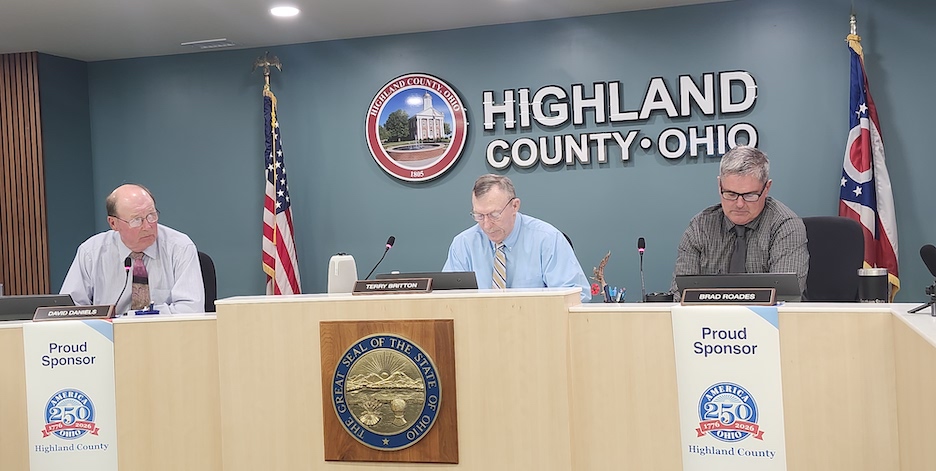
Pictured from left to right are Highland County commissioners David Daniels, Terry Britton and Brad Roades. (HCP Photo/Caitlin Forsha)
Highland County commissioners Terry Britton, David Daniels and Brad Roades, along with first responders and area residents, engaged in a 45-minute discussion of road safety concerning Amish buggies during commissioners’ Wednesday, Oct. 7 meeting.
The meeting was held after the Ohio State Highway Patrol’s Wilmington Post reported four accidents involving buggies in a one-month span, including a fatal crash Sept. 3 at U.S. 50 and state Route 753, a fatal crash Sept. 28 on state Route 138 and an accident Sept. 29 on state Route 124.
The uptick in crashes prompted the Highland County Sheriff’s Office to post “safety tips for sharing the roadway with horse-drawn vehicles” on their website and social media Sept. 30.
“Last year, January 1 to December 31, we had four related crashes with buggies — four total, the whole year,” Ohio State Highway Patrol Trooper Todd Stevens said. “This year, we have four total. They've all just happened within the last month.”
Britton said commissioners also wanted to “have an open discussion” for first responders and members of the community to share their feedback.
Among the topics discussed was the cause of accidents and whether anything could be done to help prevent further wrecks. Also discussed were speed and whether buggies are equipped with proper lights and signage.
Highland County Sheriff Randy Sanders said that one of the biggest causes is “probably distracted driving.” As an example, Stevens said that he knew at least one of the recent accidents occurred “on a straight stretch,” not in an area with “curvy roads and hilly roads.” Highland County Engineer Chris Fauber added that “at this time of year,” drivers have “the sun in their eyes” in the morning and evening, which can also be “a factor.”
“I see distracted drivers driving down the road every day, not paying attention to what they're doing,” Daniels said. “We’ve all got to take a little bit a part of this and slow down a little bit, pay attention, know that there are Amish on the road, but I would hope that they would respond in kind and know that there's a few things they can do as well to keep from having some of these problems occur.”
Highland County Prosecutor Anneka Collins and one of the residents agreed that they have seen issues that were caused by Amish buggy drivers as well, including kids racing and/or causing damage to their own buggies. However, Collins pointed out that it’s the same concept as any other teen driver who thinks “they’re invincible.
“You have to be responsible,” she said. “Be an offensive and defensive driver.”
Stevens pointed out that both the Highland County Sheriff’s Office and the Wilmington Post, which also serves Clinton and Fayette counties, are understaffed and cannot “physically be in 14 spots” that are at high risk for accidents. Collins said “the responsible thing to do” is to “slow down” in the areas near Amish communities, particularly Routes 124 and 138, which have a lot of curves.
One of the residents in attendance said that he has seen motorists either hit, or nearly hit, buggies while being “impatient” and trying to pass other cars. Another resident asked if lowering the speed limit around Amish communities would be a viable option “so that the drivers and the cars and the buggies can coexist safely at the same time.”
The same resident said that in the Mansfield area, “they actually have a third lane that’s dedicated to the Amish,” and asked if that is something that could be part of the county’s “long-term plan.
““In order for everybody to live their lives, we all have to make accommodations,” he said. “They've got to get the the flags on. They've got to get the lights on to comply with the law. We have to do something in the English community. We have to do something within our context, within our lives, to ensure their safety. And if that means putting in an extra lane, if that means reducing the speed limit so people can respond in the amount of time, then that's what we need to do.”
In either scenario, Fauber said the issue is “who’s paying for that,” including the cost of signage, purchasing rights-of-way and then the actual construction of additional lanes. Roades and Fauber both pointed out that the Amish also do not contribute to the license fees and fuel tax that fund such projects, although Fauber did acknowledge that the Amish donate to the engineer’s office instead.
Britton also said that the county had considered the additional lane for the Amish “when the ARPA funding came out,” but the proposal “got moved to the side.”
For changing the speed limit, Fauber said that the Ohio Department of Transportation would be responsible for that decision on state routes, and both he and Stevens said citizens and/or commissioners could try to reach out to ODOT.
Another resident asked if the county could seek grants “that can help with funding for some of these things.”
“We did do a study and tried to get funding to add another lane, especially on 124,” Fauber said. “There's so many people that get involved — ODOT, and the cost, and then you funnel it all to one spot. Then you got to buy enough right away to make a lane all the way to town. I mean, it's a major undertaking.”
Daniels argued that “everybody has to obey” traffic laws. However, for all four crashes in the past month, Stevens said the buggies had “SMV [slow moving vehicle] visible notifiers,” which include signs and/or flags. Sanders also said that attempts to enforce certain traffic laws on Amish buggies — including requiring lights or issuing tickets — have been unsuccessful in other counties based on religious freedom.
“It’s their constitutional right,” Collins said. “The First Amendment protects you for freedom of religion.”
Also discussed was the lingering impact of the crashes, both from an emotional and practical standpoint.
“This is not just the Amish,” Sanders said. “It’s people hitting the buggy. That's going to remain with them too when something bad happens.”
Daniels also added that “as a result of some of these accidents, insurance companies have paid out to the tune of about half a million dollars to those victims that are out there,” with drivers facing increased insurance rates.
“The person that actually ends up hitting them could, whether by accident or regardless of what, ends up with a lifetime of the fact that ‘I might have killed somebody,’” Daniels said. “There's two sides to this I think that we need to be aware of or at least be thinking through as we kind of talk about these things.”
One citizen in attendance said that a relative was in an accident that involved a buggy, although she said fortunately neither party was injured.
“I went from telling my kids to watch for deer to watch for the Amish, and it's not that I don't think they should share the roadways,” she said. “I have nothing against them. We're friends with a lot of them.
“Some of them have signs, some of them don't, and it's just a chance they take, and unfortunately, as motorists, we do too.”
Britton asked if it would help to have additional signage along the roads warning drivers to watch out for buggies. Fauber said there are “about 80” on county roads already.
Another resident said that their Amish neighbors drive “not just buggies,” but “wagons” and “little carts,” often “full of children,” through their neighborhood. She added “it’s pedestrians as well,” as they often see Amish children walking along the road.
“I know [Fauber] said that there were already a lot of signs, but can some of the signs have flashing lights?” she asked. “Can speed limits be reduced in certain high-risk areas?
“We’re very aware of where we live to watch out for them, and most of the people on our road are, but I still see people going down our road way too fast, even with that knowledge.”
Another resident also suggested flashing signs for motorists entering Amish neighborhoods.
“I tell people all the time, if I thought signs fixed everything, I’d put signs everywhere,” Fauber said. “You can have too many signs. We’ve got buggy signs, but it comes down to people.”
One of the residents said that “education and awareness” for drivers of all ages would be best, “and this conversation here is a start.” Collins said that “common sense” would also help.
“Right now everyone is in the fields,” Collins said. “We're harvesting, so and it's not just the Amish community. It’s the English community with combines and tractors and grain wagons and all this, UTVs, ATVs. I mean, everybody is using the roads right now because of that, and people need to be aware that you have got to slow down.
“Maybe we don't hear about the the accidents with tractors and combines and things because they're bigger and they're more sturdy, so people aren't as likely to be passing away from them, but it is common sense. People have got to have common sense when they get behind the wheels.”
Britton thanked everyone for their input.
“I think it's been a great conversation, and I think there's a couple points here we're going to follow up on,” Britton said. “This probably won’t be the last conversation that you hear from us, and thanks for your participation.”
In other discussion:
• Commissioners voted 3-0 to enter a master employer services agreement with American Fidelity Assurance Company for ancillary benefits for county employees, after several weeks of discussion with Human Resources director Amy Bradley.
“I read over the information and understand the need for the [Section] 125 administrator,” Daniels said. “I looked over the products that they had to offer. All those things are options that our employees can take advantage of, and it's on their dime. It doesn't cost us anything.”
• Commissioners issued public answers to two questions in an email from a concerned citizen, Eric Mathews, regarding proposed battery storage facilities in Highland County.
As previously reported, the up to 200MW Barr Energy project being proposed will encompass approximately 35 acres on Mad River Road in New Market Township, near state Route 138. If approved, this would be NextEra Energy Resources’ first battery storage facility in Ohio, as they already own and operate 50 sites across the U.S. and Canada, according to their website.
In an unrelated project, the Ohio Power Siting Board (OPSB) voted in September to authorize Hecate Energy Highland LLC to construct an up to 300 megawatt (MW) battery energy storage system alongside its existing solar energy facility in Highland County.
“[Mathews] asked two questions here that I think he would like to have an answer to,” Daniels said. “One of them, ‘would the commissioners be willing to request the Ohio Power Siting Board or PJM or the respective developers provide the county with comprehensive explanation on battery storage and related energy development currently proposed?’
“They have had community meetings that have been widely publicized in the paper that give residents the opportunity to come in and see those. While that's part of that responsibility, those meetings have happened, and if somebody has missed them, I mean, it's unfortunate, but they have, I think, tried to be transparent in what they're proposing.”
Both Roades and Britton said they agreed.
“The second question is, ‘I would ask the commissioners to consider holding a public meeting addressing these projects collectively,’” Daniels said. “We have had meetings where we discuss solar and had people come in and talk about them, and it's kind of the same issue. These are private contracts between landowners and developers, and we've said it on more than one occasion — absent zoning, absent those kind of opportunities that we have to control that, those are private contracts between landowners and those developers.”
Daniels said the commissioners would issue a written response.
• Commission clerk Ashleigh Willey said that the county and crews for the courthouse renovations would be conducting a progress meeting Oct. 8, with construction on the exterior slated to begin during the week of Oct. 12.
“There may be some fencing and things that we need to pay attention to when we're entering and exiting the courthouse,” Willey said.
• Commissioners said that they have received additional information regarding a proposal to transfer their payroll system to the cloud and are taking that into consideration before making a decision.
Commissioners also made the following approvals, each by a 3-0 vote:
• The issuance of a letter to the Public Utilities Commission of Ohio regarding the withdrawal of copper-based telephone services in Highland County.
“Most carriers are starting to do away with their landline service,” Daniels said. “We’ve been asked to provide a letter of support, making sure that before those copper-based services are discontinued, that a consumer has another option available to them.”
• The certificate of the countywide cost allocation plan by Maximus US.
• A contract between commissioners and Job & Family Services for the Highland County Department of Job and Family Services Procurement Plan.
• The approval of an NPDES permit issuance for the Highland County Southwest Wastewater Treatment Plant.
• A request from the Auditor’s Office to declare listed items as no longer needed by the county and obsolete, ORC 307.12(B)(1). Therefore, the board declared the listed item to be surplus property and no longer needed by the county.
• A budget modification request from Common Pleas Court within the 2295 Common Pleas budget from Repair & Maintenance to Other Expense in the amount of $1,000.
• A budget modification within the 1000 County General fund from Contributions to Rentals in the amount of $14,360.01.
• A budget modification within the 1000 County General fund – from Contracts and Services to Motor Vehicles in the amount of $6,625.80.
• A resolution granting authorization for a “then and now” purchase order and authorizing the county auditor to issue warrants for payment.
Constitutional Right?
To disregard Ohio Revised Codes is a touchy issue. I see that. Spoke to Commissioner Roades recently about this. Sheriff Sanders states unsuccessful in other counties. Highland County could at least try. When children are injured or killed because parents ignore the ORC's, is the State of Ohio not ignoring their responsibility to protect them? Unborn children are protected. Either enforce the laws or eliminate the laws. Laws not enforced because the constitutional rights "may" be infringed on is an argument to eliminate the current laws or revise them. I see many violations of 4513.114. When in Brown, Pike, and Highland Counties. 4513.115 covers lights, refelectors, and emblems. How many photos would elected officials like to see of non-compliant buggies? Amish, Mennonite, or other religious sects? The population of these religious sects is only increasing. I welcome the growth. Self sufficient and enterprisng. No reliance on federal and state resources. My and your tax dollars. May actually force out the hard drug users. Imagine that. And the population of children placed into foster care coulddrop. A drain on County resources. And improve the quality of life for the majority of law abiding citizens. And this will not be my last word on this. Subject to the Publisher's decision as always.