


Sewer rate proposal, city finances debated at Hillsboro City Council meeting
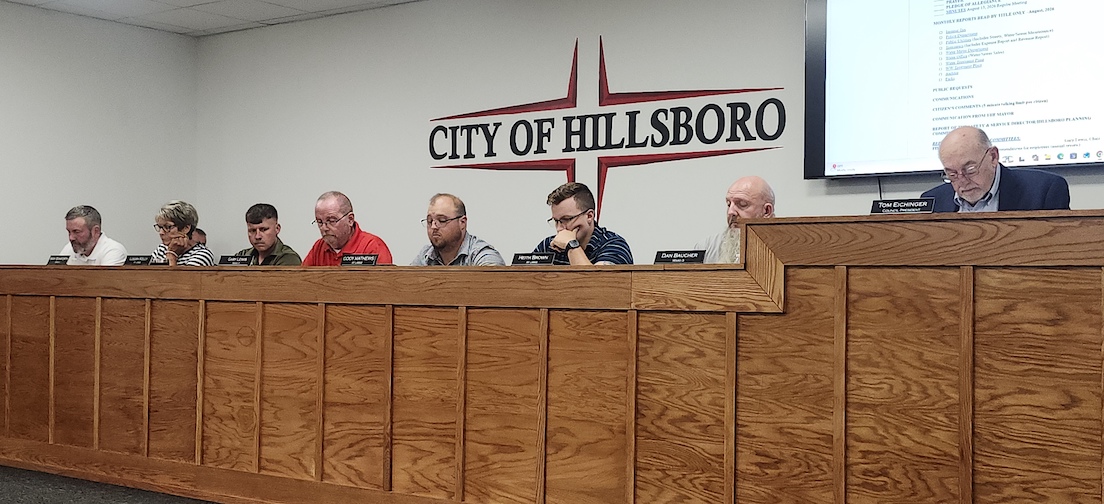
Pictured, from left to right, are Hillsboro City Council members Adam Wilkin, Mary Stanforth, Logan Kelly, Gary Lewis, Cody Mathews, Heith Brown, Dan Baucher and Tom Eichinger. (HCP Photos/Caitlin Forsha)
A proposed sewer rate increase and the city’s finances were among the topics hotly debated by Hillsboro City Council members and city administrators during the Thursday, Sept. 17 council meeting.
Almost half of the meeting involved discussions of the second reading of an ordinance authorizing an increase to sewer rates for the city of Hillsboro, to the point that a special meeting was proposed to be held before its third reading.
As previously reported, at the conclusion of their regular July meeting, council members attended a virtual informational presentation by Waterworth on water and sewer rates. Utilities committee chair Mary Stanforth said her committee met July 23 to further review Waterworth’s study.
The city is seeking funding for the first of what will be multiple phases of a sanitary sewer project to address the city’s I&I (inflow and infiltration) issues.
If approved, the new legislation will set the minimum rates as follows (but subject to change based on annual review): $41.02 in 2027, $47.17 in 2028, $52.24 in 2029, $55.90 in 2030 and $58.13 in 2031 and thereafter unless amended by council.
Council member Gary Lewis asked to clarify the number of phases to the proposed sewer project — as safety and service director Shawn Adkins said there are five phases planned — and asked about a “timeline” for work to begin.
“We're in the process of doing a study as far as the design of phase one,” Adkins said. “We have a company in here right now doing a study on the flow and what we need to do, whether it be lining or replacement. That's part of something we are doing in house, so we won't have phase one ready until we get this report back.
“I think they're going to finish up this week. They're finishing up cameras this week, so then it'll go back to DLZ [engineering firm], so we should have it within the month, I would think, as far as if it needs to be relined or if it's something that needs to be totally dug up and replaced.”
Lewis pointed out that the difference would “affect the entire nature of the project,” and Adkins responded that the city has been planning “based on a worst-case scenario, that is total dig up and replace.”
Lewis asked if the city would still continue with the project regardless of the outcome of the sewer rate increase.
“Yeah, it has to be bid out,” Adkins said.
“I was hoping that you were not waiting for legislation to be passed on this,” Lewis said.
Adkins said that they “have a design loan” and will have to wait until the study results, then the bid, to know “what the cost estimate will be.”
Lewis, as well as council member Cody Mathews, then began asking questions about the finances as outlined by Waterworth and about the city’s sewer fund.
“That sewer fund, it's been growing pretty well,” Lewis said.
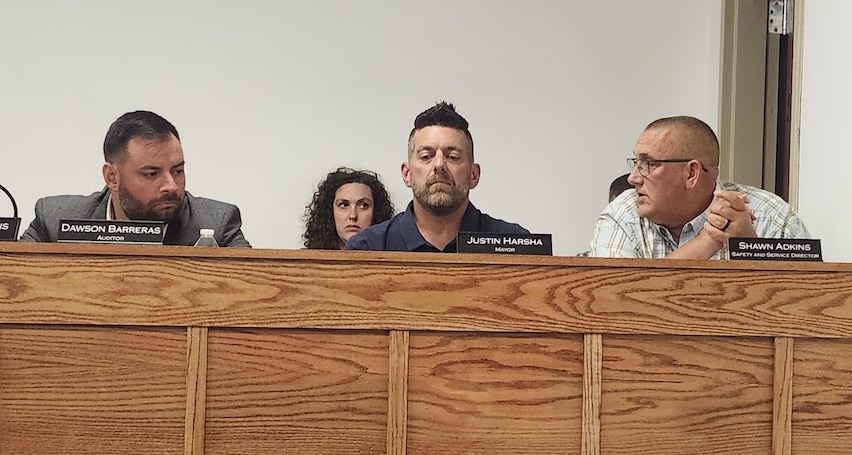
“It was until just recently, and that is being because we have done a lot of storm sewer replacement, and we had some sanitary sewer replacement in previous jobs,” Adkins said. “When Waterworth [did] our presentation two months ago — I can't remember exactly what it was — they have showed you we are falling short on our sanitary sewer. Even now, we're falling short on keeping up with our maintenance and repair with the I&I.
“If you look at the graph, even if we don't do the increases, we're still falling short next year as far as making payments back to our requirements, as far as our loans that we've got.”
“I kind of have to disagree with that,” Lewis said. “At the unexpended balance of 2024, you increased that fund by almost $391,000. At the end of 2025, it was increased by $405,000. A conservative estimate for 2026 would be an over $300,000 increase.
“In 2027, I applied the proposed legislation, the increase, complete with payments and on the expense side, and gave it a 3% bump on inflation, and it still looks like it's going to be increased by $500,000, which is understandable if you're looking at one phase. But you're doing a 20% increase that first year, and then in ’28, again, the estimate that I came up would be an increase of $640,000. In ’29, it goes up to $836,000, and it kind of goes like that. I went out to 2036.”
Lewis added that “it's always nice to have money, but this is money that's coming from somewhere else, and it's coming from consumers.”
Adkins offered to “bring Waterworth in” again for a presentation to outline the expenses. Lewis said he had “no objection to that.”
At that point, Mathews said that he had questions for Waterworth that have gone unanswered, both during a presentation at a committee meeting and through emails to the company.
“They're saying that even if without doing the project, at our current rate collection, that we're still projected to be under that line,” Mathews said. “I couldn’t get a good sense of, assuming the project didn't even happen, how we'd still be going under that.”
Adkins said that there are “no increases scheduled right now,” although after Mathews pointed out a 10-percent increase was already approved, Adkins said it was “factored in” to Waterworth’s figures.
“We have done several storm sewer increases, and during that storm sewer rehab that we’ve done, we also replaced a lot of sanitary sewers that we took low-interest loans out on,” Adkins said. “We have those loans to pay back.
“Our infrastructure is aged. Guys, it's getting older every year, so we are getting more and more I&I in our infrastructure, so we have more and more cost to combat this issue. Plus, our sewer plants are getting older, so we have pumps that we have to replace. Our chemical cost is going up. Everything is going up more than our three percent, and we don't have a three-percent increase. We have no increase right now at all on our rates. None.”
In response to another question from Mathews about “patchwork” fixing of issues instead of the full replacement, Adkins said the city is “doing preventive maintenance.
“We are not doing any replacement at all unless we sub it out,” Adkins said.
Mathews asked for “an example of a project [the city] would be doing” without the complete sewer infrastructure upgrades.
“What’s the difference in a preventative maintenance project versus a replacement?” Mathews asked.
Using an example Mathews brought up of “replacing a pump that’s gone bad,” Adkins said that would not be included in their budget because there is no way to anticipate when pumps will fail.
“I'm trying to understand how Waterworth gets to ‘hey, even without the project, you're underwater, so you’ve got to increase rates anyway,’” Mathews said.
“We had a meeting a month ago,” Adkins said. “Why did you not ask these questions?”
“I did,” Mathews said. “I asked these questions on the Zoom meeting. I did. I did not get an answer.”
City auditor Dawson Barreras said that Waterworth is “not factoring parts of what would be on a project. They’re just factoring in what could happen.”
“Sure, but it seems like those overlap because the infrastructure is aging,” Mathews said. “If a pump goes out, we’re going to do it in phase one, or if a pump goes out, we’re going to patchwork it because we decided not to do the bigger thing.”
“The pumps are totally different from the project because the phase one is our collection system,” Adkins said. “The pumps are part of our plant. As far as maintenance, repair and upkeep, I think the pump life expectancy is 20 to 25 years. We are borderline 20 to 25 years on our plant upgrade when it was taking place.”
Mathews asked if the sewer rate increase ordinance is “factoring in down the road having to replace that sewer plant” as well.
“I honestly can’t answer that because I think a plant is between 30 to 50 years expectancy, and I think that’s part of our loan,” Adkins said. “We still have an OWDA loan on our sewer plant. It’s a 30-year loan.”
Mathews said he has asked Waterworth to “game out several of these scenarios.”
“I haven’t seen your questions,” Adkins said. “It would be nice if you had included me on your questions.”
“I did not know you wanted me to do that,” Mathews said.
After they talked back and forth about Mathews not CCing Adkins on emails, council president Tom Eichinger said that the conversation is “missing the point.
“We're mixing apples and oranges on this thing,” Eichinger said. “The pumps have to do with the sanitary sewer plant and that operation. The projects that the increases are there to try to cover have to do with solving the influx, I&I. Those are two different things.
“If we don't do that project, it's not going to matter because you still have the maintenance on whatever the pumps are, and all the rest of that, which is what those numbers are all about. The projects are simply to plug the holes, if you will, in the pipes that are sending water that doesn't need to be treated to the treatment plant. There are two separate things.”
“That was kind of the root of my question originally is that if Waterworth was factoring in pumps,” Mathews said.
“It has nothing to do with the infrastructure project,” Eichinger said.
Council member Adam Wilkin suggested that “Mr. Mathews can ask all his questions to Waterworth when they come back and meet with us on the new meeting,” and Adkins agreed.
“We had a Zoom meeting,” Mathews said. “I asked this question, and I did not get an answer.”
“I don’t remember you asking that question at the Zoom meeting,” Wilkin said.
“You weren’t at the Zoom meeting,” Mathews said.
Several council members argued over one another before Eichinger interjected.
“What I’m going to suggest, based on the dialogue that's happened here tonight, is that we find out when Waterworth can come,” Eichinger said. “We find out when council members are available, and if there are more than three council members that want to be in the meeting, we will have to have a public meeting. I'm suggesting it should be the whole council, so we may have to have a special council meeting in order to resolve this issue.”
That was not the only exchange between council members and administration Thursday. During the reading of monthly reports for August by title only, within the first two minutes of the meeting kicking off, Lewis — who is the former longtime city auditor — called attention to the auditor’s report in the council packets. (The report was not included in the original packet sent out by the clerk Sept. 11.)
Although the reports from other departments were for August, Lewis said the auditor’s report was from July.
“Why are we looking at July information?” he asked. “This is the middle of September.”
Barreras said that it was due to “some issues” with the city’s “new payment processor.
“I finally got the correct reporting on for the online and all the payments we take in for credit cards and for our parks department and water and sewer, and after finally getting those, we are now finally getting caught up,” Barreras said. “August is not closed out yet, but it will probably by Monday.”
“Why is it not closed?” Lewis asked. “It took me three days, five at the max, and I didn’t even have an AI tool to help me.”
Barreras said that he “didn't want to close out the month without having the proper reporting to be able to tell and to be able to reconcile what the numbers were that I was receiving on the bank statement.”
Lewis then highlighted the contents of the report itself, as he said there are “four negative numbers on the year-to-date fund report,” including the general fund.
“Technically, you can't even do payroll out of there,” Lewis said.
“Well, general fund's negative because the amphitheater project and the grant money has been encumbered in that fund,” Barreras said.
“Then it’s been handled the wrong way — completely the wrong way,” Lewis said.
“No, it's it's legal,” Barreras said. “I talked to the state about it.”
“You’re always talking to the state, but it’s run through the wrong fund,” Lewis said. “I guarantee it. You can do it this way, but it’s not the right fund.”
“You might be correct on that, but that’s how we originally opened the PO [purchase order],” Barreras said.
“An auditor should be able to correct that,” Lewis said.
“Well, I can correct it, but as far as opening it up in the general fund, that's where we receive the funds, and that's where the administration wanted to be able to,” Barreras said.
“A negative number on an end-of-month report — I did that one time in 15 years, and I got wrote up for that by an auditor,” Lewis said. “It's a pretty regular habit here now, so you might want to shore that up pretty quick.”
A similar exchange about procedures took place between Lewis and Barreras later in the meeting when an ordinance making supplemental appropriations in the amount of $2,744,593.45 was introduced and approved by a 7-0 vote. The legislation is “to authorize the use of grant reimbursement funds for the Crossroads [Park] project.”
“This is money that Ross County handed us to go ahead and spend before the state deadline, which is next month,” Barreras said.
“Where to begin?” Lewis said. “You have reimbursement forms that you send, correct?”
“We do, yeah, most of the time,” Barreras said. “They’re mostly invoices. We don't really get reimbursement. I mean, we pretty much send them invoices, and then they send us whatever the invoice amount is, and then we pay that invoice. That's how it has been going.”
“One of my senses of confusion here is a park in the general fund,” Lewis said. “I just can't get over that, but I guess that's just my own personal problem.”
“You’re probably correct on that,” Barreras said.
“Is this going to clear up your general fund problem that you have?” Lewis asked.
“Yes, it is,” Barreras said. “All these reimbursements from the grant — once the grant's over with, the encumbered amount in the general fund will be back to square. That negative is from the encumbered PO from the entire grant because I opened the PO for the full grant amount, and obviously we haven't received that full grant amount yet.”
“I’m just flummoxed,” Lewis said. “I have a report shows $400,000 negative in my general fund, and I just don't know how that happens, and how are you making transactions out of that fund with that? I feel for you when you get audited.”
“No, the auditors actually told me to do it this way,” Barreras said. “They say that's how people have been doing it now.”
“Boy, they have sure changed in less than a year,” Lewis said. “I guess we’ll see when it washes out.”
In an unrelated question-and-answer exchange, during the safety and service director’s report, council member Logan Kelly, as well as Lewis, asked questions about Flock cameras in the city.
“We actually own 14 cameras for the city,” Adkins said. “Two of them are our pan-tilt zoom cameras, which one is located at North High Street and West Main at the center of town. The other one is North High and Harry Sauner, which we’re using for weather issues because we do have weather differences between the south side of town and the north side of town as far as calling out our departments, as far as treating for snow events and weather issues.
“The others, some are inside the city and some are outside the city.”
For questions about the cameras’ use, Adkins referred Kelly to Hillsboro Police Chief Eric Daniels. Kelly asked Daniels “what [the cameras] are being used for and who can access them.”
“The two pan-tilt zoom cameras are for observation and traffic conditions. The 12 LPR, license plate readers, document license plates as they pass the cameras,” Daniels said. “They're cataloged by Flock. They are used for legitimate law enforcement purposes only, and only employees of the police department have access to them.”
“Does the police department give you weather reports, then?” Kelly asked.
“Well, it's being used for public works reporting,” Daniels said. “Before we call them out, we can look at the intersections and determine. Also, if we have a Flock hit, we can actually determine directions of travel if somebody is wanted. With a Flock alert, we can determine directions of travel. As far as meteorology, that's not our specialty.”
Adkins added that there is a “different weather pattern on the south side of town versus the north side of town.
“That's all those two cameras are strictly put in there for,” Adkins said. “They're not put in for anything other than trying to get the public works out, so we can get employees out to salt the hills on the north side of town.”
Lewis asked “how long the data is stored” for the license plate readers, “who stores it” and “where the data is stored.” Daniels said it was stored for 30 days by Flock but could not say the “general locality” of where on the cloud the data is stored.
“Do you know who's allowed to purchase that information that's stored in there?” Lewis asked.
“I don’t control the data,” Daniels said. “We pay a subscription to access the data.”
In other discussion:
• Council voted 5-2 to approve a new social media policy for the City of Hillsboro, with adjustments as recommended by the civil service and employee relations committee. Lewis and Mathews both voted against the legislation.
The policy outlines how comments posted by the public do “not imply endorsement of, or agreement by, the City, nor do the comments necessarily reflect the opinions or policies of the City.” There is a provision to “block or otherwise deny access to City social media sites for any individual or users who violate the City’s social media policy.”
The policy also lists 11 different types of “inappropriate content” that may be subject to deletion if posted on a city social media page and includes information on maintaining public records related to social media pages.
At the recommendation of the civil service and employee relations committee, a section on employee social media use was removed from the resolution.
An ordinance to repeal and replace the residential fee schedule and commercial fee schedule passed by a 7-0 vote on its third reading. The legislation was recommended by the street and safety committee “so the city can come closer to breaking even,” as chair Wilkin said “the city lost nearly $41,000” last year based on the current fee schedule.
• Council also approved two resolutions related to placing properties on the tax duplicate by an emergency on their respective first readings, following suspension of the three-reading rule. Both resolutions are for certain parcels “to be placed on the tax duplicate, and collected, as other taxes are collected.”
The first was a resolution certifying nuisance abatement invoices to the Highland County Auditor for placement on the Highland County tax duplicate. There are 10 properties listed, all owing money for grass abatement.
Also approved was a resolution certifying delinquent water and sewer bills to the Highland County auditor for placement on the Highland County tax duplicate. There are four parcels listed with water/sewer assessments.
“This is for water bills unpaid by renters,” Adkins said. “This goes on the property owner’s tax bill.”
“Have these people been notified more than once?” Stanforth asked.
“Yes, ma’am,” Adkins said. “I know the renter has been notified. The owner signs a letter when they have a rental, saying that they will take care of the bill when it is not paid. That is part of when you get signed up for a water bill.”
• Mayor Justin Harsha gave an update on progress at the multimillion-dollar-grant-funded Crossroads Park, as he said construction has “gone pretty quickly here the last month or so.
“They've got the sheeting on the roof for the amphitheater,” Harsha said. “I think the stage roof is going to be started in the next week or two. Also, the amphitheater pad, the last bit of concrete, I think is going to be started soon, so then they'll be kind of finishing off indoors. The roof for the community building will be done, I think, next week.
“Everything's coming along really well. We have had some meetings about stage naming rights and park naming rights. I can't tell everybody what that is yet, but that'll be coming soon. Everything's good on our end and great news, and we're pleased with the progress down there. We’re planning on being open early next spring with the first event the Thursday before Memorial Day.”
• In his report, Adkins continued the construction updates, as he said the Rails to Trails paving is underway and the new uptown parking lot on West Main Street is “complete.”
In response to a citizen’s comments in August, Adkins asked for a water main replacement on Westover Drive and Greystone Drive to be placed in the finance committee to determine financial feasibility. He also asked for the employee eligibility status for health insurance in the city employee manual to be reviewed by the civil service and employee relations committee.
Adkins said that as of this week, the developers of the long-discussed Marriott Hotel project have had their plans, which now include an additional floor, approved by Marriott.
Adkins also said the city issued 12 building permits, including 10 residential and 12 commercial, for the month of August.
• Zoning and annexation committee chair Dan Baucher reported on an Aug. 13 meeting to review skilled gaming businesses. The committee voted to refer the matter to the Hillsboro Planning Commission “to update the zoning map and amend use classifications to account for skill gaming and electronic games of skill.”
Baucher said the committee also voted to “recommend to council that the yearly fee for the electronic games of skill should be increased to $100 per machine per year” Law director Hannah Bivens said legislation to that effect would be presented at council’s October meeting.
Stanforth asked how the $100 per machine fee change would compare to the current legislation.
“Their licensing fee with the city was based upon the number of machines in their business,” Bivens said. “There was multiple levels, and so like one to 10, 10 to 20, 20 and above. There was a flat fee, and the committee decided to change it to an amount per machine instead of doing it by the flat fee.”
“So per machine, it's going to be $100 per machine,” Stanforth said. “Some of these skill places, how many machines do they have?”
“They easily could have 50-plus,” Barreras said.
The current annual fees are $500 for businesses with one to 11 games; $750 for businesses with 10-25 games; and $1,000 for businesses with 25 or more games.
What ... Flock?
Recommend the flock cameras be labeled with which taxpayer funds are funding the operation of said camera. Example. New Flock camera on east bound State Route 138 aka Danville Pike by Elks Lodge golf cart barn. Why here? Funded by City of Hillsboro? Highland County? Liberty township? Other? Phone number of data storage in addition to the Flock company. Every Flock camera should require a public hearing before being installed. This unwarranted invasion of privacy needs to cease.
Who decided the location? Why? Cost versus benefit. When I enter the City of Hillsboro, or pass through, is not relevant to any private company or any government agency.