


A perfect day in 1968: Steve Sieg tosses McClain's only recorded perfect game
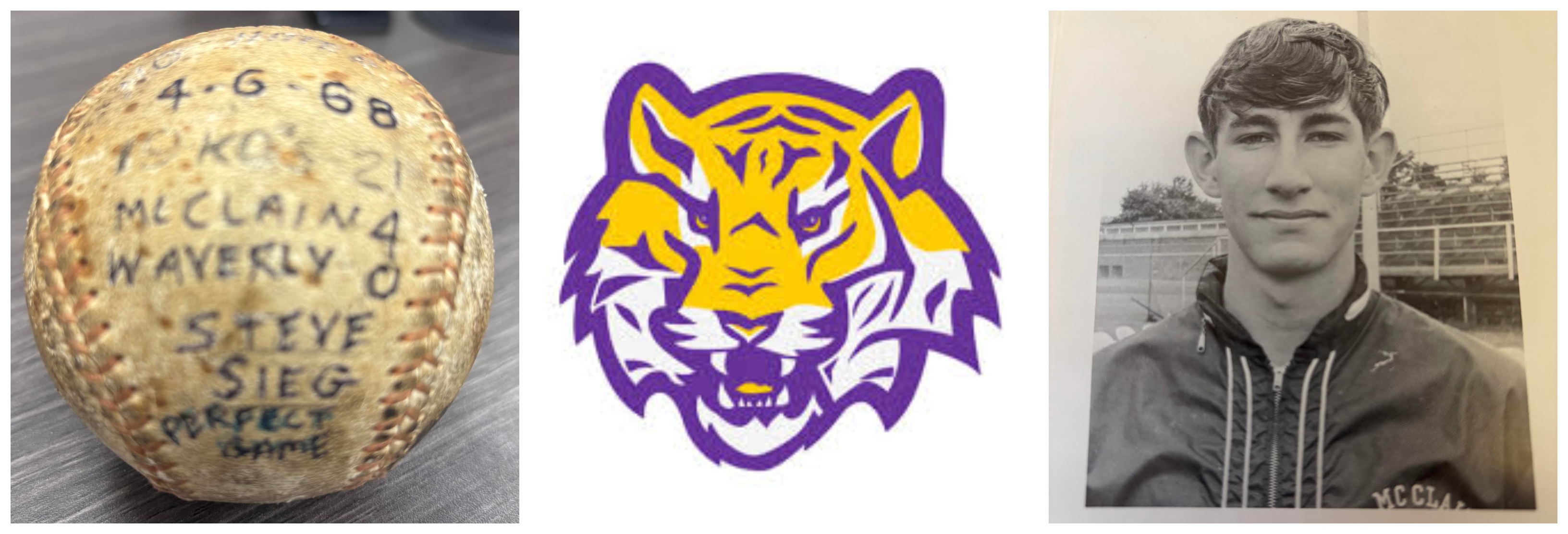
Pictured is Steve Sieg from 1968 while a student at McClain. Also pictured is the game ball from the perfect game pitched by Sieg. (Photos submitted by McClain Athletics)
The definition of “perfect” in Merriam-Webster's dictionary is “being entirely without fault or defect,” or otherwise flawless, and that is what occurred on the mound in Greenfield on an April day in 1968.
To be perfect on the mound in high school baseball, a pitcher must not only be in sync with his catcher, but his fielders must be aware of every pitch thrown. The pitcher himself must be accurate with his pitches and not allow a single batter to reach a base of any sort in seven innings.
Not often does a feat like that happen. Even at the highest level of the game, there have only been 24 perfect games thrown since MLB began in 1876, but on one spring day in 1968, the only recorded perfect game for the McClain baseball program happened, and it is said to be a thing of beauty for the pitcher from “the school of beauty.”
Having an unusually comfortable day with the weather forecast in Greenfield — as the average temperature during that time was usually in the high 40s — Saturday, April 6, 1968 was a day that was perfect for then-senior Steve Sieg. Sieg faced 21 batters at the now-defunct baseball field — named the Municipal Playground — located where the current bus garages sit, which was the home of McClain High School baseball before the current location of Mitchell Park.
To be perfect, Sieg shut down all 21 batters he faced, finishing with 19 strikeouts, and only two balls were hit into play that day. Today, Sieg lives away from Greenfield and was unable to travel to the area to be honored for his feat nearly 60 years ago.
The accomplishment hasn’t been equaled since for the McClain baseball program, as a ball from that game sits in the trophy case in the lobby at the high school. On that day in Greenfield, Sieg was unhittable, which led to a 4-0 win for the McClain Tigers — who were coached by Fred Raike — over the visiting Waverly Tigers, as he basically played a game of catch with his catcher Kirk Thompson.
“A perfect game is a pretty big deal,” Thompson said. “I called the pitches, and he never shook too much. We talked earlier this spring, and as I told him, I grew up around ball, and Steve was as good as anyone I ever batted against or saw in terms of when he was on. I wished we had radar guns back then. You could only judge (the speed) by how many things of sponge you had to put in the catcher’s glove so you didn’t have busted blood vessels.”
Thompson, as he described the modest Sieg, said the pitcher asked him during their recent phone call, “Well, why?” when talking about him being recognized for his accomplishment.
“I said it is the right thing to do,” Thompson said.
Just how good of a pitcher was Sieg? The previous week against Paint Valley, he threw a one-hitter, plus Sieg was an all-around excellent athlete, as he also starred on the basketball court for the Tigers, playing on some of the greatest Tigers teams in the storied history of the program.
But on the baseball diamond, Sieg even had an article about him in the Dayton Daily News, where it was reported he not only threw the one-hitter and the perfect game, but he followed that with a two-hitter, resulting in 38 strikeouts in the first 43 batters he faced. It was also reported by DDN reporter Marty Williams that Sieg struck out 48 batters in his first 75 recorded that season.
Thompson described the weather the day of the perfect game as “a pretty decent temperature,” as he spoke about the rarity of a perfect game.
“I didn’t like cold weather, and that game was a pretty decent temperature for early April as I recall,” he said. “All of the baseball with my dad as a kid, and all that I have watched growing up, it is a rare, rare occasion you see a perfect game. It goes like this for pitchers: a shutout, a no-hitter and a perfect game, and a perfect game is the godfather of them all. It is just unusual.”
Looking at the day of perfection by Sieg, an article in Greenfield Daily Times on Friday, April 19, 1968 described some of the game action, with it saying:
“Only two balls were hit into play — a lazy popup to George Smith (at second base) … and a short fly to Gary Hiles in centerfield.”
The article by Tom Rife in the GDT quoted Sieg — ever the competitor — following his feat as saying, “It felt good, but I should have had it a week earlier against Paint Valley.”
Sieg was also quoted as saying:
“There is one guy I’d like to mention -- our catcher, Kirk Thompson. Anytime there is a no-hitter, a lot of the credit belongs to the catcher.”
As for the offense of the Tigers in that game, another article from the Greenfield Daily Times on April 8, 1968 reported McClain’s runs came with a two-RBI single by Phil Bowers, which scored Thompson and teammate Rick Smith. Later, the article reports scoring came off a fifth-inning error that scored Sieg, and a sixth-inning error which scored Tom Kellis.
Thinking back about the game itself, Thompson said “at some point, about the last two innings I started pressing, thinking about what do I want to call here because we are this close to nobody getting to first base.
“I won’t say Steve never, but he didn’t shake off many pitches,” Thompson said. “Of course, we never studied batters to the degree they do nowadays.
“Back then, you had to do it one to the other, and usually truthfully what got you through it was you had to have a little bit of stuff to go along with a fastball back then, because the heat will get you so far. The stuff is what will get you through to where Steve got to, because batting is timing, and if you throw the timing off with the stuff, that’s what it is.
“Steve had what was a really good curve-drop, that would go down and away from either the right or left-handed hitters, and he never really used a slider, but his pitches were a fastball that would move, it would tail,” Thompson continued. “Then of course the curveball and the drop ball, and he had a better curve-drop than a drop ball.
“You have to realize his curveball would have been a changeup to a certain degree, because it is slower. Their stuff is what makes the changeup that is maybe a curve-drop or a slider because of the change of speed. You hit them twice … you hit them with the ball moving, and you hit them with the change of speed.”
Back to their early spring phone call, Thompson said Sieg reflected on the accomplishment, but he isn’t one for “tooting his own horn” about that.
“It was an accomplishment … it was a milestone to me, and a milestone in his life to pitch a perfect game,” Thompson said. “Trying to reflect back 60 years about what it was like when the game was over, you went out to the mound, you stood there, shook hands, embraced, and it was a unique day. When I look back about what I was thinking then, I was like, ‘I doubt if I ever do this again. I doubt if I'll ever catch another perfect game.”
Thompson had some final reflections on that “perfect day” in Greenfield during the spring of ’68.
“The immediate thoughts I had was one, we won the game, and the unusual thought was I don’t think this will happen again, at least to me in my lifetime, and it didn’t,” he said. “For somebody who was embedded with sports in their rearing and raising up as an individual … if they were sports-minded in their whole high school career and before, it always stays with you, even into adulthood.
“That was the thing that it was a milestone to achieve on Steve’s behalf. I was lucky to be at the right place at the right time.”
Refreshing humility
Excellent story, Stephen. Well written and researched.