


SSCC president provides update to commissioners during Community College Month
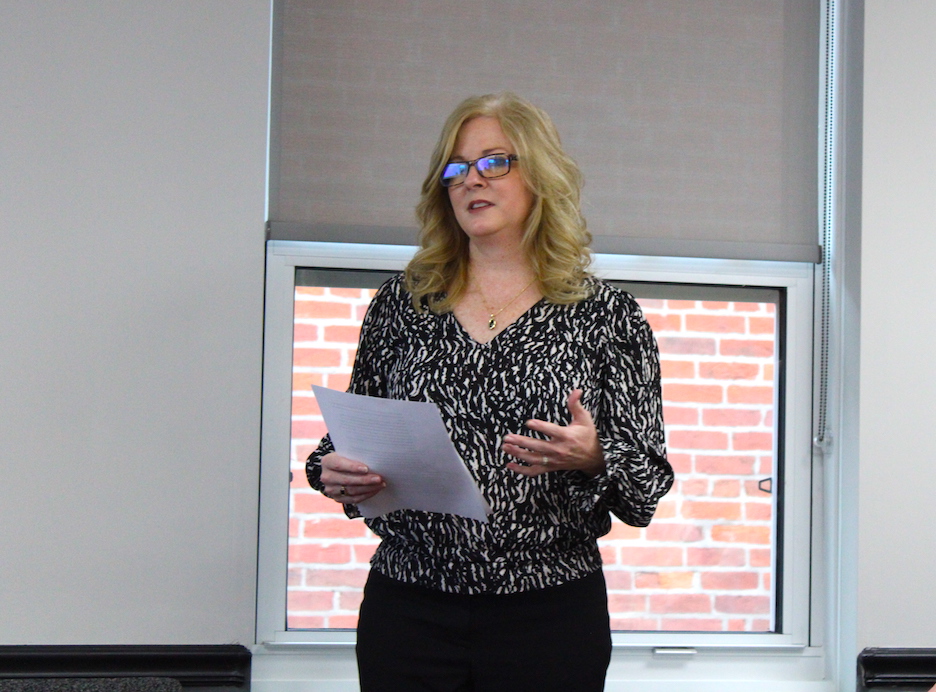
Southern State Community College president Dr. Nicole Roades is pictured during the April 10 Highland County commission meeting. (HCP Photo/Caitlin Forsha)
With April being recognized as Community College Month, Highland County commissioners David Daniels, Brad Roades and Terry Britton heard from Southern State Community College president Dr. Nicole Roades at their April 10 meeting.
Dr. Roades, who officially became the College’s sixth president in July 2022, gave an approximately 15-minute presentation to discuss SSCC’s local impact, as well as to tout community colleges in general. Also present for the meeting was Amy McClellan, Executive Director of Workforce Development at SSCC.
As explained by Dr. Roades, the College — which has two campuses, one in Hillsboro and one in Mount Orab — serves Adams, Brown, Clinton, Fayette and Highland counties. SSCC is one of “nearly a thousand” community colleges across the country serving “8 million students,” and one of 23 community colleges in Ohio, guided in part by the Ohio Association of Community Colleges, she said.
Part of Dr. Roades’ presentation was discussing the most recent Strategic Ohio Council for Higher Education (SOCHE) economic impact study, which was completed by the University of Cincinnati Economics Center and released last May. According to SOCHE (https://www.soche.org), “The study assesses spending by SOCHE’s members in their respective operations and capital expansions, as well as through research funding, donations and additional spending by outside visitors and students. The Economic Impact Study included 22 colleges and universities, affecting a 21-county footprint.”
The study determined that the “total economic impact of SOCHE’s member institutions was $7.5 billion in fiscal year 2019. … Of the total economic impact, ongoing Institutional operations comprised 64.4 percent, one-time capital expenditures comprised 4.8 percent, and student spending comprised 30.9 percent. This activity has a significant and cumulative impact on the economic health of southwestern Ohio,” according to SOCHE.
For SSCC’s five-county region, “our economic impact is around $45 million,” Dr. Roades said.
“It does sound like a big number,” she said. “But when you think about the employees that we have in that five-county area who are living here, making a wage here; the students that attend our college, aid that they receive, the money they're putting back into the economy. When you think about all of those things, the capital expenditures — that $45 million really isn't quite as big as what you might think.
“I think the total economic impact is something we should be proud of.”
For Highland County specifically, Dr. Roades said the college “employs 64 people through our network of campuses,” and Highland County students make up “25 percent of our total enrollment” with 496 individuals currently enrolled.
Between the associate’s degree and certificate programs, an average of 300 students graduate from SSCC each year, according to Dr. Roades.
For both SSCC and other community colleges, “affordability, accessibility and transfer” are the three areas Dr. Roades promoted for those seeking higher education.
“In terms of affordability, Ohio's community college average tuition is $5,192,” she said. “You compare that to the average tuition of four-year universities, that's over $16,000. That's the average, and that's a public institution, so clearly, I think that we are an affordable option.”
For “accessibility,” Dr. Roades said an advantage of community colleges is that they “tend to be open enrollment,” eliminating the stress of students trying to determine whether or not they will get admitted to college.
“At a community college, you all get in,” she said. “You may not start at the same level in terms of your math and English, but you all get in. That’s, I think, a really good thing to help encourage students to pursue higher education.”
The third area, “transfer,” is a “key factor,” Dr. Roades said, and also ties into affordability and accessibility.
“The number of students that start at community colleges and save their families money is just astronomical,” she said. “In Ohio, we're very fortunate to have a system called Ohio Transfer 36. You'll often hear it called OT 36. This is a set of core courses that students can take that essentially are the first two years of any four-year degree.
“You can get all of those classes at a community college, and if you've stuck with classes that are on that OT 36 — which we offer, and all community colleges do — you've essentially kind of knocked out your first two years with tuition that is considerably less than the four-year colleges.”
SSCC can also help with “specific transfer agreements” for a student’s desired major, Dr. Roades said. In addition, they have approximately “20 solid relationships with other public and private universities across the state of Ohio” that open up other opportunities for four-year degrees, she added.
“I want our students to live here, stay here, play here, work here and make their life here,” Dr. Roades said. “Those relationships that we have with other four-year colleges allow that to be possible, sometimes without a student ever leaving the area.
“Just as an example, in our computer science program, we have a relationship with the University of Cincinnati, that operates much like what we call a 3+1. You can take classes at Southern State, sometimes even creeping into what would be your junior year of a four-year program, and then finish up those courses either on our site or online. Those are really nice relationships. We have a similar agreement with Franklin University.”
Dr. Roades also spoke about the career and workforce development offerings from SSCC. She described McClellan as “a jack of all trades” at the college.
“You have to be ready to help faculty introduce new curriculum, be responsive to employer needs, but at a community college I think we're well positioned to be that partner because we're pretty flexible,” she said. “Oftentimes, she can come back with feedback that she's heard from a local employer, and by the next term, we might have a course that's relevant to what she has heard in terms of training someone. I think we're pretty agile in that respect.”
Referring back to the accessibility of the college, Dr. Roades said that “as an open enrollment institution, we take students regardless of what kind of background they bring.
“We serve many first-generation students, minority students, and then adults who are seeking the workforce skills and training,” she said. “I love that kind of open door policy.”
SSCC offers “noncredit” courses, Dr. Roades said, that offer workforce development opportunities in several different ways, including training for new jobs or teaching skills to individuals in a particular field.
“We have a Truck Driving Academy in which we graduate 100 truck drivers or more a year,” she said. “Those things are our opportunities, obviously, to speak to Ohio’s in-demand careers, and truck driving is one of those. That program does very well.
“We also do workforce development training that is basically tailored to the needs of a specific employer. So if Amy learns of a need — let's just say for example, one of the more popular ones we hear is bankers often have a group of people that need Excel training. She's able to kind of put that together to speak specifically to the needs of that employer, do it in an environment that doesn't have all the rest of the process that you would normally experience if people are taking the course for credit.”
Another area in which SSCC helps prepare students is through the Adult Opportunity Center, which offers adult literacy classes, college readiness courses, GED preparation and assistance in reading, writing and math.
“The Adult Opportunity Center exists for students whose life may have gotten in the way and interfered with their ability even to get a high school diploma,” she said. “We have eight different locations throughout the area where we offer training for people who are working on a high school diploma or GED, that they can take classes basically free of charge.
“We’ve had people come in at the fifth grade reading level, and we’ve worked with them all the way through getting them through the GED.”
Along with adult learners, Dr. Roades spoke about College Credit Plus, a program through which high school students can take college classes for free and receive dual credit for both college and high school. The majority of SSCC students are enrolled through College Credit Plus, she said.
“We actually have relationships with over 50 high schools across the southern Ohio area and beyond,” Dr. Roades said. “In Highland County, we have a relationship with every single high school that is in this county.
“By choosing these kinds of relationships with your local community college, you're saving your family extensive amounts of money by pursuing college early and using and leveraging Ohio's College Credit Plus program. That population among our total population is about 60 percent of our student body, so we have roughly 2,000 students, and about 1,500 of those, more or less, are College Credit Plus students.”
In response to a question from a citizen in attendance, Mark Partin, Dr. Roades said that enrollment numbers have “taken a hit” since the pandemic.
“We lost probably, I’m guessing about 20 percent of our student enrollment,” she said. “Last year was one of the first years we started to see a solid rebound. We grew about three percent compared to where we were pre-pandemic.”
Now, Dr. Roades said, SSCC is facing another significant hurdle with the FAFSA [Free Application for Federal Student Aid] delays at the federal level, “amidst what I thought was some positive momentum like we're starting to rebound.
“There are major glitches at the national level,” Dr. Roades said. “Our first enrollment report for summer — I just had an emergency meeting yesterday — was down 25 percent. Summer is not typically a high enrollment period anyways, but when you see anomalies like that, there's something gravely wrong, and you’ve got to figure out what it is what it is. I will tell you at the end of the conversation with my team, it's FAFSA.
“Our FAFSA applications are down about 30 percent across the board, and that's just something that is really hard to recover from.”
The college’s mission statement is “to provide accessible, affordable and high-quality education to people in southern Ohio,” and Dr. Roades said that is something that has “remained consistent for the last 50 years.
"I have a real urgency about continued relevance of community colleges,” she said. “If you listen to the news, even for five minutes, you would know that higher education is under attack, and in some cases, rightfully so. Some colleges are simply charging too much and not delivering the end product. I don't believe that that is the case with community colleges, but we're getting sandwiched into that conversation the same as everybody else.
“My biggest fear is that there would ever be a day that we're not here. Obviously, the economic impact is strong, but I think for a community like where we live, it's very important to have a community college here. My vision for our college is that we basically position ourselves to be indispensable, meaning you can't live without us. What that means is we have to vigorously pursue grant funding. We have to be financially responsible. We have to build a sustainable model so that for the next 50 years, we're still here for future generations. And I will tell you — this is my 26th year in higher education — it is getting harder and harder every year.”
She also briefly outlined the four areas in the College’s strategic plan: enrollment, relevance and excellence, student success and workforce development.
“In conclusion, I think community colleges are often the hidden engine of economic prosperity,” Dr. Roades said. “I believe that. Too often, I think that we think of college as the four-year university, when that is not what college necessarily means. Not just in Ohio, but across the nation, we serve nearly 40 percent of all undergraduate students. When people say they're going to college, it doesn't just mean that they're going to a four-year university.
“I think we are fortunate to have a community college in this area. I thank you for the support that you all as a commission extend to us. I often feel like you're just a phone call away from a letter of support or advocacy in some area, and I appreciate that very much.”
Commissioners thanked Dr. Roades for the update. For more information on the college, visit www.sscc.edu.
For more from Wednesday's meeting, see the stories at:
https://highlandcountypress.com/news/commissioners-updated-ongoing-area…
and
https://highlandcountypress.com/news/commissioners-alternatives-violenc….
Publisher's note: A free press is critical to having well-informed voters and citizens. While some news organizations opt for paid websites or costly paywalls, The Highland County Press has maintained a free newspaper and website for the last 25 years for our community. If you would like to contribute to this service, it would be greatly appreciated. Donations may be made to: The Highland County Press, P.O. Box 849, Hillsboro, Ohio 45133. Please include "for website" on the memo line.