


How to avoid the coming federal debt avalanche
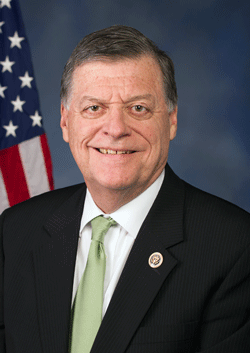
By U.S. Rep. Tom Cole
R-Oklahoma
https://cole.house.gov/
The nation will be snowed under unless we tackle the main cause of the problem, mandatory spending.
Raise taxes. Cut the Pentagon’s budget. Shut down the government. Eliminate federal agencies.
We often hear these rallying cries when Congress considers the national debt. Yet our attention to the issue invariably wanes, as the nation seemingly becomes numb to it until the next spending deadline. Then, like clockwork, the battle of budget priorities begins.
As an appropriator, I have witnessed this cycle for years. Thanks to such creative thinkers as Elon Musk and Vivek Ramaswamy, however, we are poised to approach the next round of deliberations with new energy and perspective. Their proposals for government reform through the Department of Government Efficiency – challenging our entrenched bureaucracy – align with conservative principles of efficiency and accountability. They are forcing a new conversation, geared toward delivering for the American people, and convening Republicans and Democrats to challenge stasis in Washington.
As House Appropriations Committee chairman, I’m proud of the work we have done to get spending under control. The past two years have shown that House Republicans are willing to make difficult decisions, including the initiation of double-digit reductions to various subcommittee bills and their well-meaning programs. We’ve cut spending to bloated programs, rooted out abuse, and directed resources away from diversity, equity and inclusion initiatives. The synergy between our committee’s work and DOGE is clear: We are unified in acting to put America on a fiscally responsible path.
Achieving this aim first requires us to recognize the differences in how government doles out its resources. There are two types of spending: discretionary and mandatory.
Discretionary spending is decided by lawmakers through the annual appropriations process. This concerns resources for executive agencies – the expenditures affected by spending fights often seen in headlines and linked to shutdowns. Mandatory spending, by contrast, runs on autopilot. It isn’t decided through the appropriations process and receives little congressional oversight. These expenditures are initiated through authorizing bills, which allow the government to cover all costs associated with such programs as Medicare, Medicaid, and Social Security.
The difference is stark. Mandatory spending, plus interest payments on the debt, accounts for 72% of the federal budget. Discretionary priorities take up the remaining 28%. The latter’s share has been declining for decades—from 45% in 1981, when Rep. Hal Rogers, dean of the House, began serving—and, according to the Congressional Budget Office, will fall to about 20% by 2034. This situation is similar to discovering a forgotten subscription that has quietly ballooned over time, now consuming nearly three-quarters of your budget. Meanwhile, our debt is estimated to exceed $50 trillion by 2034.
That’s unsustainable, but none of the aforementioned solutions suffice. The nation recently boasted historic revenue receipts, yet our debt hasn’t budged downward. We can’t tax our way out of the problem. Nor can we afford to cut the Pentagon’s budget. We face an increasingly dangerous world, with adversaries plotting our downfall. Lawmakers can and should reject the false choice between protecting our nation and achieving fiscal stability.
Shutting down the government, as some have recommended, isn’t economical. These episodes are more costly than the status quo, thanks to obligations to furloughed government workers, increased costs from delayed starts—which prevent new and planned projects from commencing—and constrained economic growth. Eliminating federal agencies wouldn’t fix the underlying problem either. We could end discretionary spending and the nation would continue to be in a hole.
The inescapable conclusion is that we can’t change our fiscal trajectory without addressing mandatory spending. That doesn’t mean eliminating the entitlement programs that enrich Americans’ lives. On the contrary, our efforts are geared toward saving them for future generations. Without action, the combined Social Security trust funds will go insolvent by 2035 and Medicare payments will be cut as soon as 2036. The longer we wait, the harder and more austere the choices become.
President-elect Trump recognizes that we have an opportunity to achieve responsible governance. Such initiatives as DOGE will provide the president with useful guidance on where to trim fat. At the same time, Congress will have the opportunity to use budget reconciliation to protect the crucial programs hardworking Americans have paid into their entire lives. I encourage my colleagues on the authorizing committees to take a long, hard look at the 800-pound gorilla in the room. I am more than willing to work with them on wrangling mandatory spending, the greatest threat to the success of our nation.
As we do so, we might consider consulting our most important resource: the American people. Lawmakers have advanced various proposals to address mandatory spending in recent years, but most have been deeply unpopular. Our government is supposed to be of, by and for the people. We ought to engage with our constituents and learn from their own expertise. Together, I’m confident we can develop creative solutions to reduce expenditures while preserving programs that exemplify the values that define our nation.
* * *
••• Publisher's note: A free press is critical to having well-informed voters and citizens. While some news organizations opt for paid websites or costly paywalls, The Highland County Press has maintained a free newspaper and website for the last 25 years for our community. If you would like to contribute to this service, it would be greatly appreciated. Donations may be made to: The Highland County Press, P.O. Box 849, Hillsboro, Ohio 45133. Please include "for website" on the memo line.
No DOGE!
The GAO issues annual reports to Congress. Problem is Congress ignores issues already identified. We do not need to outsiders like Elon and Vivek reinventing the wheel. See GOA.GOV for current issues of 2.7 trillion in savings.