


When in doubt, shimmy!
Lead Summary
By
-
By Cindi Pearce
For The Highland County Press
GREENFIELD – Belly dancing has always been an integral part of the Middle Eastern culture. It is a corporeal, mysterious, fluid form of dance that has slowly but surely made its way into Western consciousness. It is now considered main stream because of our vast exposure to it on the Internet and, of course, courtesy of Miles Copeland and the Belly Dance Superstars and singer Shakira.
Allison Flynn, whose belly dance name is “Najla,” caught belly dance fever and has been dancing for nearly 10 years. She now teaches Egyptian cabaret style belly dance in both Chillicothe and Greenfield. Her students range in age from 12 to 74.
Of Syrian descent, Flynn was familiarized early on with Middle Eastern dance, but she didn’t have any exposure to actual belly dancing until her late thirties when she agreed to join a class with a friend.
Her father’s family is from Syria and when she was small the family would gather and listen to Middle Eastern music and dance. They did the traditional dance of Syria called Debke’, which is a series of traveling steps and hops that are done in a circle. A man leads the dance, as he twirls a white handkerchief in his hand.
Like her own students, Flynn said she didn’t know what to expect when she took her first belly dance class in Chillicothe from Lisa Cyrus Fox. “I wouldn’t necessarily say that I was good. There were some things that came naturally and there were other things that I had to really work hard on.”
Flynn realizes that some people may have a less than favorable impression of belly dancing, associating it with decadent harems and opium dens, which is a misrepresentation because it is a beautiful art form and should be treated as such. In fact, when you watch an accomplished belly dancer do her thing you are going to become completely mesmerized by her skill and undulations, wondering, how does she DO that? How is it even possible to do that? Belly dancers are quite skilled dance technicians.
The World’s Fair
Flynn takes belly dancing very seriously and has spent years researching the topic. She said much of the material that has been passed down over the years is more fiction than fact. Belly dancing first came to the attention of Americans, while simultaneously suffering a P.R. backlash, during the Chicago World’s Fair in 1893. A little controversy and scandal goes a long way. Are you familiar with The Snake Charmer Song that is often associated with belly dancers? There is a good reason why you make this connection. This song was used during the Chicago World’s Columbian Exposition in 1893, and one of the attractions was “A Street in Cairo.” Snake charmers performed and camel rides were offered. This is where the legend of the dancer Little Egypt began.
Little Egypt: Fact or Fiction?
The very first Little Egypt was actually Farida Mazar Spyropoulos who was a dancer and she performed at the Chicago World’s Fair. Flynn points out that “Little Egypt” was actually 62 years old when she danced at the World’s Fair. Technically, she never used the name Little Egypt but went by Fatima. The Little Egypt tag came about because of her size and that was how the audience referred to her. The name caught on and many subsequent belly dancers lay claim to it. Sol Bloom brought the dancers to the World’s Fair and he called them “danse du venture,” which means dance of the stomach.
Ironically, the “hoochy koochy” dancers at the World’s Fair performed fully clothed. Neither their bellies nor legs were exposed. However, it was still scandalously evident that they were performing undulations with their bellies, which was pretty risqué at the time. We’re talking about the Victorian Era where modesty was demanded at all costs. Even a glimpse of ankle was enough to get you in hot water.
The dancers definitely made the news and soon thereafter became known as belly dancers. To this day, there is still that raise-the-eyebrow response to belly dancers because of the less than desirable association with the hoochy koochy girls. Flynn likes, and insists on, educating people otherwise.
Big Bellies Welcome!
One of the best things about belly dancing is that big bellies are welcome. In fact, belly dancers who have a belly on them generally look better when dancing than do their skinnier counter parts. Flynn said her dancing looks much better now that she’s gained some weight. But have no doubt about it your big belly is going to feel the burn when you are belly dancing and, in time, you are going to notice that it is toning and firming up. You may even see the start of a six pack.
Belly dancing is extremely isometric. You work out your core muscles (including those muscles that you never knew existed), as well as your legs, hips and arms. After an hour’s session, you will be wiping off the sweat and groaning. Undulating isn’t easy, if you thought otherwise.
Flynn says that belly dancing is for all women. “It doesn’t matter how old you are, how round you are, what shape or size you are, belly dancing is for all women. Anybody can do it and that’s what’s so great about it."
“It’s a complete body work-out and is very easy on your joints. The movements are very natural to a woman’s body, so there isn’t a lot of stress on your body as there is when you do aerobics.”
Additionally, Flynn points out that belly dancing “gives you confidence, helps your posture and improves your self esteem. The belly dance class is a place where women can let go and not worry about how others see them.”
Let’s Dress Up!
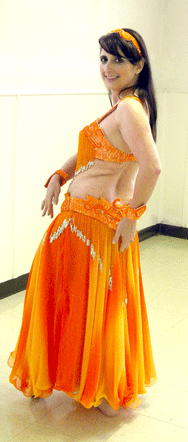
If you love dressing up in costumes, this is the dance form for you. The belly dancing costumes are gloriously beautiful, made of silk, chiffon and other flowing materials in rich, vibrant colors, decorated with beads, baubles, coins, sequins and other sparkly stuff.
Dancers sometimes use scarves that they twirl around. Some cover their faces in veils, while others wear ornate headgear and ankle and wrists bracelets, belly button jewels and bindis (the jeweled dot on the forehead.) This is definitely a situation where excess is welcome. “The costumes are meant to accentuate the dance moves,” explains Flynn.
The hips scarves, worn around the waist and what you hear tinkling (the coins and beads) when a belly dancer is performing came about out of necessity. As the ancient Ghawazee tribe of Egypt traveled throughout the Middle East, they wore their clothing instead of carrying it. When they would dance for an audience, people would throw money at them. They attached the coins to the scarves that they had tied around their waists because they didn’t have any pockets. That’s how belly dance hip scarves came to be.
Flynn also teaches students how to use zills, which are finger cymbals. Playing a musical instrument with your fingers, while executing the dance moves simultaneously, is difficult for many novices. It’s like trying to walk, talk and chew gum at the same time.
Flynn drills her students, over and over, after teaching them a new dance step because she said this is the only way to learn the moves. You do them until your muscle memory automatically knows what you’re supposed to be doing, and you don’t have to think about it so much.
If you are ready to take the plunge and see snake arms, hip thrusts, pistons, the camel walk, chest rolls and undulations in your future, contact Flynn via her email: allisonnajlabellydance@yahoo.com. Her phone number is 740-466-7590. Her website is http://najlasdance.com/.[[In-content Ad]]
For The Highland County Press
GREENFIELD – Belly dancing has always been an integral part of the Middle Eastern culture. It is a corporeal, mysterious, fluid form of dance that has slowly but surely made its way into Western consciousness. It is now considered main stream because of our vast exposure to it on the Internet and, of course, courtesy of Miles Copeland and the Belly Dance Superstars and singer Shakira.
Allison Flynn, whose belly dance name is “Najla,” caught belly dance fever and has been dancing for nearly 10 years. She now teaches Egyptian cabaret style belly dance in both Chillicothe and Greenfield. Her students range in age from 12 to 74.
Of Syrian descent, Flynn was familiarized early on with Middle Eastern dance, but she didn’t have any exposure to actual belly dancing until her late thirties when she agreed to join a class with a friend.
Her father’s family is from Syria and when she was small the family would gather and listen to Middle Eastern music and dance. They did the traditional dance of Syria called Debke’, which is a series of traveling steps and hops that are done in a circle. A man leads the dance, as he twirls a white handkerchief in his hand.
Like her own students, Flynn said she didn’t know what to expect when she took her first belly dance class in Chillicothe from Lisa Cyrus Fox. “I wouldn’t necessarily say that I was good. There were some things that came naturally and there were other things that I had to really work hard on.”
Flynn realizes that some people may have a less than favorable impression of belly dancing, associating it with decadent harems and opium dens, which is a misrepresentation because it is a beautiful art form and should be treated as such. In fact, when you watch an accomplished belly dancer do her thing you are going to become completely mesmerized by her skill and undulations, wondering, how does she DO that? How is it even possible to do that? Belly dancers are quite skilled dance technicians.
The World’s Fair
Flynn takes belly dancing very seriously and has spent years researching the topic. She said much of the material that has been passed down over the years is more fiction than fact. Belly dancing first came to the attention of Americans, while simultaneously suffering a P.R. backlash, during the Chicago World’s Fair in 1893. A little controversy and scandal goes a long way. Are you familiar with The Snake Charmer Song that is often associated with belly dancers? There is a good reason why you make this connection. This song was used during the Chicago World’s Columbian Exposition in 1893, and one of the attractions was “A Street in Cairo.” Snake charmers performed and camel rides were offered. This is where the legend of the dancer Little Egypt began.
Little Egypt: Fact or Fiction?
The very first Little Egypt was actually Farida Mazar Spyropoulos who was a dancer and she performed at the Chicago World’s Fair. Flynn points out that “Little Egypt” was actually 62 years old when she danced at the World’s Fair. Technically, she never used the name Little Egypt but went by Fatima. The Little Egypt tag came about because of her size and that was how the audience referred to her. The name caught on and many subsequent belly dancers lay claim to it. Sol Bloom brought the dancers to the World’s Fair and he called them “danse du venture,” which means dance of the stomach.
Ironically, the “hoochy koochy” dancers at the World’s Fair performed fully clothed. Neither their bellies nor legs were exposed. However, it was still scandalously evident that they were performing undulations with their bellies, which was pretty risqué at the time. We’re talking about the Victorian Era where modesty was demanded at all costs. Even a glimpse of ankle was enough to get you in hot water.
The dancers definitely made the news and soon thereafter became known as belly dancers. To this day, there is still that raise-the-eyebrow response to belly dancers because of the less than desirable association with the hoochy koochy girls. Flynn likes, and insists on, educating people otherwise.
Big Bellies Welcome!
One of the best things about belly dancing is that big bellies are welcome. In fact, belly dancers who have a belly on them generally look better when dancing than do their skinnier counter parts. Flynn said her dancing looks much better now that she’s gained some weight. But have no doubt about it your big belly is going to feel the burn when you are belly dancing and, in time, you are going to notice that it is toning and firming up. You may even see the start of a six pack.
Belly dancing is extremely isometric. You work out your core muscles (including those muscles that you never knew existed), as well as your legs, hips and arms. After an hour’s session, you will be wiping off the sweat and groaning. Undulating isn’t easy, if you thought otherwise.
Flynn says that belly dancing is for all women. “It doesn’t matter how old you are, how round you are, what shape or size you are, belly dancing is for all women. Anybody can do it and that’s what’s so great about it."
“It’s a complete body work-out and is very easy on your joints. The movements are very natural to a woman’s body, so there isn’t a lot of stress on your body as there is when you do aerobics.”
Additionally, Flynn points out that belly dancing “gives you confidence, helps your posture and improves your self esteem. The belly dance class is a place where women can let go and not worry about how others see them.”
Let’s Dress Up!
If you love dressing up in costumes, this is the dance form for you. The belly dancing costumes are gloriously beautiful, made of silk, chiffon and other flowing materials in rich, vibrant colors, decorated with beads, baubles, coins, sequins and other sparkly stuff.
Dancers sometimes use scarves that they twirl around. Some cover their faces in veils, while others wear ornate headgear and ankle and wrists bracelets, belly button jewels and bindis (the jeweled dot on the forehead.) This is definitely a situation where excess is welcome. “The costumes are meant to accentuate the dance moves,” explains Flynn.
The hips scarves, worn around the waist and what you hear tinkling (the coins and beads) when a belly dancer is performing came about out of necessity. As the ancient Ghawazee tribe of Egypt traveled throughout the Middle East, they wore their clothing instead of carrying it. When they would dance for an audience, people would throw money at them. They attached the coins to the scarves that they had tied around their waists because they didn’t have any pockets. That’s how belly dance hip scarves came to be.
Flynn also teaches students how to use zills, which are finger cymbals. Playing a musical instrument with your fingers, while executing the dance moves simultaneously, is difficult for many novices. It’s like trying to walk, talk and chew gum at the same time.
Flynn drills her students, over and over, after teaching them a new dance step because she said this is the only way to learn the moves. You do them until your muscle memory automatically knows what you’re supposed to be doing, and you don’t have to think about it so much.
If you are ready to take the plunge and see snake arms, hip thrusts, pistons, the camel walk, chest rolls and undulations in your future, contact Flynn via her email: allisonnajlabellydance@yahoo.com. Her phone number is 740-466-7590. Her website is http://najlasdance.com/.[[In-content Ad]]