


The ‘First Annual’ Highland County Fair
By Steve Roush
HCP columnist
Ladies and gentlemen, as the calendar prepares to turn from August to September in Highland County, one thing is certain: It is almost time for the fair.
For generations, the Highland County Fair has been a late-summer tradition filled with familiar sights, sounds and memories — a ride on the carousel or Ferris wheel, a livestock show, a hard-earned ribbon, or an evening spent strolling the midway with friends or someone special.

As another fair season approaches, it is a fitting time to take a walk down memory lane and explore the history of this enduring Highland County institution.
The official origins of the Highland County Fair can be traced to Oct. 3, 1845, when the Highland County Agricultural Society was organized. The society later reorganized under state law in September 1848.
The first county fair was held in Leesburg on Oct. 19 and 20, 1849 — nearly 177 years ago.
But for this offering, let’s move ahead to 1877, when the Highland County Stock & Agricultural Society was preparing to promote what it called its “First Annual Fair,” scheduled for Oct. 10-13.
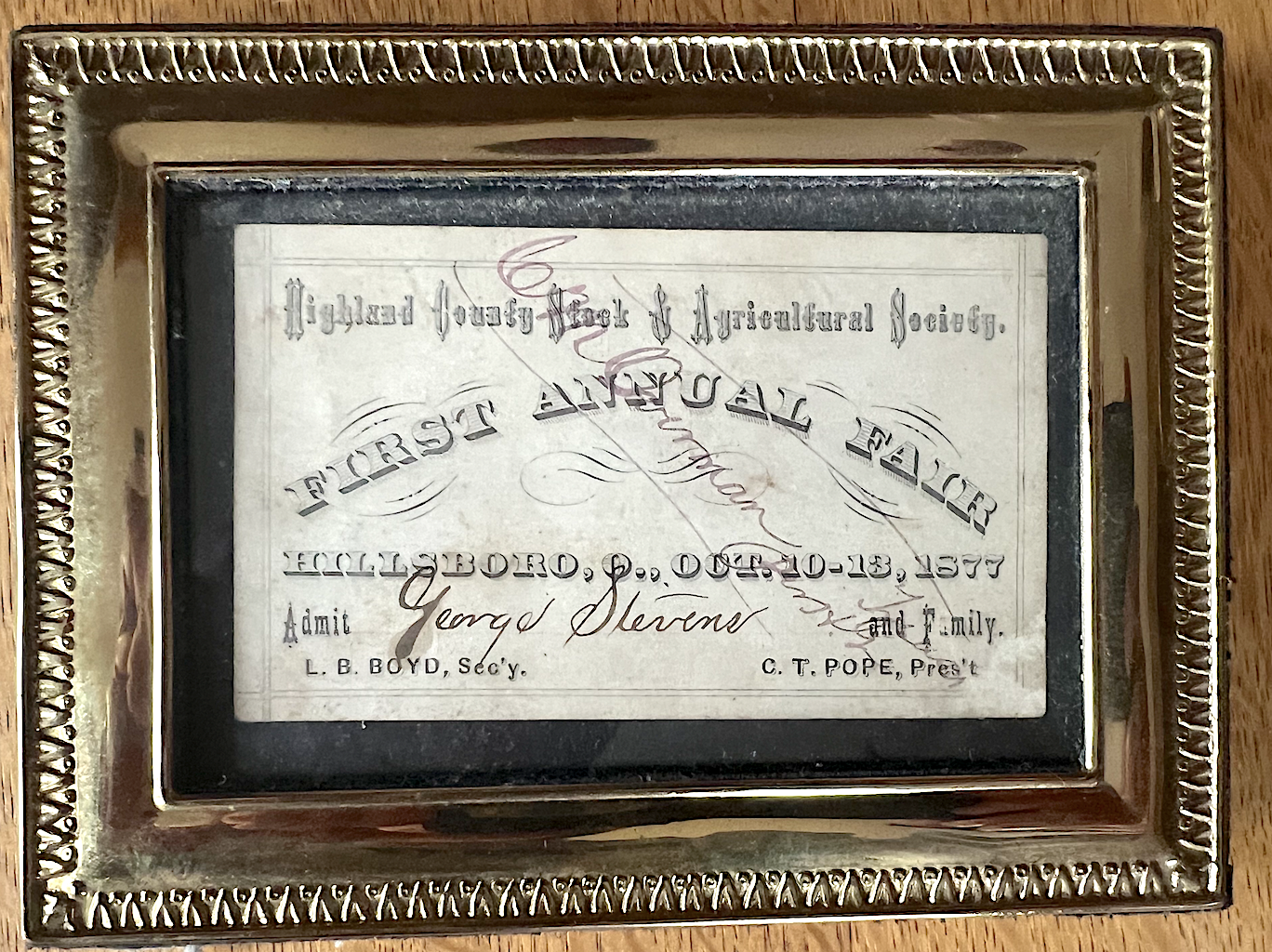
Several years ago, while looking through my folks’ Ohio Sesquicentennial Farm barn, we came across a fair pass admitting George Stevens and his family to the “First Annual Fair.” The pass listed C.T. Pope as president of the society and L.B. Boyd as secretary.
Just think about that for a moment. The pass dates to 1877 — nearly 150 years ago. It naturally raises the question: How many similar passes have survived?
If you have one, or know of one, I would enjoy hearing from you. My email address appears at the end of this column.
You might also wonder who George Stevens was. I had heard a few stories, but a quick look through an 1877 newspaper identified a George Stevens as the Highland County recorder. That seems to provide at least one possible clue about the pass holder. Maybe our good friend and current Highland County Recorder Chad McConnaughey can shed some light on this.
But let’s return to the fair itself.
The Sept. 27, 1877 edition of The Highland Weekly News carried a front-page article titled “Highland County Fair.” The article offered an enthusiastic preview of the event and praised the local citizens who had worked to revive and improve the county fair.
It began:
“Through the energy, and enterprise, as well as public spirit, of some of our fellow-citizens, we are to have this fall, beginning on the 10th day of October, and upon the old Fair grounds, a new County Fair. No expense has been spared, under the care and superintendence of the able and efficient managers, to make the grounds and all the appurtenances, the best in the State, as all who visit it, freely attest.”
The article went on to describe the improvements being made to the fairgrounds:
“When all the contemplated improvements are completed it will be at a cost of about $10,000. The money has been expended in erecting new and commodious buildings, large and convenient stalls for stock of all descriptions, dining halls and booth, and a grand stand, opposite the Judges’ stand, with raised and covered seats, capable of accommodating several thousand persons. By additions to the present large and commodious grounds they have been enabled to construct a half mile exhibit track, sixty feet wide, equal, if not superior, to any in the State.”
The newspaper also highlighted the premiums being offered to exhibitors:
“By reference to the premium list, it will be seen that the premiums offered are very liberal, and no doubt will be increased as the Society becomes better able. It is incumbent, therefore, upon our citizens in town and country, that they come forward, one and all, and assist in making this and each succeeding Fair a grand success. It is wholly unnecessary to make any special appeal to the ladies, for they are always in the lead in all laudable public enterprises.”
The article concluded with another appeal for public support:
“It is to a liberal public patronage that the managers look for success. If that liberality is accorded, which is justly due them for their energy, enterprise and public spirit, they will be enabled to make still greater improvements and pay more liberal premiums.”
The language may be formal by today’s standards, but the message remains familiar. The organizers had invested a considerable sum in the fairgrounds and wanted the public to attend so the event could succeed and continue to grow.
The $10,000 spent in 1877 would be equivalent to roughly $320,000 in purchasing power today — a substantial investment for the time. That money went toward new buildings, livestock stalls, dining facilities, booths, a grandstand and a half-mile track.
And, in a line that still brings a smile, the newspaper assured readers that no special appeal was needed to the ladies because they were “always in the lead” in worthy public enterprises.
The 1877 fair was more than a collection of exhibits and attractions. It represented a significant community investment and an effort to establish a permanent agricultural and social institution in Highland County. The fairgrounds, improvements and premiums were intended to encourage better farming, livestock breeding, local commerce and community fellowship.
Nearly 150 years later, many of those same themes remain part of the Highland County Fair.
For now, we’ll pause here. In the next installment, we’ll continue exploring the history of the fair and see what else the newspapers of the era had to say about this important Highland County tradition.
Steve Roush is president of the Highland County Historical Society and has served as both chairman and vice chairman of the HCHS Board of Trustees. He is also a board member of the Highland District Hospital Foundation, vice president of an international media company, and a columnist and contributing writer for The Highland County Press. He can be reached at roush_steve@msn.com.