


SSCC approves bonding for campus expansion; area banker asks for 'fair shot' to bid WATCH THE VIDEO
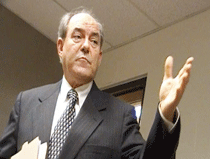
In a 5-2 vote, the Southern State Community College Board of Trustees approved the issuance of receipt bonds, not to exceed $20 million, to fund the construction of a new Brown County campus and refinance old receipts. Before the board could proceed to the vote, however, a local investment banker asked that the board select the underwriter of the bonds "in an open forum" instead of going with an institution that had been recommended by the college administration.
The discussion ended when a disagreement between the investment bankers led SSCC Board President Kay Ayres to gavel down the exchange and call for a vote on the resolution.
The board met Wednesday at SSCC's Central Campus in Hillsboro. During the meeting, SSCC Vice President of Business and Finance Jim Buck explained a resolution on the issuance of the bonds and the process through which the bonds would be sold.
Buck introduced to the board the potential underwriters of the project, Eric Ericson and Brian Seedhouse of Fifth Third Securities and Mary Duffy and Greg Lavigne of Peck, Shaffer and Williams, LLP of Cincinnati, Duffy and Lavigne have been appointed by the Ohio Attorney General's Office to serve as bond counsel in the matter.
Before the board could proceed to a vote, Dallas Hurt, a Brown County resident and an investment banker with Stern Brothers, asked to be heard by the board.
"I'm also an investment banker, live in the area, live in the district and will be paying for several years on this debt," Hurt said. "I came to ask for this to be considered for underwriting this, as well. Just because you've got a relationship with someone that the prior board established doesn't mean that you're getting the best deal today. I was going to ask you to consider an open forum and select your underwriter in an open manner."
On Nov. 2, the board voted 5-2 (with trustees Michelle Cimis and Rory Ryan voting no) to approve a $3.25-million contract to purchase 63 acres to construct a $14 million Brown County campus, and unanimously accepted an option for a donation agreement for 19 acres of property for a possible Adams County campus.
On Wednesday, Buck explained that the issuance of the bonds is in an amount "not to exceed $20 million. The Brown County project is an estimated $14 million, with $10 million for the Brown County facility construction; $3.25 million for the Brown County property and amounts for "soft costs."
The additional $6 million refunds the college's 2003 issue of $1.9 million for the construction of the Patriot Center; and a $2.5 million bond for the 2008 Fayette Campus expansion project. Buck said that the refunding of the 2008 issues may or may not happen, depending on whether or not the "interest environment" would be advantageous. By including it, the college can decide to proceed but are not required to. There is also $1.2 million for capitalized interest. That totals $19.6 million, and the remaining $400,000 is for "issuance costs and other related costs."
Board member Michelle Cimis, of Highland County, asked Buck to elaborate on the remaining $400,000, and if it all went to issuance costs, or if it would go to Fifth Third. Buck said that it was going to be issuance costs and bond counsel costs and debt service reserve, but that it was "essentially rounding" and that Fifth Third's fee would be "substantially less."
"That's a big rounding," Cimis said.
Buck said Fifth Third's underwriting fee was $4 per $1,000, "which is very competitive." Bond counsel's fee is determined by the Attorney General's Office. The combined fees will be less than $100,000, Buck said.
Buck referred the situation it to refinancing a mortgage, saying that because interest rates were better, "We have an opportunity to take and sell bonds, the proceeds of which can go to pay these 2003 bond issues off at a lower rate."
The refinancing move has the potential to save the college $80,000 to $100,000 in interest, Buck said.
The bonds will be sold, according to Buck, "in two packages," and the college wanted to get them done before the end of the year because they were "bank qualified," which gives the college an opportunity to save "25 basis points on your borrowing.
"Because you can't issue more than $10 million in a given year, the idea is to break this up into two sections to keep them below $10 million in the balance in calendar year 2011 and calendar year 2012. It's just a matter of doing these in increments."
Duffy reiterated to the board that the resolution authorized the bonds but did not obligate the college to issue bonds in any amount.
"It's simply to give you the flexibility to make the best economic decision for the college when the bonds are actually sold," Duffy said.
When it is determined what the actual best rate for the college is, Duffy said is when they will do the "actual bond documents, and the bond will be delivered to the seller and the ultimate purchaser. That is where Fifth Third Securities comes in, making that match between you as the seller of the bond and the ultimate purchasers of the bonds.
"The bonds will be paid back with the available receipts of Southern State. The biggest chunk of that, of course, is tuition from the students. But there is also a special credit enhancement that this bond issue is taking advantage of."
The credit enhancement is called the Bond Intercept Program, Duffy said, for the state's share of the instruction that the college receives. It is a program they work on with the Ohio Board of Regents.
Board member Don Moore, of Fayette County, asked if there was anything in the resolution regarding how the bonds were to be sold, "either in a competitive manner or in some other manner?"
Duffy said that, "The bonds are initially sold to Fifth Third securities. They are the original purchaser. They underwrite the issue, then they go out in the marketplace and they determine what the interest rate will be, and that is very, very competitive."
Buck said that the market will determine if the bonds are sold "at a premium or at a discount." Ericson said that for the 20 years combined, the interest rate would be less than 4 percent.
The bonds are in $5,000 denominations, Ericson said, and anyone who was interested in purchasing them needed to contact Buck. Part of them will be purchased by banks, he said, and part will be purchased by individuals.
"We'll certainly make plenty available for the community here," Ericson said.
As he had reported earlier this month, Buck said that student tuition will not be raised in order to fund the Brown County project.
"These are 20-year bonds, and it's a low, fixed interest rate," Buck said.
Moore said, "I was just concerned, and I guess I still am concerned: Why Fifth Third?"
Buck said that the Patriot Center project and the Fayette expansion were structure the same way, and that Fifth Third was used.
"The thing that's a little more difficult for us is that we don't have a tax levy," Buck said. "We don't have the ability to tax. The community colleges that do – your Sinclairs, your Tri-Cs (Cuyahoga Community College) – they actually have tax revenue and can be attached by the bond orders. We don't have the privilege. That is why an underwriter is necessary. But why Fifth Third? When we did the 2003 issue we went and requested proposals, and Fifth Third had the best proposal. The reason they were used in 2008 and this one is for continuity's sake. They did an excellent job for us, and particularly in the 2008 issue, helped us quite a bit. They were competitively selected and continue to be used for continuity, and it makes a big difference."
Board President Kay Ayres began to put the bonding issue for a vote when Hurt asked if he could be heard. Ayres said that he was not on the agenda, but they would be glad to speak to him afterward.
Hurt said that he felt that it should be openly bid "because it's still going to be paid off with taxpayers' money."
Duffy said, "No, actually, it's not. Generally, the available receipts are the student tuition. The state's share of instruction is, but that's not necessarily property tax or anything."
Hurt said, "I understand. That's general taxes. We pay for that on April 15."
"It's the available receipts of the college, and it's not taxpayer dollars," Duffy said.
Buck told the board, "I gave you the information on how (Fifth Third was) selected. We did it competitively. Fifth Third Bank was selected in 2003. They performed an exceptional job. Their rate is competitive. If the gentleman would like to be considered for future issues, that's something we can look at."
Cimis asked Buck, "How many other bids did you get for this one, besides Fifth Third?"
"We took bids in 2003," Buck said.
"Yeah, but this is 2011," Cimis said.
"Right. As I said, we took bids in 2003," Buck said. "We had a good experience there. We also chose Fifth Third to be the underwriter in 2008 based on the competitive bids we had from 2003. What you really need to understand with this process is the experience. Price is not always the best indicator. Besides the history, we also have a banking relationship with Fifth Third Bank."
Cimis said she understood that reasoning, but she would have preferred getting other rates this year.
Hurt attempted to respond to Cimis, but Ayres told him that she felt the board had been lenient with him since they do not normally permit public participation unless a person is on the agenda.
Board member Paul Hall, from Brown County, said that he wanted to hear more from Hurt because based on everything he had heard, he was not prepared to go forward with passage of the resolution.
Hall made a motion, which was seconded by Moore to hear more from Hurt. The board passed it 6-1, with Ayres voting against it.
Ayres gave Hurt 10 minutes to make a presentation. He acknowledged that it would be unfair for him to say that he could do the underwriting for less than $4 because he had been able to hear Fifth Third's rates. Ayres agreed, saying, "Yeah, you have."
Hurt said those were "reasonable prices" and that he was not going to be able to offer substantially lower rates, such as $2.
"I have nothing to say about my competitors at Fifth Third. But you're not dealing with Fifth Third here in Hillsboro, or Fifth Third Bank in Washington C.H.," Hurt said. "You're dealing with Fifth Third Securities, which is a company owned by a holding company, which also owns those banks. The federal law prohibits you from borrowing this money from Fifth Third Bank."
Hurt said that while administration may be satisfied with the work Fifth Third Securities did on the 2008 project, "it was underwritten in a wholesale manner. Because once it was underwritten, I was working for a company in Columbus, Sweney Cartwright, and they called up other companies and asked us to sell the bonds for them. We provided the retail capacity ... I think that we can do every bit as good a deal for you and get you a better interest rate. I'm asking you to do an open, fair game plan, have us in, have us make our quotes. We can act as fast as they can. If you need to raise money by Dec. 31, we can do that as well. Give us a fair chance."
Buck asked Hurt how many colleges he had underwritten in Ohio. Hurt said that he underwritten an $8 million project for Ohio Christian University. Hurt said that on that project, "No one else in the state was able to get it done."
Buck clarified, and asked how many public colleges he had done. Hurt said that he had done a dormitory issue for Ohio University, but that the college needed to look at the experience of his team and institution as a whole, especially his colleague, Megan Browning.
"We're completely prepared to make a proposal if you'd like us to make a proposal," Hurt said. "The interest rates are where you're going to save money. What you can save in a competitive interest rate is what is going to save you money over the time, over the 20 years. If we can get you 3.22 percent (interest) instead of 3.33 (percent, per Fifth Third), that is what your savings (are) going to come from."
Hall asked Hurt, "Why do you think you could get it any cheaper than them? You're both going to the market."
"We're both going to a sector of the market," Hurt said. "We have a substantial marketing capability that stretches far outside the Midwest. They've been wholesaling them out to other dealers. I'm just saying, the only way you can be assured of getting a sharp price tight to the market is having us price against one another."
Brown asked the Fifth Third representatives about their taking it to a wholesaler.
"That's simply not true," Ericson said. "Quite frankly, we are the lead underwriter in Ohio. We've done about 120 issues so far this year. We're done twice the number of issues as our next leading competitor. I don't recall seeing any Stern Brothers issues in Ohio."
Fifth Third representative Brian Seedhouse said, "We've got 32 institutional sales people registered in 50 states. We are a regional firm, but we're selling nationally."
Hall said that was not what his question was.
"In 2008, you wholesaled it?" Hall asked.
"No, we did not," Seedhouse said.
Ericson said, "I'm not saying that some of the bonds didn't get to some dealer, but we did not wholesale that issue."
Hall said to Ericson, "You're saying, point blank, that you did not wholesale any bonds in 2008?"
Ericson said that was right.
Hall said to Hurt, "And you're saying, point blank, that they did?"
"I'm saying we got it directly from Fifth Third Securities," Hurt said. "We didn't get them through intermediaries."
Fifth Third said that is not how they operate.
Hurt said, "There are two ways of doing business like this. One is to choose a company and go with them like you have in the past. One is to pick two or three and price them against one another and let the best deal stand. I just came to ask you for a fair shot."
Ericson said that other firms are typically higher, and "We're the lead underwriter in Ohio. I gave Jim (Buck) a very attractive price, $4 per $1,000. I could probably share some news articles from Greene County about your friend Megan, what she did with her predecessor firm."
Hurt said, "Well, we could also dig up the articles on where you managed the pension funds for the state of Ohio, too."
Ayres brought the discussion to a close by banging her gavel and saying, "I think we've heard enough. Thank you."
SSCC President Dr. Kevin Boys thanked Hurt for his attendance and the information he provided. Boys then told the board about previous experience that he has had working with Fifth Third at other institutions. When it came to fees, he said that there was very little difference between them and their competitors, but when it came to customer service, "Fifth Third beat them all."
Ayres then entertained a motion on the bond issue. A motion was made, and Ayres asked for a second. After a few moments of silence, Ayres said that she would step down as chairman to make a second on the matter. Cimis and Hall voted against the issue, and Ayres, Moore, Doug Boedeker, Leilani Popp, and Dr. Vicki Wilson voted for the issue. The motion passed 5-2. Board members Rory Ryan and Larry Anderson, both of Adams County, were not in attendance.
After the motion, the board voted to go into executive session to discuss the employment of a public employee.
[[In-content Ad]]