


Noncitizen voting ballot measures in eight states this fall
By Shirleen Guerra
The Center Square
Conversations about noncitizen voting is growing louder as some states begin legislative efforts before the November elections.
Congress passed legislation in 1996 that prohibited noncitizens from voting in elections for the U.S. Senate and House of Representatives and presidential elections. This federal law states that it is unlawful for noncitizens to vote in federal elections, but it did not refer to elections on the state or local level and left states to decide for themselves.
While each state's constitution mentions U.S. citizenship in some way or another when referring to voting, the laws on noncitizen voting vary from state to state. Not all align with the act from 28 years ago.
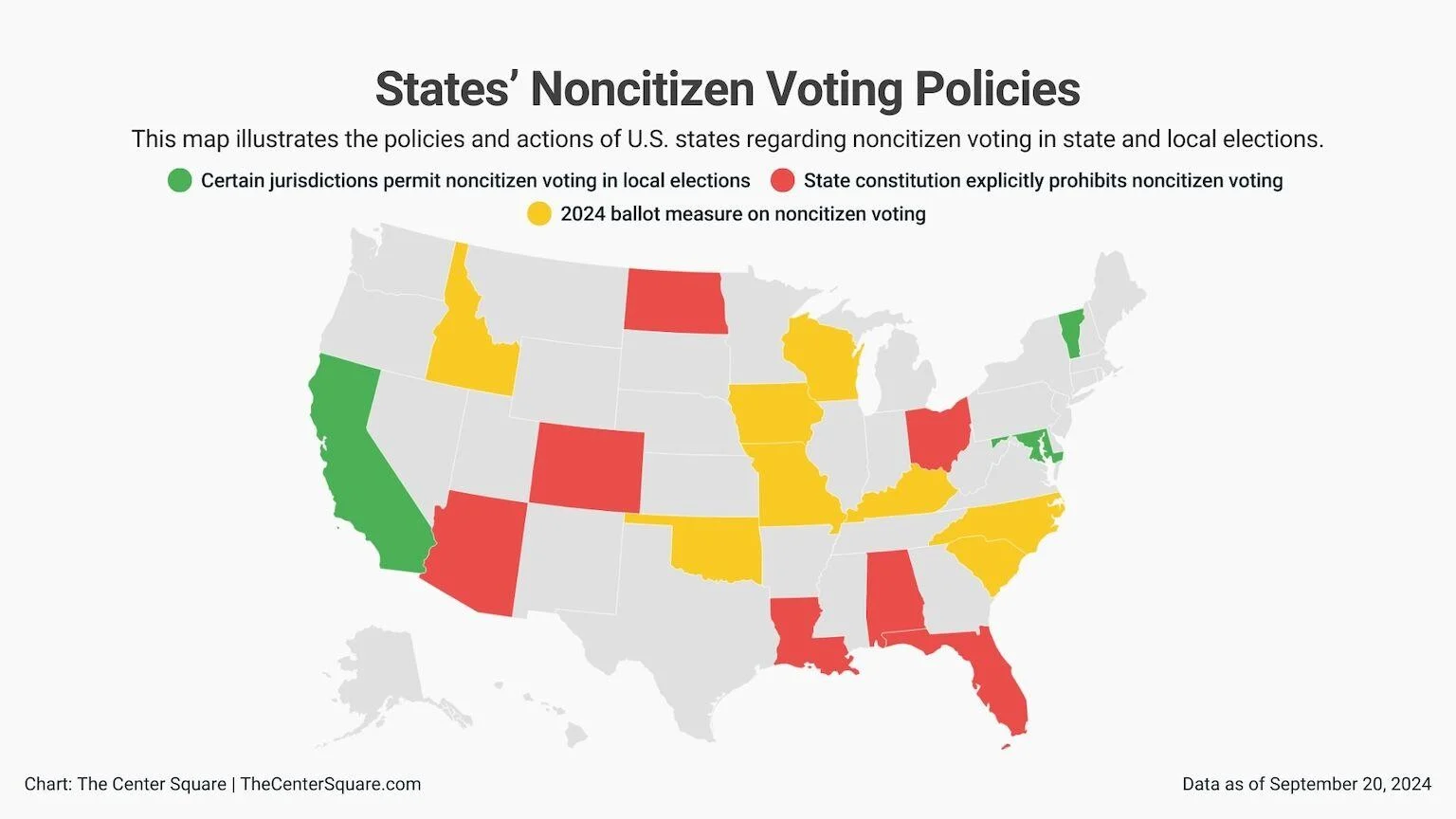
Eight ballot measures this fall either ban the option for noncitizens to vote in state or local elections or allow it. Lawmakers at the state level have been at work for some time.
Federal lawmakers have, too. The Safeguard American Voter Eligibility Act, known as SAVE Act, pushed by Speaker of the House Mike Johnson, R-La., passed the House 221-198 in July with five Democrats in support and no Republicans against.
It has stalled in the Senate, where Democrats have a majority.
The SAVE Act required those voting to provide proof of U.S. citizenship when registering to cast their votes in elections.
State constitutions explicitly prohibit noncitizen voting in Arizona, Colorado, North Dakota, Louisiana, Georgia, Florida and Ohio. Certain jurisdictions permit it in California, Maryland and Vermont.
The ballot measures are in Idaho, Oklahoma, Missouri, Iowa, Wisconsin, Kentucky, South Carolina and North Carolina.
Few municipalities across the country are increasing efforts like Frederick, Maryland, which will allow noncitizens to cast their ballots in the city's upcoming primary election.
By contrast, in Iowa for example, Attorney General Brenna Bird is reportedly prosecuting a case involving a resident without citizenship accused of registering and voting.
These differences highlight the issue of individual state-to-state legislation covering it, the confusion that has followed since past elections, and the accusations of voter fraud throughout states.
“Haphazard efforts to remove noncitizens from voter rolls on the back end are ineffective and inadequate," testified Rosemary Jenks, cofounder and policy director of the Immigration Accountability Project. "Once an election is decided, it’s too late. Only by preventing noncitizens from registering on the front end can we restore confidence in our election system.”
The House Judiciary Subcommittee on the Constitution and Limited Government held the hearing earlier this month to discuss the issue of "The Biden-Harris Border Crisis: Noncitizen Voting.”
Andrea E. Senteno, the regional counsel of the D.C. office of Mexican American Legal Defense and Educational Fund, said, “Rhetoric about the legitimacy of our elections, which evidence shows are indeed secure, is instead used to justify voter suppression measures in too many states across our country.”
On social media, Johnson wrote, "Six states have already done their own audits. They've proven you've got thousands and thousands of illegals on the voter rolls right now. And here's the problem. You know, if you have just a small percentage of those millions of people that try to participate, you can throw the outcome of the election."
The Center Square, putting together government numbers and unofficial numbers from Border Patrol agents who are not authorized to speak publicly about gotaways, estimates 12.5 million people have entered the country illegally since President Joe Biden took office in January 2021. Gotaways is a term for those that cross illegally, are seen but not documented to have done so, are not detained, and do not turn back.
Oklahoma Gov. Kevin Stitt, a Republican, and state election officials announced more than 453,000 voter registrations involving ineligible voters have been removed since 2021. The announcement included recommendations like banning ranked choice voting and mandating post-election audits.
Texas Attorney General Ken Paxton sent a letter to the federal government urging the release of the citizenship status of every registered voter to determine eligibility.
The same day, Secretary of State Jane Nelson sent a letter to the U.S. Citizenship and Immigration Services requesting the data on Texas voters by Oct. 2 to ensure voter integrity, posted by the Texas Secretary of State X account.
* * *
••• Publisher's note: A free press is critical to having well-informed voters and citizens. While some news organizations opt for paid websites or costly paywalls, The Highland County Press has maintained a free newspaper and website for the last 25 years for our community. If you would like to contribute to this service, it would be greatly appreciated. Donations may be made to: The Highland County Press, P.O. Box 849, Hillsboro, Ohio 45133. Please include "for website" on the memo line.