


Kasich announces new gaming agreement
Lead Summary
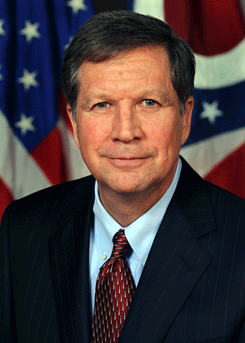
By
-
COLUMBUS – Gov. John R. Kasich has announced that an agreement has been reached with Penn National Gaming, Inc., in which Penn would pay Ohio $110 million over 10 years, and Ohio’s Commercial Activity Tax would be applied to Penn’s wagers minus payouts, instead of on wagers only.
The agreement with Penn comes in the wake of a similar agreement with Rock Ohio Caesars, LLC (ROC) that Kasich announced on at events in Cincinnati and Cleveland with ROC’s CEO Dan Gilbert.
Kasich issued the following statement:
“I’m proud that Ohioans are getting $220 million more from gaming companies—funds that will help improve education and job training, as well as support food banks. I know that many thought it was futile to push the gaming companies for a better deal, but the governor’s job isn’t just to enforce laws, it’s also to make sure they benefit Ohioans in the greatest possible way. This agreement does that, and also provides the casinos a more predictable set of rules so they can be more successful. The casinos can now more forward without delay. This is a win for all involved.”
Highlights of the new agreement are:
• $220 million more for Ohioans: ROC and Penn would pay Ohio $110 million over 10 years–$10 million per year for the first five years and $12 million per year for the next five years;
• Tax certainty for gaming companies: Ohio’s Commercial Activity Tax (CAT) would be applied to casinos’ total dollars wagered minus winnings and prizes paid out to customers;
• Capital Expenditures: Gaming companies would make a combined capital expenditure in their casino facilities of at least $700 million (ROC: Cleveland and Cincinnati, Penn: Columbus and Toledo);
• $50 million VLT Licenses: The Lottery Commission intends to allow each of Ohio’s seven horse racing permit holders to apply for a 10-year sales agent license to operate a VLT facility. Licenses would cost $50 million and be paid over time: $10 million upon application, $15 million at the onset of VLT sales, and $25 million one year later;
• Track Relocations: The state would consider transferring horse racing permits from current track locations to new locations, including locations in the Dayton and Youngstown areas;
A copy of the complete Memorandum of Understanding is below.
###
MEMORANDUM OF UNDERSTANDING
The attached Appendix A sets forth the principal terms agreed upon by Penn National Gaming, Inc. (“Penn”) and Rock Ohio Caesars LLCs (“ROC”) (collectively referred to as “the Gaming Companies”) and the State of Ohio (“State”) as it relates to land-based casinos in Cleveland, Cincinnati, Columbus, and Toledo, Ohio as well as video lottery terminal (“VLT”) facilities in the State of Ohio.
This Memorandum of Understanding (“MOU”) reflects a non-binding agreement in principle between the Gaming Companies and the State that is expected to be incorporated into a subsequent written agreement between the parties. In those instances in which an obligation is placed upon the State (as set forth in Appendix A) which would require the enactment of a new or revised statute or administrative rule, the State will use its best efforts to pursue the enactment of such statute or rule.
In the event that any such new or revised statute or administrative rule is not adopted exactly as envisioned in Appendix A, or is adopted as envisioned in Appendix A but for whatever reason is unable to be implemented, the parties will in good faith negotiate and discuss whether the statute or rule as adopted is sufficient to meet the State’s obligation or whether additional negotiations or discussions on any such obligation are necessary, including extending the deadlines and obligations set forth in this MOU. This MOU is only between the Gaming Companies and the State and is not intended to be applicable to or inure to the benefit any third party.
For and Behalf of Penn National Gaming, Inc. For and Behalf of the State of Ohio
___________________________________ ______________________________
Timothy J. Wilmott Jai Chabria
President and Chief Operating Officer Senior Advisor to the Governor
Dated: ____________________________ Dated: ________________________
For and Behalf of Rock Ohio Caesars LLC
_
Dan Gilbert
Chairman & CEO
Dated:
Appendix A: The Gaming Companies and the State Memorandum of Understanding
State of Ohio
• Agrees to seek the following statutory or rule changes applicable to each Gaming Company (a) paying the constitutional $50 million license fee per casino, (b) agreeing to make an additional payment to the State of $10 million/year for the first five (5) years and $12 million/year for the next five (5) years (as more fully described herein, “the Additional Payments”), and (c) investing at least $700 million in the aggregate on such Gaming Company’s Ohio land-based casinos (inclusive of the initial license fee or some lesser amount in the State’s discretion, but excluding any investment in VLT facilities):
• Amend the Commercial Activity Tax (“CAT”) in Revised Code Chapter 5751 to provide that the CAT applies to “gross casino revenue” as defined in Art. XV, Section 6 of the Ohio Constitution;
• Amend R.C. §3772.11(A)(2) to change to 5% for privately-held companies;
• Promotional credits distributed to casino customers are not subject to any taxes owed by the operators;
• Allow operators to settle debts with debtors for less than the full amount owed;
• No “central system,” as defined by R.C. §3772.01(G), will be required by the Casino Control Commission (CCC) provided the licensee complies with all applicable payment and reporting requirements;
• Amend R.C. §3772.28(B) to increase the threshold for reporting debts incurred with affiliated companies from $500,000 to $10 million in the aggregate;
• Amend R.C. §3772.091 & §3772.17 to allow the transfer of a casino operator license (or acquisition of new majority control) without incurring the $50 million license fee in Art. XV, § 6 of the Constitution;
• All “affiliates” of casino licensees will also have to be licensed. State will define “affiliates” as persons who own 5% or greater of the economic interests of the casino licensee.
• For the first ten year period following the final issuance of the first VLT license in Ohio the State will not directly or indirectly support more than 4 stand-alone casino licenses.
• Beginning with the opening of each Gaming Company’s second land-based casino or 3/31/13, whichever date is earlier, and continuing for a period of ten (10) years thereafter, in the event of a significant and material change in the economic benefits to the Gaming Companies arising out of the changes and clarifications proposed by the State or any changes in the number of or composition of the Gaming Licenses, the Gaming Companies’ obligation to pay any then-unpaid portion of the Additional Payments shall cease immediately. For the purposes of this item, a “material change” in the economic benefits to the Gaming Companies means:
• The State’s inability to obtain or maintain the statutory changes to the CAT as described above; or
• Promotional credits distributed to casino customers become taxable to the operators; or
• An increase in the number of casino licenses authorized by the State beyond the four (4) licenses currently authorized by the Ohio Constitution; or
• An increase in the authorized number of VLT sales agent licenses beyond the seven (7) licenses currently authorized under Ohio law; or
• The State authorizing in the future a casino licensee to operate a new casino in a location in close proximity to one of the casino locations currently described in Art. XV, Section 6 of the Ohio Constitution; or
• The State authorizing in the future a VLT sales agent licensee to operate a new VLT sales facility in close proximity to any existing VLT sales facility that is authorized per the Lottery Commission’s rules and this MOU, provided that neither of the circumstances listed below will constitute a “material change”:
• The possible horse racing permit location transfers to the Dayton or Youngstown areas referenced below, or any transfers of existing permits to a nearby location (i.e., within 50 miles of an existing permit holder’s present location); or
• The payment of incremental taxes or fees by a permit holder in exchange for the right to transfer a racing permit to a new location.
• The Casino Control Commission (CCC) in the future increasing its license renewal fee to an amount significantly above its administrative costs associated with processing the license renewal, or;
• Any change to the Ohio Constitution that increases the thirty-three percent (33%) tax rate on “gross casino revenue”, as defined in Art. XV, Section 6 of the Ohio Constitution, at the casino locations specified in that Section of the Constitution.
• Agrees that ROC’s Cleveland project Phase I and Phase II are to be considered a single casino and the Phases may be operated concurrently.
• Lottery Commission will allow each of Ohio’s current seven horse racing permit holders to apply for a VLT sales agent license at their existing facilities for a fee of $50 million per license.
• The VLT sales agent license fee of $50 million is payable: $10 million upon application (which $10 million shall be refundable if the Lottery Commission does not grant the applicant the VLT sales license), $15 million upon the beginning of VLT sales by the sales agent, and $25 million one year from the beginning of VLT sales by the sales agent;
• If the racing permit holder does not apply for a VLT sales agent license by 6/30/12, the Lottery Commission may offer the license to another company in reasonable proximity of the permit holder’s existing facility;
• VLT sales agent renewal fee to be paid once every three (3) years in an amount to be determined by the Lottery Commission that is designed to cover all of the Lottery Commission’s administrative costs in processing the licensee’s renewal application;
• No VLT sales agent license transfers for the first five (5) years from the date the first license is issued by the Lottery Commission, however the sale of a holding company of which the VLT facility is less than ten percent (10%) of the holding company’s value shall not be considered the sale or transfer of a license;
• Per R.C. §3770.21(B), the Lottery Commission will specify a capital investment of no more than $150 million at the facility of each permit holder applying to become a VLT sales agent, with a credit of not more than $25 million given for value of existing land and facilities;
• Each horse racing permit holder who holds a VLT sales agent license shall complete the development of and open a permanent VLT sales facility within three (3) years from the date that the permit holder’s VLT sales agent license is approved and final;
• Lottery Commission will promulgate rules specifying that the commission for licensed VLT sales agent, calculated as a percentage of “VLT Income,” shall be no more than 66.5%;
• The State will require that a portion the VLT sales agents’ commissions will be paid to and for the benefit of the Ohio horse racing industry. The amount of the VLT sales agents’ commissions to be paid to the Ohio horse racing industry is to be mutually agreed upon expeditiously by the licensed VLT sales agents and the relevant horse racing industry constituents under the monitoring of the State. If the parties are unable to reach agreement before VLT sales are set to begin, the State may set the parameters for such an agreement between the parties. No VLT sales may commence without such an agreement.
• Lottery Commission will issue no more than seven (7) VLT sales agent licenses for ten (10) years from date the first license is issued;
• State will consider transferring horse racing permits from current track locations to new locations in the Dayton and Youngstown areas. The State will consider transferring permits from a current location to another location nearby (i.e., not to exceed 50 miles) on a case-by-case basis:
• State will receive proposals to transfer permits to new locations, including what incremental economic benefits the permit holder is willing to provide to the State, through 12/31/11;
• State will approve or deny transfers by 1/31/12;
• Permit holders will have until 6/30/12 to decide to apply for the VLT sales agent license at the new location;
• The State reserves the right to continue to discuss and negotiate with parties with respect to transferring horse racing permits to new track locations as described above, and may, in its discretion, enter into agreements with respect to the transfer of permits to new locations in advance of the proposal process contemplated by this agreement. If the State is able to achieve its objectives with respect to transferring permits to new track locations in advance, the proposal process above would be eliminated;
• If a current permit holder cannot lawfully make VLT sales at its existing facility, then State will consider allowing the permit holder to move its track to another location in the immediate vicinity where VLT sales are permissible.
The Gaming Companies
• Each Gaming Company pays the State the $50 million license fee per casino location upon license application for each casino;
• Upon the earlier of the opening of each Gaming Company’s second land-based casino or 3/31/13, each Gaming Company agrees to pay the State the Additional Payments of $10 million/year for the first five (5) years and $12 million/year for the next five (5) years;
• Agrees that each casino license will be renewed once every three (3) years for a fee to be determined by the CCC that is designed to cover the CCC’s administrative costs;
• Agrees that any transfer of casino license to a new licensee (or acquisition of new majority control or interest in a casino) requires only a payment of the $1.5 million application fee in §3772.17(B), plus administrative costs, by the new licensee/majority owner and that the Casino Control Commission retains the right to approve or deny the transfer of the license to the new majority interest in a casino.[[In-content Ad]]
The agreement with Penn comes in the wake of a similar agreement with Rock Ohio Caesars, LLC (ROC) that Kasich announced on at events in Cincinnati and Cleveland with ROC’s CEO Dan Gilbert.
Kasich issued the following statement:
“I’m proud that Ohioans are getting $220 million more from gaming companies—funds that will help improve education and job training, as well as support food banks. I know that many thought it was futile to push the gaming companies for a better deal, but the governor’s job isn’t just to enforce laws, it’s also to make sure they benefit Ohioans in the greatest possible way. This agreement does that, and also provides the casinos a more predictable set of rules so they can be more successful. The casinos can now more forward without delay. This is a win for all involved.”
Highlights of the new agreement are:
• $220 million more for Ohioans: ROC and Penn would pay Ohio $110 million over 10 years–$10 million per year for the first five years and $12 million per year for the next five years;
• Tax certainty for gaming companies: Ohio’s Commercial Activity Tax (CAT) would be applied to casinos’ total dollars wagered minus winnings and prizes paid out to customers;
• Capital Expenditures: Gaming companies would make a combined capital expenditure in their casino facilities of at least $700 million (ROC: Cleveland and Cincinnati, Penn: Columbus and Toledo);
• $50 million VLT Licenses: The Lottery Commission intends to allow each of Ohio’s seven horse racing permit holders to apply for a 10-year sales agent license to operate a VLT facility. Licenses would cost $50 million and be paid over time: $10 million upon application, $15 million at the onset of VLT sales, and $25 million one year later;
• Track Relocations: The state would consider transferring horse racing permits from current track locations to new locations, including locations in the Dayton and Youngstown areas;
A copy of the complete Memorandum of Understanding is below.
###
MEMORANDUM OF UNDERSTANDING
The attached Appendix A sets forth the principal terms agreed upon by Penn National Gaming, Inc. (“Penn”) and Rock Ohio Caesars LLCs (“ROC”) (collectively referred to as “the Gaming Companies”) and the State of Ohio (“State”) as it relates to land-based casinos in Cleveland, Cincinnati, Columbus, and Toledo, Ohio as well as video lottery terminal (“VLT”) facilities in the State of Ohio.
This Memorandum of Understanding (“MOU”) reflects a non-binding agreement in principle between the Gaming Companies and the State that is expected to be incorporated into a subsequent written agreement between the parties. In those instances in which an obligation is placed upon the State (as set forth in Appendix A) which would require the enactment of a new or revised statute or administrative rule, the State will use its best efforts to pursue the enactment of such statute or rule.
In the event that any such new or revised statute or administrative rule is not adopted exactly as envisioned in Appendix A, or is adopted as envisioned in Appendix A but for whatever reason is unable to be implemented, the parties will in good faith negotiate and discuss whether the statute or rule as adopted is sufficient to meet the State’s obligation or whether additional negotiations or discussions on any such obligation are necessary, including extending the deadlines and obligations set forth in this MOU. This MOU is only between the Gaming Companies and the State and is not intended to be applicable to or inure to the benefit any third party.
For and Behalf of Penn National Gaming, Inc. For and Behalf of the State of Ohio
___________________________________ ______________________________
Timothy J. Wilmott Jai Chabria
President and Chief Operating Officer Senior Advisor to the Governor
Dated: ____________________________ Dated: ________________________
For and Behalf of Rock Ohio Caesars LLC
_
Dan Gilbert
Chairman & CEO
Dated:
Appendix A: The Gaming Companies and the State Memorandum of Understanding
State of Ohio
• Agrees to seek the following statutory or rule changes applicable to each Gaming Company (a) paying the constitutional $50 million license fee per casino, (b) agreeing to make an additional payment to the State of $10 million/year for the first five (5) years and $12 million/year for the next five (5) years (as more fully described herein, “the Additional Payments”), and (c) investing at least $700 million in the aggregate on such Gaming Company’s Ohio land-based casinos (inclusive of the initial license fee or some lesser amount in the State’s discretion, but excluding any investment in VLT facilities):
• Amend the Commercial Activity Tax (“CAT”) in Revised Code Chapter 5751 to provide that the CAT applies to “gross casino revenue” as defined in Art. XV, Section 6 of the Ohio Constitution;
• Amend R.C. §3772.11(A)(2) to change to 5% for privately-held companies;
• Promotional credits distributed to casino customers are not subject to any taxes owed by the operators;
• Allow operators to settle debts with debtors for less than the full amount owed;
• No “central system,” as defined by R.C. §3772.01(G), will be required by the Casino Control Commission (CCC) provided the licensee complies with all applicable payment and reporting requirements;
• Amend R.C. §3772.28(B) to increase the threshold for reporting debts incurred with affiliated companies from $500,000 to $10 million in the aggregate;
• Amend R.C. §3772.091 & §3772.17 to allow the transfer of a casino operator license (or acquisition of new majority control) without incurring the $50 million license fee in Art. XV, § 6 of the Constitution;
• All “affiliates” of casino licensees will also have to be licensed. State will define “affiliates” as persons who own 5% or greater of the economic interests of the casino licensee.
• For the first ten year period following the final issuance of the first VLT license in Ohio the State will not directly or indirectly support more than 4 stand-alone casino licenses.
• Beginning with the opening of each Gaming Company’s second land-based casino or 3/31/13, whichever date is earlier, and continuing for a period of ten (10) years thereafter, in the event of a significant and material change in the economic benefits to the Gaming Companies arising out of the changes and clarifications proposed by the State or any changes in the number of or composition of the Gaming Licenses, the Gaming Companies’ obligation to pay any then-unpaid portion of the Additional Payments shall cease immediately. For the purposes of this item, a “material change” in the economic benefits to the Gaming Companies means:
• The State’s inability to obtain or maintain the statutory changes to the CAT as described above; or
• Promotional credits distributed to casino customers become taxable to the operators; or
• An increase in the number of casino licenses authorized by the State beyond the four (4) licenses currently authorized by the Ohio Constitution; or
• An increase in the authorized number of VLT sales agent licenses beyond the seven (7) licenses currently authorized under Ohio law; or
• The State authorizing in the future a casino licensee to operate a new casino in a location in close proximity to one of the casino locations currently described in Art. XV, Section 6 of the Ohio Constitution; or
• The State authorizing in the future a VLT sales agent licensee to operate a new VLT sales facility in close proximity to any existing VLT sales facility that is authorized per the Lottery Commission’s rules and this MOU, provided that neither of the circumstances listed below will constitute a “material change”:
• The possible horse racing permit location transfers to the Dayton or Youngstown areas referenced below, or any transfers of existing permits to a nearby location (i.e., within 50 miles of an existing permit holder’s present location); or
• The payment of incremental taxes or fees by a permit holder in exchange for the right to transfer a racing permit to a new location.
• The Casino Control Commission (CCC) in the future increasing its license renewal fee to an amount significantly above its administrative costs associated with processing the license renewal, or;
• Any change to the Ohio Constitution that increases the thirty-three percent (33%) tax rate on “gross casino revenue”, as defined in Art. XV, Section 6 of the Ohio Constitution, at the casino locations specified in that Section of the Constitution.
• Agrees that ROC’s Cleveland project Phase I and Phase II are to be considered a single casino and the Phases may be operated concurrently.
• Lottery Commission will allow each of Ohio’s current seven horse racing permit holders to apply for a VLT sales agent license at their existing facilities for a fee of $50 million per license.
• The VLT sales agent license fee of $50 million is payable: $10 million upon application (which $10 million shall be refundable if the Lottery Commission does not grant the applicant the VLT sales license), $15 million upon the beginning of VLT sales by the sales agent, and $25 million one year from the beginning of VLT sales by the sales agent;
• If the racing permit holder does not apply for a VLT sales agent license by 6/30/12, the Lottery Commission may offer the license to another company in reasonable proximity of the permit holder’s existing facility;
• VLT sales agent renewal fee to be paid once every three (3) years in an amount to be determined by the Lottery Commission that is designed to cover all of the Lottery Commission’s administrative costs in processing the licensee’s renewal application;
• No VLT sales agent license transfers for the first five (5) years from the date the first license is issued by the Lottery Commission, however the sale of a holding company of which the VLT facility is less than ten percent (10%) of the holding company’s value shall not be considered the sale or transfer of a license;
• Per R.C. §3770.21(B), the Lottery Commission will specify a capital investment of no more than $150 million at the facility of each permit holder applying to become a VLT sales agent, with a credit of not more than $25 million given for value of existing land and facilities;
• Each horse racing permit holder who holds a VLT sales agent license shall complete the development of and open a permanent VLT sales facility within three (3) years from the date that the permit holder’s VLT sales agent license is approved and final;
• Lottery Commission will promulgate rules specifying that the commission for licensed VLT sales agent, calculated as a percentage of “VLT Income,” shall be no more than 66.5%;
• The State will require that a portion the VLT sales agents’ commissions will be paid to and for the benefit of the Ohio horse racing industry. The amount of the VLT sales agents’ commissions to be paid to the Ohio horse racing industry is to be mutually agreed upon expeditiously by the licensed VLT sales agents and the relevant horse racing industry constituents under the monitoring of the State. If the parties are unable to reach agreement before VLT sales are set to begin, the State may set the parameters for such an agreement between the parties. No VLT sales may commence without such an agreement.
• Lottery Commission will issue no more than seven (7) VLT sales agent licenses for ten (10) years from date the first license is issued;
• State will consider transferring horse racing permits from current track locations to new locations in the Dayton and Youngstown areas. The State will consider transferring permits from a current location to another location nearby (i.e., not to exceed 50 miles) on a case-by-case basis:
• State will receive proposals to transfer permits to new locations, including what incremental economic benefits the permit holder is willing to provide to the State, through 12/31/11;
• State will approve or deny transfers by 1/31/12;
• Permit holders will have until 6/30/12 to decide to apply for the VLT sales agent license at the new location;
• The State reserves the right to continue to discuss and negotiate with parties with respect to transferring horse racing permits to new track locations as described above, and may, in its discretion, enter into agreements with respect to the transfer of permits to new locations in advance of the proposal process contemplated by this agreement. If the State is able to achieve its objectives with respect to transferring permits to new track locations in advance, the proposal process above would be eliminated;
• If a current permit holder cannot lawfully make VLT sales at its existing facility, then State will consider allowing the permit holder to move its track to another location in the immediate vicinity where VLT sales are permissible.
The Gaming Companies
• Each Gaming Company pays the State the $50 million license fee per casino location upon license application for each casino;
• Upon the earlier of the opening of each Gaming Company’s second land-based casino or 3/31/13, each Gaming Company agrees to pay the State the Additional Payments of $10 million/year for the first five (5) years and $12 million/year for the next five (5) years;
• Agrees that each casino license will be renewed once every three (3) years for a fee to be determined by the CCC that is designed to cover the CCC’s administrative costs;
• Agrees that any transfer of casino license to a new licensee (or acquisition of new majority control or interest in a casino) requires only a payment of the $1.5 million application fee in §3772.17(B), plus administrative costs, by the new licensee/majority owner and that the Casino Control Commission retains the right to approve or deny the transfer of the license to the new majority interest in a casino.[[In-content Ad]]