


Hillsboro resident wants answers on sewer increase, data reporting WATCH THE VIDEO
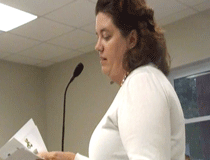
With the Hillsboro City Council scheduled to hear the second reading on a resolution that would increase sewer rates by 15 percent over three years, an area resident spoke out, saying that she needed more answers on what was being done with the money.
Armed with state statistics, grant resources, and comparisons to other cities, Christine Kerley told council during their regular meeting Monday that based on statistical data, in 2010 the average family will pay more in water and sewer services than they will pay in city taxes, and those utilities average to 1.9 percent of the medial annual household income.
"The first question I have, I'm curious to know why Hillsboro has not reported in the years 2003, 2004, 2005, 2008 and 2009 to the state of Ohio EPA office in regard to their residential sewer rates," Kerley said. "I would like to get those figures."
Over the course of her presentation, council members questioned Kerley on her statistics and thoughts, but no one from the city offered any explanation as to why the reporting was not made to the EPA, which Kerley said was required reporting.
Kerley had several pages of figures she provided to council. For water, she said, the average family pays $42.83.
"My concern is this: Water at $42.83 a month is going to become a burden to the citizens of our community, if we consider the growth," Kerley said. "The next thing was a sewer increase. You're proposing a 5-percent increase. I would like to know what that increase is going to include. What is it covering for our city? Where is that money going to go? What is it earmarked for?"
Kerley said that she is a new resident of Hillsboro, and that she works for NASA and is familiar with governmental accounting and reporting.
"My concern is the increase (to sewer rates)," she said. "I do not have the history of the sewer. I tried to find it online. I could not find the information. I contacted (the mayor's) office and asked them for information and they could not provide me with information. You are requesting a 5-percent increase, but your figures are not available to (the) public of what we're actually paying."
Kerley said that "based on statistics" from 2002 to 2006 the average citizen had an increase of just over $68.
"Then, you jump $111 per year, per family, from $660 to $771. This is all averages and all statistical figures," she said. "Based on that, if you consider the averaging of statistics, and what I did is I divided the difference between the 2002-2006, 2006-2007, added it up together and divided it by a percentage of 25 percent - because of the 25-percent increase that we see. It's $89.50 a year increase. So, that's 141.9 percent more than the increase of water that was increased the year before.
"I, as a citizen, have a problem when it's charging me 141.9 percent more for me to flush my toilet," Kerley said. "The same amount of water to fill my toilet is the same amount of water that's leaving my toilet. I understand that there are city sewer lines and I understand that there are different things, I understand I take a shower. It's the same amount of water for me to run that shower as it is for that shower to drain. It's the same amount to fill the washer as it is to drain the washer. My concern is this: Where is that money going to, what is it improving, and where is it at? I don't see the justification and I don't see the numbers in reports figured to the state."
Kerley said that based on those figures, the average family in Hillsboro will pay $1,039.50 in sewer alone, not including water, which adds $514.
"So the average citizen, or family, is going to spent $1,600, roughly, on water and sewer. That is more than what most citizens pay in city taxes," Kerley said. "That's more than what citizens pay in gas to heat their homes if they're on a budget plan. That's more than I pay to heat my home in gas. Gas is expensive. Why is my water so much money?"
In addition to the data and statistics she gave council, Kerley also provided the resources and websites where they were found, so that council members could review and verify them.
Kerley compared the rates of neighboring cities, saying that Chillicothe - which had $2.9 million water treatment plant replacement in 2004 - has an average water/sewer bill of $30 per month. Wilmington's average is $42 per month for sewer (which includes trash collection). Wilmington had a sewer replacement, she said, in 2001 at a cost of $1.9 million. Milford residents on average pay $38 per month. For comparison, she said that Cincinnati is $59 per month for sewer.
"I see a problem if we, as Hillsboro, can't feed our own, but yet we want to charge our citizens up to $160 a month without even an increase right now for our water and sewer," Kerley said. "There's a problem here. I know that the sewer lines need replaced in town. I get it. I live in an old house and I've already replaced out to the street, and I've still got backup, and I've still got raw sewage coming into my house. I know this. But my problem is, is that I don't see an increase necessary if we can't fix the problem that's already there. And I want to know where the money is going, where it's at, and why it's not on these reports."
Hillsboro Safety and Service Director Ralph Holt asked Kerley if she had driven on North High Street and seen the construction on the new wasterwater treatment plant under construction on the back side of Liberty Park.
"The sewer plant (that cost) $17 million?" Holt asked.
"I know that cost," Kerley said.
"A portion of (the sewer bill) is paying for that sewer plant that the EPA required us to build," Holt said.
Kerley said, "OK, so my next question is what were the sources of funding that are being used, were used and have been used for the water treatment plant?"
Holt wanted to know what number she called when she said she contacted the mayor's office, because she should have been directed to administrative assistant Kirby Ellison, who did all the writing for the city's grant funding for the plant.
"I called the mayor's office and asked for the documentation and reports for the annual cost of the water," Kerley said. She was told that they didn't know where to get those reports.
Holt said that the city had received $7 million in grant funds for the plant. Kerley asked if the city had continued to apply, because there are continuing grant dollars available, for continuous work and maintenance. Holt asked if she could call the mayor's office Tuesday and to ask for Ellison, and Kerley said that she would do that.
"My concern is that ... I understand the need for new sewer lines, I understand there's a need to have a new sewer treatment plant," Kerley said. "I get that need. But my question is, where do we find the funding for it. Did we actually search and find every available source? (Indicated to her research) There's an EPA source funding here through the state of Ohio. The city can apply two times a year for $1.6 million in grants alone, in Appalachian Counties. Highland County was number three on the list of approval counties for the state to approve. If we ask ... even if we got $100,000 as a community, that's $100,000 our citizens and I, as a family, do not have to pay."
Council member Rod Daniels thanked Kerley for the reports that she presented to council, and said they had been well laid-out and well-researched. He said that sometimes grants "are not free" and have strings attached.
Kerley said that she understood there were matching funds and upfront costs associated with some grants, but she said that she was unable to find a list of the grants the city had received so far.
Additionally, according to citydata.com, Kerley said, the median household income in Hillsboro was $30,888.
"The average citizen will pay 1.9 percent of their annual income to the water and sewer department for fees and usage rates," Kerley said.
Chillicothe and Wilmington residents, she said, will pay less than .7 percent of their median incomes.
"I have a problem with that number, because that's a number that's a large amount of income coming out of peoples' pockets," Kerley said. "I know water is a major resource and a major need, but I don't think it costs this much. It does not cost me 141.9 percent increase to flush a toilet, to drain my water."
Council member Dave Shoemaker, chairperson of council's utilities committee, was acting council president Monday in the absence of president Lee Koogler. Shoemaker encouraged Kerley to speak to Ellison, and said that maybe she could provide the number she was looking for.
"You're really up on your numbers, and I really applaud you for that," Shoemaker said. "Had we not froze the rates when we did (in 2008) ... your rates would have been $43.30. Right now, what they are going to be with your 5-percent increase is $25.42. So, we do have a discrepancy there in where the money is going. We can account for everything the money is going to. RCAP (Rural Community Assistance Partnership) gave us a recommendation as to where to put the money. We've put in (line items) for sewer maintains, repair and for the future."
Kerley said that she would send Shoemaker all the data she collected and Excel spreadsheets she used in sorting it.
Later in the meeting, council heard the second reading of the ordinance that would increase sewer rates by 5 percent each year for 2011, 2012 and 2013. Council will hear the third and final reading of the ordinance during their next meeting, Sept. 12 at 7 p.m. If the ordinance passes, it will go into effect in 30 days.
[[In-content Ad]]