


Finance committee examines performance audit options
Lead Summary
By
Brandy Chandler-brandychandler@gmail.com
An examination of citywide economics and efficiencies, or the policies and programming of individual departments are among the options the city of Hillsboro has when considering conducting a performance audit.
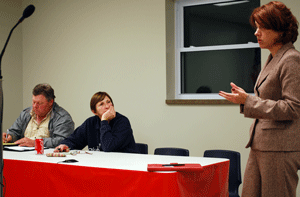
The finance committee of the Hillsboro City Council met Monday evening with Christa Criddle, Betsy Bashore and Max Uhl of Auditor of State David Yost's Office. During council's September meeting, finance committee chairperson Peter Pence requested that the committee be allowed to pursue further investigation of a performance audit and ways to finance. Hillsboro Auditor Gary Lewis had previously been suggesting the city take such a move.
On Monday, Bashore walked the committee through the steps to receive funding for the audit, and the options that were available to the city, calling it an "à la carte audit" because the city can choose the area of focus and the scope of the audit to fit its needs and its budget.
In the 15 years the Ohio Auditor's Office has been conducting performance audits, approximately 300 have been done, 100 of which have been municipalities, she said.
"There are two kinds. One is economy and efficiency where you look at how much money you put into the system and how much you get on the other side, [for example] how much it costs you per fire run, or how much it costs per check process. The other kind is a program audit, and it's related to the achievement of goals in an organization. Most of our audits focus strongly on economy and efficiency, but we include that program audit component because we don't want to compromise your services in pursuit of lower costs and greater efficiency. Your citizens have expectations of service level, and unless you're in dire financial straits, we usually take that kind of service level into consideration as part of the audit."
Part of the auditing team, in addition to people with history in accounting and finance, are former firefighters and people with a history in police services and education backgrounds, "which is quite a range of experience, which allows us to address whatever our client's unique needs may be."
For city audits, the department can examine practices and department functions citywide or take a very narrow look at a small number of departments, based on the individual city's need.
Bashore said that typically the city audits include, "an examination of administrative functions, like income tax, the mayor's office, law department, and also forecasting and what your finances look like in five years' time. Then we also look at public works in a broad sense and then public safety."
By examining public works and safety as a whole, she said that allows them to look at cross-department issues and look for potential ways to consolidate services, "use your staff differently, address citizens' needs in a different manner, so it gives a more holistic view of how city operations might function."
There is a broad scope in cost, Bashore said, in that the audits can cost from $5,000 to $1 million, with comprehensive city audits costing $60,000 to $90,000. To look at an individual department is between $15,000 to $20,000.
Hillsboro is looking into applying for LEAP (Leverage for Efficiency, Accountability and Performance) funding, which makes loans to state agencies and local public offices requiring financial assistance to defer the cost of performance audits. At the end of the audit, the city receives a series of recommendations, and "if they are sufficient enough to cover the cost of the audit, it's up to you to implement them," Bashore said. "If we don't identify sufficient savings, the audit is at our cost. Within a year's time of implementing the savings, then you begin repaying the audit costs."
Once the audit cost is paid back, the remaining savings belong to the city.
Hillsboro Safety and Service Director Ralph Holt asked what the interest on the loan would be. That figure was not immediately known but Criddle said that she would get that number of the city. Bashore said that it would be "not very high."
The time period to apply for the loan is in the early part of 2012 and begins with outlining the city's intended scope for the audit. The audit is approximately a six-month long process that involves a month of planning, months of field work within the city and several months of review. The city is consulted through the entire process and is "very collaborative, and at the end of the audit there are no surprises," Bashore said.
"We're not going to go just shooting for savings. We're looking for overall opportunities to improve overall services while economizing."
Hillsboro Mayor Dick Zink asked what would be considered "a significant savings." Bashore said that it varies per city, and that "for some organizations, $1,000 is significant. For a city of your size, I'd imagine a couple hundred thousand dollars in savings."
While he said that he would like to see all departments audited, Pence said that he thinks that will be "tough for us to do" with the cost.
Pence said that the city may have to consider doing half the city offices during one audit and the other half at another time or consider just doing the fire and EMS and police departments.
Zink agreed that a look at the fire and EMS would be beneficial, "especially with the township question we've got right now. We're not collecting near enough for the townships for providing the services."
Pence said another variable may be seeing the thoughts of the new city administration and if it will be on board with making the changes.
"As of Jan. 1, we're going to have a new administration," Pence said. "I think it's important that - although we're starting this process now - eventually that new administration would be the ones responsible for implementing any findings that are found in the performance audit. If they're not willing to implement them, then there's no sense in doing it."
Zink said, "The administration implements council's wishes. That's something you need to remember."
The auditors said that there was no limit, that they were aware of, for how many times a city could receive LEAP funds, so multiple audits could be possible.
Committee member Dave Shoemaker said that he would like to see the city "get the most bang for the buck" and asked Bashore which type of audit is advisable for the most potential savings.
Since she had heard committee members refer to "cuts," Bashore said, "so I imagine you're thinking about downsizing your expenditures over time. You're probably wanting feedback on where you're spending money that could be reduced without compromising your services or - or without having to compromise them a lot. Things like human resources policies can save your money. How you schedule people can save you money. How you've negotiated your collective bargaining agreements, if you have those with fire or police. How you decide what you count as a work day has a big impact on the costs. There's a lot of opportunities to look at sections of policies that do have an impact on the bottom line."
Bashore said that historically approximately 60-65 percent of the recommendations of the audit end up being implemented but that "one of the hardest things to implement is collective bargaining practices."
It was recommended that the city take a look at previous-performed performance audit, and the "local government toolkit," which is available at www.skinnyohio.org, a website operated by the State Auditor which looks at ways to streamline government practices. Bashore said the website was like a database of ideas for best practices that had been implemented by Ohio municipalities to streamline or share services.
Pence said he feels like the performance audit would be a worthwhile pursuit because "it either validates that you're doing what you're supposed to be doing, or it show us the areas that need improvement."
"I think it's money that will be well-spent, if we can get those kinds of savings," Shoemaker said.
The committee did not make any recommendations for council, but Pence said that they will continue to look at what may be best for the city, as well as what it can afford.
The November meeting of a full Hillsboro City Council is scheduled for Monday, Nov. 14 at 7 p.m.
An examination of citywide economics and efficiencies, or the policies and programming of individual departments are among the options the city of Hillsboro has when considering conducting a performance audit.
The finance committee of the Hillsboro City Council met Monday evening with Christa Criddle, Betsy Bashore and Max Uhl of Auditor of State David Yost's Office. During council's September meeting, finance committee chairperson Peter Pence requested that the committee be allowed to pursue further investigation of a performance audit and ways to finance. Hillsboro Auditor Gary Lewis had previously been suggesting the city take such a move.
On Monday, Bashore walked the committee through the steps to receive funding for the audit, and the options that were available to the city, calling it an "à la carte audit" because the city can choose the area of focus and the scope of the audit to fit its needs and its budget.
In the 15 years the Ohio Auditor's Office has been conducting performance audits, approximately 300 have been done, 100 of which have been municipalities, she said.
"There are two kinds. One is economy and efficiency where you look at how much money you put into the system and how much you get on the other side, [for example] how much it costs you per fire run, or how much it costs per check process. The other kind is a program audit, and it's related to the achievement of goals in an organization. Most of our audits focus strongly on economy and efficiency, but we include that program audit component because we don't want to compromise your services in pursuit of lower costs and greater efficiency. Your citizens have expectations of service level, and unless you're in dire financial straits, we usually take that kind of service level into consideration as part of the audit."
Part of the auditing team, in addition to people with history in accounting and finance, are former firefighters and people with a history in police services and education backgrounds, "which is quite a range of experience, which allows us to address whatever our client's unique needs may be."
For city audits, the department can examine practices and department functions citywide or take a very narrow look at a small number of departments, based on the individual city's need.
Bashore said that typically the city audits include, "an examination of administrative functions, like income tax, the mayor's office, law department, and also forecasting and what your finances look like in five years' time. Then we also look at public works in a broad sense and then public safety."
By examining public works and safety as a whole, she said that allows them to look at cross-department issues and look for potential ways to consolidate services, "use your staff differently, address citizens' needs in a different manner, so it gives a more holistic view of how city operations might function."
There is a broad scope in cost, Bashore said, in that the audits can cost from $5,000 to $1 million, with comprehensive city audits costing $60,000 to $90,000. To look at an individual department is between $15,000 to $20,000.
Hillsboro is looking into applying for LEAP (Leverage for Efficiency, Accountability and Performance) funding, which makes loans to state agencies and local public offices requiring financial assistance to defer the cost of performance audits. At the end of the audit, the city receives a series of recommendations, and if they are sufficient enough to cover the cost of the audit, it's up to you to implement them," Bashore said. "If we don't identify sufficient savings, the audit is at our cost. Within a year's time of implementing the savings, then you begin repaying the audit costs."
Once the audit cost is paid back, the remaining savings belong to the city.
Hillsboro Safety and Service Director Ralph Holt asked what the interest on the loan would be. That figure was not immediately known but Criddle said that she would get that number of the city. Bashore said that it would be "not very high."
The time period to apply for the loan is in the early part of 2012 and begins with outlining the city's intended scope for the audit. The audit is approximately a six-month long process that involves a month of planning, months of field work within the city and several months of review. The city is consulted through the entire process and is "very collaborative, and at the end of the audit there are no surprises," Bashore said.
"We're not going to go just shooting for savings. We're looking for overall opportunities to improve overall services while economizing."
Hillsboro Mayor Dick Zink asked what would be considered "a significant savings." Bashore said that it varies per city, and that "for some organizations, $1,000 is significant. For a city of your size, I'd imagine a couple hundred thousand dollars in savings."
While he said that he would like to see all departments audited, Pence said that he thinks that will be "tough for us to do" with the cost.
Pence said that the city may have to consider doing half the city offices during one audit and the other half at another time or consider just doing the fire and EMS and police departments.
Zink agreed that a look at the fire and EMS would be beneficial, "especially with the township question we've got right now. We're not collecting near enough for the townships for providing the services."
Pence said another variable may be seeing the thoughts of the new city administration and if it will be on board with making the changes.
"As of Jan. 1, we're going to have a new administration," Pence said. "I think it's important that - although we're starting this process now - eventually that new administration would be the ones responsible for implementing any findings that are found in the performance audit. If they're not willing to implement them, then there's no sense in doing it."
Zink said, "The administration implements council's wishes. That's something you need to remember."
The auditors said that there was no limit, that they were aware of, for how many times a city could receive LEAP funds, so multiple audits could be possible.
Committee member Dave Shoemaker said that he would like to see the city "get the most bang for the buck" and asked Bashore which type of audit is advisable for the most potential savings.
Since she had heard committee members refer to "cuts," Bashore said, "so I imagine you're thinking about downsizing your expenditures over time. You're probably wanting feedback on where you're spending money that could be reduced without compromising your services or - or without having to compromise them a lot. Things like human resources policies can save your money. How you schedule people can save you money. How you've negotiated your collective bargaining agreements, if you have those with fire or police. How you decide what you count as a work day has a big impact on the costs. There's a lot of opportunities to look at sections of policies that do have an impact on the bottom line."
Bashore said that historically approximately 60-65 percent of the recommendations of the audit end up being implemented but that "one of the hardest things to implement is collective bargaining practices."
It was recommended that the city take a look at previous-performed performance audit, and the "local government toolkit," which is available at www.skinnyohio.org, a website operated by the State Auditor which looks at ways to streamline government practices. Bashore said the website was like a database of ideas for best practices that had been implemented by Ohio municipalities to streamline or share services.
Pence said he feels like the performance audit would be a worthwhile pursuit because "it either validates that you're doing what you're supposed to be doing, or it shows us the areas that need improvement."
"I think it's money that will be well-spent, if we can get those kinds of savings," Shoemaker said.
The committee did not make any recommendations for council, but Pence said that they will continue to look at what may be best for the city, as well as what it can afford.
The November meeting of a full Hillsboro City Council is scheduled for Monday, Nov. 14 at 7 p.m.
[[In-content Ad]]