


Congressman Taylor introduces bill to back businesses navigating waste disposal regulations
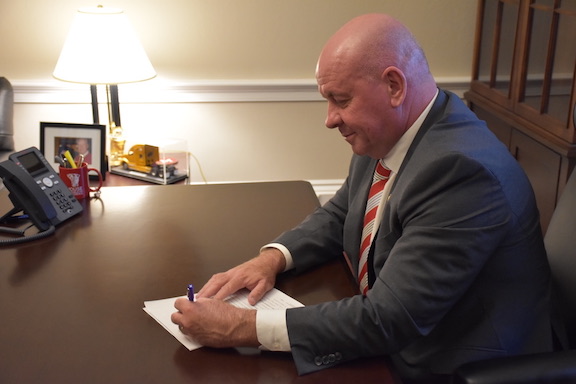
Rep. Dave Taylor
WASHINGTON, D.C. – Congressman Dave Taylor (OH-02) introduced H.R. 3897, the Confidence in Clean Water Permits Act, which will provide clarity in the National Pollutant Discharge Elimination System (NPDES) permitting process to guide and protect American businesses in their waste disposal process. This bill states that businesses and wastewater treatment plants that are acting in good faith within their permit guidelines cannot be held liable or otherwise adversely impacted, as long as they are following the existing guidelines established by the Environmental Protection Agency (EPA).
“Southern Ohio businesses should not be penalized for the EPA’s inability to establish effective guidelines for responsible waste disposal. The current discharge permitting process is yet another example of ambiguous government overreach that is making everyday operations of American businesses so burdensome,” said Congressman Taylor. “My Confidence in Clean Water Permits Act will rightfully reform the federal government’s regulatory reach so businesses and wastewater facilities have clarity on how to meet pollutant discharge requirements as they provide critical services to our communities.”
“Congressman Taylor’s bill helps solidify the Supreme Court’s ruling in San Francisco v. EPA by providing a reasonable liability shield for permit holders who act in good faith with their permits. I commend Congressman Taylor for his leadership on this issue and for introducing legislation that will provide much-needed certainty for the regulated community,” said Chairman Sam Graves.
Initially established through the Clean Water Act by the EPA, the NPDES permit program enforces permitting, administrative, and enforcement requirements to regulate discharge pollutants to waters of the United States. These permits contain information on permissible materials that businesses and wastewater treatment plants can discharge, such as dredge soil, solid waste, sewage, chemical waste, biological materials, rock, sand, agricultural waste, etc., to limit environmental pollutants that cause adverse effects to human health.
With the recent discovery of new chemicals like PFAS in more areas, American businesses across the Nation face an onslaught of new litigation for discharging these chemicals into local water supplies. Although the EPA has made it clear that PFAS chemicals cannot be released into the environment, it fails to provide guidance for businesses to accurately detect and measure PFAS in the surrounding air, water, soil, fish, and wildlife within their existing NPDES permits. Environmental extremists use this ambiguity to bury small businesses in new lawsuits outside the original scope and purpose of the NPDES permit.
The Confidence in Clean Water Permits Act states that businesses and wastewater treatment plants that are acting in good faith within their permit guidelines cannot be held liable for the impermissible discharge of unknown chemicals. The bill details that the EPA, not businesses themselves, possesses the ultimate responsibility to test and provide guidance for the detection of possible environmental pollutants. This would protect small businesses and organizations that are under attack by the government and third-party environmental groups for fulfilling requirements they have no tangible metric for fulfilling.
A member of the House Transportation and Infrastructure Committee, Congressman Taylor serves as the Vice Chairman of the Water Resources and Environment Subcommittee.
Background:
On March 4, 2025, the Supreme Court issued a 5-4 ruling against the EPA in San Francisco v. EPA, preventing the EPA from imposing generic prohibitions in permits issued under the National Pollutant Discharge Elimination System (NPDES) program without defining the specific parameters in which chemical discharges are permissible.
This ruling protected American businesses by reining in overreaching and ambiguous requirements from the federal government that restricted their ability to dispose of waste. The ambiguous language in question in the San Francisco v. EPA case had been added to San Francisco’s NPDES permit for one of two sewer overflow facilities in the area in 2019. This revision included generic phrases deemed by the Court as “end-result requirements,” which fail to instruct businesses on how to achieve required outcomes.
These requirements were stated as:
• prohibition of any discharge which “contributes to a violation of any applicable water quality standard” for receiving waters, and;
• not allowing any treatment or discharge that “creates pollution, contamination, or nuisance as defined by California State Water Code section 13050.”
The Court’s ruling held that section 1311(b)(1)(C) of the Clean Water Act fails to authorize end-result requirements, and they would violate the permit shield principle. This decision put the responsibility on the EPA to enforce water quality standards and outline specific steps and limitations for businesses to take to ensure adherence to waste disposal requirements. Thus, permit holders could not be held liable for violating the terms of their permit due to the generic, outcome-based language in which it was written.
Public and private organizations, ranging from wastewater utility companies to mining companies to home builders, benefited from this ruling, and it serves as precedent for the Confidence in Clean Water Permits Act.
Congressman David Taylor represents Ohio’s Second Congressional District, which includes Clermont, Clinton, Pike, Adams, Brown, Highland, Ross, Scioto, Pickaway, Hocking, Vinton, Jackson, Lawrence, Gallia, and Meigs counties, as well as part of Fayette County. Taylor serves on the House Committee on Transportation and Infrastructure and the House Agriculture Committee. Prior to serving in Congress, Taylor worked as an assistant prosecutor for Clermont County before joining his family’s concrete business, where he ultimately served as President. Please visit https://taylor.house.gov/ for more information.