


Board of DD, Biggert await decision
Lead Summary
By
Brandy Chandler-brandychandler@gmail.com
A referee's recommendation is anticipated in less than a week for a former Highland County Board of Developmental Disabilities administrator who alleges that he was terminated without cause.
The former Superintendent, Chuck Biggert, testified that he was surprised and caught off guard when the board voted earlier this year to not renew his contract, and ultimately terminated his employment. The only explanation he said he received was that the board wanted to go "in a different direction" and to avoid "bad PR."
However, the board president testified that repeated warnings had been issued regarding his management style, alleged disregard of board directives, and that on multiple occasions they offered to give him six months pay if he would resign on his own.
Two days of hearings were held Dec. 8-9 at Biggert's request, as he claims that he was wrongfully terminated and not given an opportunity to defend himself against the allegations on which the board made its decision to terminate his contract.
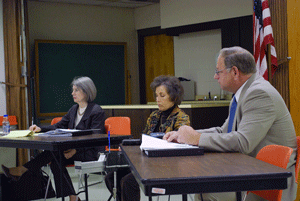
Monica Bohler was the referee for the hearing. She was appointed in a joint decision by counsel for Biggert, Sam Lillard, and board counsel Jim Hughes. She has 10 days from the the last day of the hearing (Dec. 9) to issue her finding of fact and report. At that time, the Board of DD will decide to accept or not accept the report. If an agreement cannot ultimately be reached, the matter could proceed to the Highland County Court of Common Pleas.
The board voted in October to terminate Biggert's contract, citing allegations of intimidation and bullying of employees and county-elected officials and a style of management that “lacked character” and “lacked integrity.” The decision to terminate his contract was based on approximately 12 charges [non-legal infractions against rules of conduct and the board's code of ethics]. Biggert said that he was never given the opportunity to defend against the allegations.
Biggert testified last week that he if had been given an opportunity to address the allegations he would have been able to refute "every one of them."
Biggert testified that he through his work at the board, the organization was able to receive a five-year accreditation through the state, which is a "milestone achievement" that reflects work above and beyond what is expected; that he was able to make cuts while keeping services and that the organization "soon will have $2 million in reserve for future years," and that "only a few" boards of DD in the state, "have the resources Highland County has right now."
However, the cuts he made included the "abolishing" of some positions, and instituting a 5-percent pay cut for some employees, which was not a popular decision among some employees, he said.
Under cross-examination by the board's attorney Jim Hughes, Biggert said that he believed that there were several people in Highland County that had a "vendetta" against him, including Highland County Commissioner Tom Horst, and current and former Board of DD members Sam Snyder and Gary Boatman, respectively.
Biggert also admitted to contacting the employers of board members, but denied that he was attempting cause them harm in their personal lives.
Hughes said that Biggert did not disclose that he had been terminated by a previous board of DD before he was offered the job in Highland County.
Biggert had entered into evidence his resumé, which stated that he had been the superintendent of the Williams County Board of Developmental Disabilities. The board entered Biggert's application to the Highland County Board of DD into evidence. The application asks his reason for leaving Williams County. Biggert wrote "see resumé" on the application. Biggert testified that the resumé did not state his reason for leaving, but that the resumé in evidence might have been an updated one where the reason for leaving was eliminated.
Lillard objected several times regarding the questioning on the resumé and application, saying that it was not a matter listed in the allegations that that it "appears to be a desperate attempt of the board to now manufacture some anomaly about his application back in 2008. It has never been addressed, ever."
Bohler overruled the objection and said, "You are correct, but Mr. Hughes is entitled to impeach the witness."
Hughes asked, "Mr. Biggert, you were terminated from your position as the superintendent of the Williams County Board of Developmental Disabilities, is that correct?"
Biggert said, "That is not correct."
"You would disagree that on Dec. 26, 2006 that the Williams County Board of Developmental Disabilities terminated you?" Hughes asked.
Biggert said, "I would disagree because of the continued issue with this, they did not fire me. I resigned per agreement with the board."
Hughes submitted into evidence the minutes from a special session of the Williams County Board of DD dated Dec. 26, 2006, which stated, "As a result of executive session (the board president) asked for a motion to terminate the employment of Superintendent Biggert effective Dec. 31, 2006."
After reading that portion of the minutes aloud, Hughes asked, "The Williams County Board ... terminated your employment?"
"I'll say correct," Biggert said.
Hughes asked about a settlement "later that year" in which there was an agreement, and if the board withdrew the termination. Biggert said that was correct.
"You never disclosed to the Highland County Board of DD at any time, prior to their offering you employment, that you were terminated by the Williams County Board of DD, did you?"
Biggert said that he had disclosed it, to then-president of the board Dennis Butler, and administrative assistant Sherry Morrison.
On direct examination from Lillard, Biggert testified that he had received evaluations from that board that were "very good," and that based on his performance the board had no cause to terminate him. Lillard had said they were "exemplary" evaluations, and that Biggert received an average of 3.5 out of 5.0.
Biggert testified that he had "no idea" why he was being terminated, except "for the amount of PR the board was receiving."
When Hughes questioned Biggert on the evaluations, he used a blackboard to write out scores of two sections. For years 2008, 2009 and 2010, Biggert received respective scores in personnel development of 3.85, 3.16 and 2.88. In the category community/agency relations, he received a 3.0, 3.9 and 2.66 for those respective years. The board did not evaluate him in 2011.
Hughes said that the scores showed that over the course of three years Biggert's performance was declining in those area.
"It is your testimony that your performance evaluations were very good?" Hughes asked, and Biggert said, "Overall, they were very good."
On redirect examination, Lillard questioned Biggert on other scores he had received on the evaluation, which were more than 4.0 in some categories.
Hughes questioned Biggert on a police report that was filed against him in May after he allegedly sent a text message to Robert Morrison, the husband of former employee Sherry Morrison, following an argument. According to the report, the text message contained the phrase, "You will get what you deserve." No charges were filed in the matter, but the police report indicated that the Morrisons believed the text message was a threat.
Biggert testified that he and Robert Morrison had argued earlier in the day and that harsh words were said. In saying that Morrison would get what he deserved, Biggert said that he meant Morrison would no longer be invited on a golf outing Biggert had planned.
Biggert had testified that he had terminated Sherry Morrison's employment with the board around March 2011, and that it was approved by the board.
While he was superintendent, Biggert testified, he chose to change health care brokers from local agent Doug Wagoner - who had worked with the board for eight years - to another broker. Biggert testified that he did that after complications arose with health care deductibles and there was dissatisfaction from some employees.
Wagoner, Biggert testified, was a "longtime family friend" with current Board of DD member Sam Snyder, and that Snyder is a "close friend of Commissioner Tom Horst."
"With it being such a small county, a lot of people are longtime friends, even related. So it becomes very difficult if you're doing something that needs to be done because you could upset someone," Biggert said.
During questioning from Hughes, Biggert said that he felt they had vendettas against him, along with former Board of DD member Gary Boatman.
Hughes asked, "You felt that Gary Boatman had a personal vendetta against you, didn't you?"
"That's correct," Biggert said.
Hughes asked, "And you told the board (in an email sent May 25) that you felt that Sam Snyder had a vendetta against you?"
"That's correct," Biggert said.
Hughes asked, "You felt that Tom Horst had a personal vendetta against you, didn't you?"
"That is correct," Biggert said.
Biggert testified that prior to a June board meeting, when the Board of DD was scheduled to discuss Biggert's employment, that he called the employer of then-board member Gary Boatman.
Boatman later resigned from the board. Under questioning from Hughes, Biggert said that prior to the June meeting he became concerned over paperwork issues that he felt would make Snyder ineligible from serving on the board. Snyder was subsequently removed and not permitted to vote at the June meeting. Snyder was later reappointed to the board. Biggert also testified that he had asked questions regarding the residency of Karen Adams prior to her being sworn in to serve on the board in June. Biggert later said that he felt Adams was a very good board member.
Previously in the hearing, Chuck Emery, the president of the board of trustees for SATH (Supplementary Assistance to the Handicapped, which employs Board of DD president Linda Allen) testified that Biggert had contacted him regarding alleged actions Allen had taken as a board member regarding a VRP3 grant.
Biggert testified that SATH and the Board of DD serve the same clients (people with disabilities) and that he felt Allen was part of why the grant had not been approved. Biggert said that he called Emery out of concern for their shared clients and that it was "not at all" an attempt to "strong-arm" Allen.
Earlier in the hearing, Lillard had called David Reichert, the Southwest Region Employment Manager at Cuyahoga County Board of DD, to testify. He stated during that testimony that no VRP3 grant projects went forward in the state in the time period Highland County was applying, due to a new administration coming in.
Hughes had asked Reichert, "So if a representation was made that it was approved, that would be incorrect?" and Reichert said that would be correct.
Hughes later asked Biggert why it was represented on his resumé that he had helped secure the grant. Biggert said that he and Hughes were using "two different criteria" to define grant approval, and that he felt the grant application had been successful because it had not been denied and he was continuing to work with the granting agency on improving the project.
When Biggert's testimony was concluded, Allen was called as a rebuttal witness by Hughes. She said that the board had made it very clear to Biggert for more than a year that they were displeased with some aspects of his performance, particularly when it came to interacting with the community and with employees. Allen said the board had given Biggert a deliberate instruction to not terminate Sherry Morrison, and after he did some board member expressed that they were not happy with that decision.
Allen testified that on multiple occasions over the summer, and up to the day Biggert was terminated, they had offered to pay him the remainder of his contract - which ends Dec. 31, 2011 - if he would resign.
Allen said that on several occasions she had praised Biggert's work, especially in the area of finances.
Biggert had testified that while he had encouraged board employees to share certain success with the board members, he advised them against sharing concerns or issuing complaints directly to the board. Allen testified that this upset board members because they felt they could not communicate with the employees. Biggert said that he advised employees that if they had a complaint about him that they should follow the chain of command, which meant the complaint would be given to him and that he would pass it on to the board.
When testimony concluded, Bohler ruled that Lillard and Hughes could submit their closing statements in writing, and that they were due Monday, Dec. 12. Hughes would be given the opportunity to respond to Lillard's closing, and that response was to be given to Bohler by Tuesday, Dec. 13.[[In-content Ad]]
The former Superintendent, Chuck Biggert, testified that he was surprised and caught off guard when the board voted earlier this year to not renew his contract, and ultimately terminated his employment. The only explanation he said he received was that the board wanted to go "in a different direction" and to avoid "bad PR."
However, the board president testified that repeated warnings had been issued regarding his management style, alleged disregard of board directives, and that on multiple occasions they offered to give him six months pay if he would resign on his own.
Two days of hearings were held Dec. 8-9 at Biggert's request, as he claims that he was wrongfully terminated and not given an opportunity to defend himself against the allegations on which the board made its decision to terminate his contract.
Monica Bohler was the referee for the hearing. She was appointed in a joint decision by counsel for Biggert, Sam Lillard, and board counsel Jim Hughes. She has 10 days from the the last day of the hearing (Dec. 9) to issue her finding of fact and report. At that time, the Board of DD will decide to accept or not accept the report. If an agreement cannot ultimately be reached, the matter could proceed to the Highland County Court of Common Pleas.
The board voted in October to terminate Biggert's contract, citing allegations of intimidation and bullying of employees and county-elected officials and a style of management that “lacked character” and “lacked integrity.” The decision to terminate his contract was based on approximately 12 charges [non-legal infractions against rules of conduct and the board's code of ethics]. Biggert said that he was never given the opportunity to defend against the allegations.
Biggert testified last week that he if had been given an opportunity to address the allegations he would have been able to refute "every one of them."
Biggert testified that he through his work at the board, the organization was able to receive a five-year accreditation through the state, which is a "milestone achievement" that reflects work above and beyond what is expected; that he was able to make cuts while keeping services and that the organization "soon will have $2 million in reserve for future years," and that "only a few" boards of DD in the state, "have the resources Highland County has right now."
However, the cuts he made included the "abolishing" of some positions, and instituting a 5-percent pay cut for some employees, which was not a popular decision among some employees, he said.
Under cross-examination by the board's attorney Jim Hughes, Biggert said that he believed that there were several people in Highland County that had a "vendetta" against him, including Highland County Commissioner Tom Horst, and current and former Board of DD members Sam Snyder and Gary Boatman, respectively.
Biggert also admitted to contacting the employers of board members, but denied that he was attempting cause them harm in their personal lives.
Hughes said that Biggert did not disclose that he had been terminated by a previous board of DD before he was offered the job in Highland County.
Biggert had entered into evidence his resumé, which stated that he had been the superintendent of the Williams County Board of Developmental Disabilities. The board entered Biggert's application to the Highland County Board of DD into evidence. The application asks his reason for leaving Williams County. Biggert wrote "see resumé" on the application. Biggert testified that the resumé did not state his reason for leaving, but that the resumé in evidence might have been an updated one where the reason for leaving was eliminated.
Lillard objected several times regarding the questioning on the resumé and application, saying that it was not a matter listed in the allegations that that it "appears to be a desperate attempt of the board to now manufacture some anomaly about his application back in 2008. It has never been addressed, ever."
Bohler overruled the objection and said, "You are correct, but Mr. Hughes is entitled to impeach the witness."
Hughes asked, "Mr. Biggert, you were terminated from your position as the superintendent of the Williams County Board of Developmental Disabilities, is that correct?"
Biggert said, "That is not correct."
"You would disagree that on Dec. 26, 2006 that the Williams County Board of Developmental Disabilities terminated you?" Hughes asked.
Biggert said, "I would disagree because of the continued issue with this, they did not fire me. I resigned per agreement with the board."
Hughes submitted into evidence the minutes from a special session of the Williams County Board of DD dated Dec. 26, 2006, which stated, "As a result of executive session (the board president) asked for a motion to terminate the employment of Superintendent Biggert effective Dec. 31, 2006."
After reading that portion of the minutes aloud, Hughes asked, "The Williams County Board ... terminated your employment?"
"I'll say correct," Biggert said.
Hughes asked about a settlement "later that year" in which there was an agreement, and if the board withdrew the termination. Biggert said that was correct.
"You never disclosed to the Highland County Board of DD at any time, prior to their offering you employment, that you were terminated by the Williams County Board of DD, did you?"
Biggert said that he had disclosed it, to then-president of the board Dennis Butler, and administrative assistant Sherry Morrison.
On direct examination from Lillard, Biggert testified that he had received evaluations from that board that were "very good," and that based on his performance the board had no cause to terminate him. Lillard had said they were "exemplary" evaluations, and that Biggert received an average of 3.5 out of 5.0.
Biggert testified that he had "no idea" why he was being terminated, except "for the amount of PR the board was receiving."
When Hughes questioned Biggert on the evaluations, he used a blackboard to write out scores of two sections. For years 2008, 2009 and 2010, Biggert received respective scores in personnel development of 3.85, 3.16 and 2.88. In the category community/agency relations, he received a 3.0, 3.9 and 2.66 for those respective years. The board did not evaluate him in 2011.
Hughes said that the scores showed that over the course of three years Biggert's performance was declining in those area.
"It is your testimony that your performance evaluations were very good?" Hughes asked, and Biggert said, "Overall, they were very good."
On redirect examination, Lillard questioned Biggert on other scores he had received on the evaluation, which were more than 4.0 in some categories.
Hughes questioned Biggert on a police report that was filed against him in May after he allegedly sent a text message to Robert Morrison, the husband of former employee Sherry Morrison, following an argument. According to the report, the text message contained the phrase, "You will get what you deserve." No charges were filed in the matter, but the police report indicated that the Morrisons believed the text message was a threat.
Biggert testified that he and Robert Morrison had argued earlier in the day and that harsh words were said. In saying that Morrison would get what he deserved, Biggert said that he meant Morrison would no longer be invited on a golf outing Biggert had planned.
Biggert had testified that he had terminated Sherry Morrison's employment with the board around March 2011, and that it was approved by the board.
While he was superintendent, Biggert testified, he chose to change health care brokers from local agent Doug Wagoner - who had worked with the board for eight years - to another broker. Biggert testified that he did that after complications arose with health care deductibles and there was dissatisfaction from some employees.
Wagoner, Biggert testified, was a "longtime family friend" with current Board of DD member Sam Snyder, and that Snyder is a "close friend of Commissioner Tom Horst."
"With it being such a small county, a lot of people are longtime friends, even related. So it becomes very difficult if you're doing something that needs to be done because you could upset someone," Biggert said.
During questioning from Hughes, Biggert said that he felt they had vendettas against him, along with former Board of DD member Gary Boatman.
Hughes asked, "You felt that Gary Boatman had a personal vendetta against you, didn't you?"
"That's correct," Biggert said.
Hughes asked, "And you told the board (in an email sent May 25) that you felt that Sam Snyder had a vendetta against you?"
"That's correct," Biggert said.
Hughes asked, "You felt that Tom Horst had a personal vendetta against you, didn't you?"
"That is correct," Biggert said.
Biggert testified that prior to a June board meeting, when the Board of DD was scheduled to discuss Biggert's employment, that he called the employer of then-board member Gary Boatman.
Boatman later resigned from the board. Under questioning from Hughes, Biggert said that prior to the June meeting he became concerned over paperwork issues that he felt would make Snyder ineligible from serving on the board. Snyder was subsequently removed and not permitted to vote at the June meeting. Snyder was later reappointed to the board. Biggert also testified that he had asked questions regarding the residency of Karen Adams prior to her being sworn in to serve on the board in June. Biggert later said that he felt Adams was a very good board member.
Previously in the hearing, Chuck Emery, the president of the board of trustees for SATH (Supplementary Assistance to the Handicapped, which employs Board of DD president Linda Allen) testified that Biggert had contacted him regarding alleged actions Allen had taken as a board member regarding a VRP3 grant.
Biggert testified that SATH and the Board of DD serve the same clients (people with disabilities) and that he felt Allen was part of why the grant had not been approved. Biggert said that he called Emery out of concern for their shared clients and that it was "not at all" an attempt to "strong-arm" Allen.
Earlier in the hearing, Lillard had called David Reichert, the Southwest Region Employment Manager at Cuyahoga County Board of DD, to testify. He stated during that testimony that no VRP3 grant projects went forward in the state in the time period Highland County was applying, due to a new administration coming in.
Hughes had asked Reichert, "So if a representation was made that it was approved, that would be incorrect?" and Reichert said that would be correct.
Hughes later asked Biggert why it was represented on his resumé that he had helped secure the grant. Biggert said that he and Hughes were using "two different criteria" to define grant approval, and that he felt the grant application had been successful because it had not been denied and he was continuing to work with the granting agency on improving the project.
When Biggert's testimony was concluded, Allen was called as a rebuttal witness by Hughes. She said that the board had made it very clear to Biggert for more than a year that they were displeased with some aspects of his performance, particularly when it came to interacting with the community and with employees. Allen said the board had given Biggert a deliberate instruction to not terminate Sherry Morrison, and after he did some board member expressed that they were not happy with that decision.
Allen testified that on multiple occasions over the summer, and up to the day Biggert was terminated, they had offered to pay him the remainder of his contract - which ends Dec. 31, 2011 - if he would resign.
Allen said that on several occasions she had praised Biggert's work, especially in the area of finances.
Biggert had testified that while he had encouraged board employees to share certain success with the board members, he advised them against sharing concerns or issuing complaints directly to the board. Allen testified that this upset board members because they felt they could not communicate with the employees. Biggert said that he advised employees that if they had a complaint about him that they should follow the chain of command, which meant the complaint would be given to him and that he would pass it on to the board.
When testimony concluded, Bohler ruled that Lillard and Hughes could submit their closing statements in writing, and that they were due Monday, Dec. 12. Hughes would be given the opportunity to respond to Lillard's closing, and that response was to be given to Bohler by Tuesday, Dec. 13.[[In-content Ad]]