


Hillsboro man found guilty of 3 counts of rape; sentenced to life in prison without parole
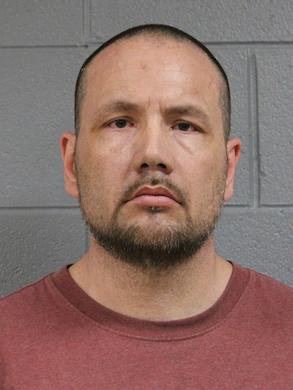
James Gragg. (Highland County Sheriff's Office mugshot)
A Hillsboro man was sentenced to life in prison without parole Thursday evening after a jury seated in Highland County Common Pleas Court found him guilty of three first-degree felony counts of rape.
As previously reported, James Gragg, 44, was indicted by a Highland County grand jury in May. For all three counts, Gragg was accused of “engaging in sexual conduct” with a victim under the age of 13. Each count was for a separate approximate one-year time span where the incident(s) are alleged to have occurred.
After a jury was seated Thursday morning around 10:30 a.m., testimony took place throughout the late morning and afternoon, and the jury began deliberations around 4 p.m. By 4:36 p.m., the jury had reached the verdict finding Gragg guilty of all charges.
“If you’re not an example for life sentence without parole for a sex offender, I don’t know who would be,” Highland County Common Pleas Court Judge Rocky Coss told Gragg.
During her opening statements, Highland County Prosecutor Anneka Collins told the jury that the case involved a child victim, whom she said Gragg raped “many times over the course of the past four years,” beginning in 2022 when the victim was around the age of 8.
“[The victim] kept the secret because the defendant made sure that [the victim] wouldn't tell, but evil always has a way of showing itself,” Collins said.
Collins said that the victim eventually revealed the abuse after “acting out and interacting with things well above [the victim’s] age” earlier this year. When questioned, the victim “broke down and cried” and disclosed the situation to a friend of the victim’s mother, after which a law enforcement investigation began. That included a forensic interview at Cincinnati Children’s Hospital, where the victim “disclosed the sexual abuse that had been going on,” and a medical exam, where the child was diagnosed with two sexually transmitted infections.
Defense attorney Kathryn Hapner told the jury to remember the state’s burden “to prove each and every element of every offense beyond a reasonable doubt.
“As odd as it may sound, sometimes just because something seems logical doesn't necessarily mean that it is correct, so I ask you to also keep that in mind as we go through the case, as you go through your deliberations,” Hapner said.
The first witness called by the state was the victim, who testified about “downloading inappropriate apps that I was not supposed to” earlier this year. When the friend of the victim’s mom asked the victim about acting out, the victim testified about telling the friend that Gragg had “been touching me.”
The victim testified that the abuse began with Gragg “putting his hands down my pants.” After the victim talked about being in second grade, Collins asked if the victim remembered sexual abuse occurring around that time, and the victim said it occurred in Gragg’s bedroom and that “it hurt.”
“Is that the only time that he’s ever touched you?” Collins asked.
“No,” the victim said.
“Were there lots of times or not lots of times?” Collins asked.
“Lots of times,” the victim said.
Collins asked the victim if Gragg “touched you when you were in the third grade,” and the victim said “yes” and described Gragg “putting his fingers” in the victim’s genitals again.
“Was there a time that the defendant used something other than his fingers to touch you down there?” Collins asked.
“Yes,” the victim said. “His boy part. He tried to put it in me.”
The victim testified about experiencing body changes after that.
“Why didn't you tell anyone that this was happening until [the mom’s friend] asked you?” Collins asked.
“Because I’ve said too many lies, and I thought no one would believe me,” the victim said, later adding that Gragg threatened that the victim would not be allowed to see the victim’s puppy if the abuse was disclosed.
The second witness called was the victim’s mother, who testified about the victim getting on “an AI app” to “talk dirty” earlier this year before the victim disclosed that Gragg had “been messing with” and “touching” the victim. The victim’s mother also testified that the victim had to go on antibiotics after being diagnosed with STIs.
The third witness was a former girlfriend of Gragg, who testified about testing positive for a sexually transmitted infection a month before the victim disclosed the abuse.
After the jury was dismissed for a lunch break, the state called their expert witness, Stephanie Helton, who is a forensic interviewer at the Mayerson Center at Cincinnati Children’s. Helton discussed her qualifications and the forensic interview process before the state played a portion of the interview.
After the interview, Helton said that she referred the victim for a medical exam, where the STI diagnoses were discovered. She also testified that the victim had “concerning” results on a “trauma symptom checklist for children.
“It asks different questions, and it essentially helps to determine how much traumatic experiences have impacted a child's behavioral health and their mental health,” Helton said. “I take that paper from the child or from the caregiver, whoever completes it, and then I score it.
“It can be either negative, positive, or concerning results. That helps to guide me in my mental health recommendations for the child.”
Collins asked what the victim’s score was, and Helton testified that it was 24 out of a possible 44, “which is considered concerning” and led to Helton recommending a mental health referral for the child.
Helton also testified that “kids don’t often disclose everything all at one time right away.
“In my experience, it's more common for kids to disclose at a later time and little by little,” Helton said.
“So the fact that [the victim] said to you ‘he didn't put his boy part in,’ if [the victim] now is saying yes, he did, would that surprise you?” Collins asked.
“No, it would not,” Helton said.
Under cross examination by co-counsel Danielle Whitt, Helton testified that the victim spoke about being “told to not tell” but was unclear about what the consequences, if any, would be.
The fifth witness called by the state was Dr. John Terpstra, who testified about a medical examination of Gragg, whom he said tested positive for a sexually transmitted infection in April. In response to questions from Collins, Terpstra said that antibiotics could be used to clear up the infection that both the victim and Gragg’s former girlfriend were diagnosed with, but not the infection for which Gragg and the victim both tested positive.
The sixth and final witness was Lieutenant Vincent Antinore of the Highland County Sheriff’s Office, who investigated the case. He testified that in March, after starting the investigation, the juvenile was taken for the interview at the Mayerson Center.
“Obviously, all of the medical testing and things were not — all those results weren't available immediately — but the very next day, I received a portion of [the victim’s] disclosures where [the victim] disclosed that [the victim] was sexually assaulted and raped by James,” Antinore said. “[The victim] disclosed that they began sometime near the second grade, and then they continued up until pretty recently when [the victim] reached out and asked for our help.”
Antinore said that after receiving the STI diagnosis report for the victim, he executed search warrants for testing on Gragg.
Much like her question to Helton, Collins asked Antinore if it was “uncommon for victims to wait to disclose sexual assault.”
“It's actually the most common way that I get reports is delayed disclosure reports,” Antinore said. “It's very rare that we get a report as it happened or immediately after it happens.”
“And based on your experience, do disclosures start small and then grow as the child becomes more comfortable?” Collins asked.
“Yes,” Antinore said. “It’s not just more comfortable. It's more trusting in the person that they're disclosing to, or the process of the disclosure, the team that's supporting and surrounding them.”
After Antimore’s testimony, the state rested, and Coss denied a Rule 29 motion for acquittal made by Hapner during a break.
The defense presented one witness, Dr. Jeff Beery, who testified that he conducted antibody tests on Gragg after law enforcement asked him to test Gragg for STIs.
“I thought an antibody test would be best because it might show positive even if you've been treated for the infection subsequently,” Beery said.
Beery said that the laboratory results showed that Gragg was negative for STIs. However, he also testified that their specimen box had been damaged during that time frame. As brought out during cross examination, Beery filed a police report regarding the damage and cautioned Antinore about it.
Also during cross examination, Collins pointed out that the report indicated that “the preferred test is swabbing of a penis, and that's the test that Highland District Hospital uses.
“Is that test more preferred because it's more accurate?” Collins asked.
“It's more sensitive,” Beery said. “If a person were infected and they had a swab, it would pick it up 90 percent of the time, whereas this test I did would be 70 to 90 percent, so it'd be as much as 20-percent less sensitive.”
It was also brought out that Beery tested for only one of the two STIs in question. In response to questions from Collins, Beery testified that both STIs can be asymptomatic, while the infection for which Gragg tested negative can be treated with antibiotics that are commonly prescribed for sinus infections.
Collins asked Beery if a child had those two infections, “in your expert opinion, how’d [they] get it?”
“Sexually,” Beery said.
“And you said that those antibodies, the absence of them, may mean that he hasn't had it in the last couple years,” Collins said. “Could it mean he had it three years before that?”
“He could have, yes,” Beery said.
After Beery’s testimony, the defense rested, and Coss then gave his first round of instructions before the jury heard closing arguments.
In her first closing argument, Collins thanked the jury for their “time and attention to this very serious matter” and summarized the testimony.
“All of these people have said the same thing — that this man raped [the victim] repeatedly over the course of four years,” Collins said.
Hapner called the jury’s attention to “several inconsistencies” in the day’s testimony, including that Gragg’s ex-girlfriend “did not testify that she got” an STI from Gragg and “there’s no evidence he’s ever had” that STI.
Hapner also said that there were inconsistencies between the victim’s discussion in the Mayerson Center interview versus the victim’s testimony in court regarding consequences of not being able to see the puppy anymore if the abuse was disclosed or whether Gragg did or did not touch the victim with his penis. She also questioned if it was “logical” that the victim would “continue to go” near Gragg “if this was happening” and pointed out that the victim also spoke about “lying.
“Think about these things and the inconsistencies and the things that just don't make sense about this case,” Hapner said.
In her final closing argument, Collins addressed several of Hapner’s comments, saying that just because Gragg did not have the one STI currently does not mean that he has never had it, as the abuse has been going on for approximately four years. She also called attention to the defense “blaming [the victim] for going back and being sexually assaulted” by asking why the child continued to go near Gragg and pointed out the child had “no benefit to lie” about the abuse or STIs on the witness stand in front of strangers.
Collins continued by recapping the testimony throughout the day and said that although the testimony revealed that Gragg tested negative for one of the STIs, there is “strong circumstantial evidence that this defendant gave both” the victim and his ex-girlfriend the infection.
“The defendant's expert, in his expert opinion, stated that this child got these STIs from sexual intercourse,” Collins said.
Collins told the jury that the defense “wants you to believe that because [the victim] … has now disclosed that [Gragg’s] penis did go in,” that there “are inconsistencies” in the testimony, but she reminded them that both Helton and Antinore testified about “delayed disclosure.
“That is not an inconsistency. It is a child who is making a lifelong disclosure of sexual abuse,” Collins said. “Again, I want to remind you that we're talking about a 12-year-old little [child] talking about the most embarrassing thing in [the victim’s] life. When [the victim] was only 8, [the victim’s] life became truly a hell every weekend.
“James Gragg, this defendant, took away [the victim’s] sense of safety. He used [the victim’s] love for a puppy named Sweet Potato to sexually assault her. He allowed [the victim’s] to believe, ‘no one's going to believe you.’”
Collins then reviewed all of the elements of the offenses and outlined how the state has “proven each element beyond a reasonable doubt.
“Doubt based on reason and common sense has been overcome, and this man is guilty of raping this little [child],” Collins said. “I'm sorry that you that you had to sit through this case. I know it's not easy to listen to, but it's necessary because there is evil in this world, and evil in this room.
“I’m asking that you go into the jury room, read the instructions, review the evidence, remember the actual testimony of the witnesses, and come to the only conclusion that makes sense. Find the defendant guilty of repeatedly raping [the victim] and of his evil actions.”
Roughly 40 minutes after the jury heard final instructions and began deliberations, court resumed with Highland County Clerk of Courts Ike Hodson reading the verdicts finding Gragg guilty of all three counts, with count one including an additional finding that Gragg was 16 years or older at the time of the offense and a specification that the victim was under the age of 10.
After the jury was dismissed, Collins told Coss that “the state is of the opinion that the sentence that is to be administered is life without parole” for count one. She also reminded Coss of a separate jury trial for gross sexual imposition involving Gragg, which the judge said he remembered.
“It's pretty obvious to me that this is the kind of defendant that the life without parole statute is exactly intended to protect the world from,” Collins said. “If he is allowed to be out, he is going to keep doing this. He's not been out of prison very long.
“I would ask the court to impose the maximum sentence against this man, because I have no doubt that if you don't, he'll do this again.”
On behalf of the victim, a sibling spoke and asked for Gragg to “receive the maximum legal punishment.
“[The victim] will have to find a way to cope with what happened to [the victim],” the sibling said. “After [the victim] came forward, [the victim] was terrified to even leave the house or have the front door unlocked, out of fear that the defendant would find out [the victim] told someone about the abuse and come for [the victim]. The fear that [the victim] felt went away upon learning that he had been arrested and could no longer hurt [the victim].
“The mental and emotional burden [the victim] carries is a heavy one, one that me and every single person who loves [the victim] will carry alongside [the victim] forever.”
Hapner asked that Coss consider imposing the “the 10 [years] to life [sentence] that the other counts carry” but not life without parole. Gragg declined to speak.
Coss said that Gragg had “a previous conviction, and now you’ve brutalized” another victim.
“The trauma that you cause is just unimaginable and simply detestable and just cannot be overlooked,” Coss said.
Coss sentenced Gragg to life in prison without parole on count one, consecutive to 10 years to life on count two, consecutive to 10 years to life on count three. Gragg had 119 days of jail time credit. Gragg is also classified as a tier III sex offender, requiring registration every 90 days for life.
“You're a repeat offender, you're victimizing children, and you know, it's clear to the court that you pose a significant risk of committing the same offense again should you ever be free,” Coss said. “Therefore, it's the court's view that the sentence that is being imposed should do everything that's possible under the law to make sure that you're never free to roam the streets of our community — or any other community, for that matter — to put children in danger.
“The sentences are not disproportionate to the seriousness of your conduct. Again, even though it’s one victim, there have been multiple, multiple offenses, and you know, the harm that you caused to [the victim] is mental anguish, and the trauma [the victim] will be dealing with for a long time — if not forever, for the rest of [the victim’s] life — is such that it's necessary for this punishment to be the sentence.”