


Hillsboro City Council reviews sewer rate proposal in special meeting
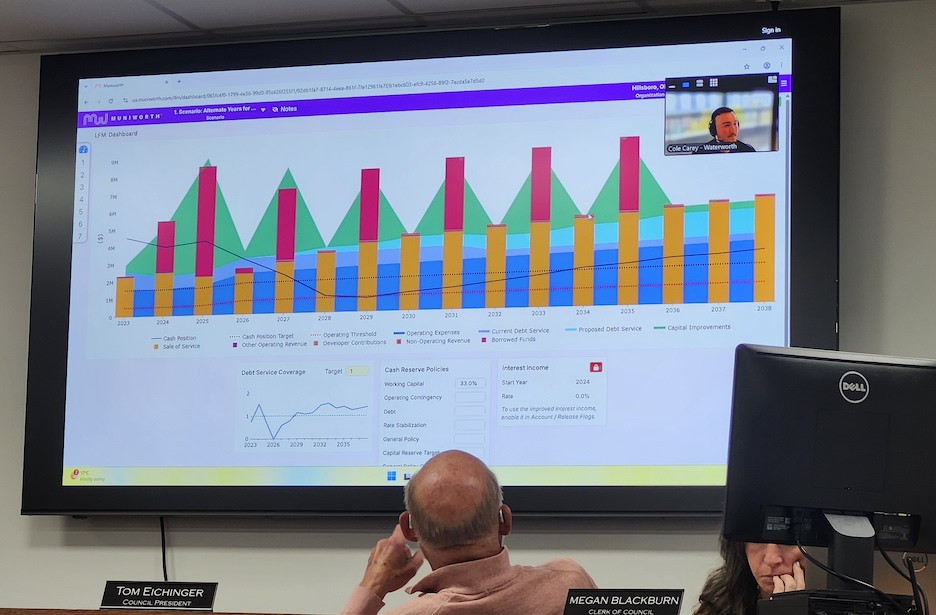
Council president Tom Eichinger reviews figures presented virtually by Cole Carey of Waterworth during council's Sept. 23 special meeting. (HCP Photo/Caitlin Forsha)
Ahead of a scheduled third reading and possible vote on a sewer rate increase in October, Hillsboro City Council members held a special meeting Wednesday, Sept. 23 to further discuss the proposal.
The city is seeking funding for the first of what will be multiple phases of a sanitary sewer project to address the city’s I&I (inflow and infiltration) issues.
As previously reported, at the conclusion of their regular July meeting, council members attended a virtual informational presentation by Waterworth on water and sewer rates. Utilities committee chair Mary Stanforth said her committee met July 23 to further review Waterworth’s study.
The ordinance authorizing an increase to sewer rates was then introduced in August. Council members had previously approved a 10-percent rate increase in May.
If enacted, the new legislation will set the minimum rates as follows (but subject to change based on annual review): $41.02 in 2027, $47.17 in 2028, $52.24 in 2029, $55.90 in 2030 and $58.13 in 2031 and thereafter unless amended by council.
As almost half of council’s regular September meeting involved discussions of the second reading of the ordinance, a special meeting was called to give council members another opportunity to ask questions.
Cole Carey, a client success specialist with Waterworth, reviewed the charts with council members for a third time Wednesday evening. According to the company’s website, “Waterworth gives public works, finance directors, and elected officials a shared financial picture – grounding funding decisions, infrastructure planning, and long-term scenario planning in the same understanding.”
The data analyzed by Waterworth includes the city’s anticipated cash position and cash position target, operating expenses, current and proposed debt service, capital improvements, non-operating revenue, other operating revenue, developer contributions, borrowed funds and operating threshold through 2038. The charts also included the actual data from the past few years, dating back to 2023.
For the operating expenses, Carey said they have applied an “annual three-percent inflationary increase” for 2027-onwards since those costs are currently known. The debt service includes current loans, which gradually lower as those payments end, and proposed debt service, which is expected to “ramp up over time” as the city seeks loans for the sewer project.
Similarly, the capital improvements graph involves the “large I&I projects spaced out every year from ’27 out to 2035,” Carey said.
“We can also see in the later end of the model, in 2036 to 2038, we do have a portion of capital expenses shown in the model as a reinvestment target without any set projects in those years,” Carey added. “You can see those I&I projects adding on to our debt payments, proposed debt and our operating expenses.”
Revenue sources include sewer bills, “some developer contributions that we've had in the past” and the current and possible loans for various projects.
“From here, we can add on and look at our operating threshold,” Carey said. “This is going to be showing four months of operating expenses. In this case, we can see that’s going to again go up based on our actuals to our budgeted amount.
“We can see that over time, once those I&I projects start to occur and we have to take out those loans to cover them, we can see this cash position start to drop as we get into ’27 and ’28, and then with the increases that we have in this proposed solution, we can see that cash position start to rebound from 2029-on.”
As a result, Carey said that 2027 is projected to have “expenses greater than our revenues,” but if the proposed ordinance is enacted, “we can start to see that cash position build back up” in future years.
At council president Tom Eichinger’s request, Carey showed the graph without the proposed legislation taking effect, as well as the graph if the I&I project did not take place at all.
“We still go below by 2030, by 2028,” Eichinger said.
Eichinger then opened the floor to questions, most of which revolved around projected expenses. Council member Cody Mathews asked about the operating expenses in the graph.
“You see going up to 2025, it's pretty stable, and then we get a big jump to ’26, and then there's the three percent expected over that, but that's all based off of the large jump in ’26,” Mathews said. “I’m asking what accounts for that big jump from ’25 to ’26.”
Carey said that the model was based on the city’s 2026 budget and referred the question to city auditor Dawson Barreras for further explanation. Barreras said that the city had to budget for “increased costs to maintain and operate our system,” including making repairs due to “bad weather and flooding” that occurred in 2025.
“We had having to replace a bunch of the starters and a bunch of other electrical components, which we’re talking tens of thousands of dollars,” Barreras said.
Safety and service director Shawn Adkins added that it was $87,000 to make the repairs.
“We knew that we had to replace all these starters and the pumps [in 2026],” Adkins said. “We had to add that in the budget toward the end when we were doing our budget because we knew we were going to have to replace them.
“It happened in 2025. We didn’t have the money. We didn’t know exactly how everything was going to play out.”
Along with the repairs, Barreras pointed out that the city budgeted for a 30-percent increase in utility costs. For example, Adkins said that due to the recent heavy rainfall, the city has “four pumps that’s got 177 hours on it since Sunday.” Wastewater Treatment Plant superintendent Tyler Warnock added that their EQ, or equalization, tank has been “at 98 percent since Sunday.”
“It cuts life expectancy also on those pumps because they're running,” Adkins said. “Not to mention the cost of treating the water that still we have to treat that goes on the effluent. We're spending that much more money on treating rainwater instead of sewer.”
Council member Gary Lewis said that it seems that “rather than just looking to fund and finance the five phases to reduce the I&I,” it appears the proposed increases would go toward “the replacement of other things.
“This fund is growing under this proposal, and it seems like it’s growing significantly,” Lewis said. “It kind of looks a little rich.
“I guess the question would be: are we intending to fund the five phases plus a lot of maintenance?”
Adkins said that there is “other stuff” besides the I&I project included in the projected models, based on wear and tear and the end of the useful life of various parts of the system.
“A Cheryl Lane lift station is my last lift station that is a confined space entry station,” Adkins said. “I actually put that in in 1999. It's due to be replaced. There was a cost that we put in on anticipated expenses with this chart.
“We need another digester. That was also included on this anticipated revenue. We tried to do a five-year anticipated revenue when we [did] this because we know that this stuff's got to be done within so many years.”
Given the 30-percent minimum expected increase in utility costs from 2025 to 2026, Adkins said they also factored that into future years, while they also know that the costs of the I&I project are likely to increase as time goes on.
“Some of that stuff I can't get definite numbers on,” Adkins said. “AEP sent a letter to us saying, guys, when you're doing your budget, they anticipate this 30- to 60-percent increase.
“Right now, when I talk to the engineer, we were basing on doing this in five years. He said, just calculate a $4 million project. If this went out 10 years, these projects are going to be more than $4 million. You know what I'm saying? Look at gas prices. Diesel fuel’s $7 a gallon. Those expenses are going to go up.”
Council member Logan Kelly asked if the “other stuff” Adkins referred to will “help our I&I” or the system itself.
“This is to maintain our system,” Adkins said. “To fix our I&I is our underground utilities.”
In response to a question from Eichinger, Carey clarified that the graph has the lift station and digester included in the 2027 figures at an overall cost of $950,000, with $4 million budgeted for the I&I project.
“A big concern for me is since this has started, it's been that we had to do these increases, that's all it's going to do is take care of the I&I,” Kelly said. “That wasn't including any extra projects. Tonight, this is the first time hearing there's extra projects put into these numbers, for the increases they are. That’s just concerning.”
“We have to do a five-year capital improvement budget, and that was part of this,” Adkins said. “I honestly didn't even think about it. The biggest issue is the I&I, and the biggest cost is the $4 million, just for one I&I project.”
Later in the meeting, Adkins also said that the budgeted expenses include a program to replace outdated basement drains for residents at no cost to the property owners.
“Part of our increase also — it’s not capital improvements, but we have been budgeting every year $75,000 to replace basement drains with sump pumps and getting basement drains out of our system, so it doesn't cost the homeowners,” Adkins said. “We’ve been paying for that, so that's something we've been trying to give back.
“We've not had a lot of participation, but we are trying to give back to the citizens that's paying these bills out of our sewer fund, and we have been for several years.”
Mathews asked what is involved with operating expenses for the department, and Carey said it would include “salaries, overtime wages, utilities, fuel, diesel, anything like that,” as well as chemicals, as Adkins said.
“We had a pretty expensive year in ’26,” Mathews said. “You knew you had some things that needed taken care of, so council approves it.
“My question is, why do we assume that ’27 will also be as expensive as ’26, and so we’re using 26 and doing a three-percent baseline?”
Mathews suggested basing the graph off of 2023-2025 numbers instead of 2026. Carey said while they “could show that,” but they would have to justify what expenses are going to be lowered in future years.
“If we're going to reduce some of the expenses for, say, starting in ’27, it would just be determining which of those expenses should be brought back down,” Carey said. “Utilities or fuel, diesel, chemicals — if those are still going to maintain that higher increase, like I believe Shawn was saying, that there's going to be a 30-percent increase on electricity — we'll want to maintain those higher amounts to project that three-percent inflation on top of that for ’27 onwards.”
Adkins confirmed that operating expenses for 2027 “will be higher” and reflected as such in next year’s budget.
Mathews said he “sees the need for all” of the improvements, but “it seems like we're throwing a lot into one basket and trying to fund it through rate increases.
“I'm trying to think about ratepayers as well,” Mathews said. “Right now, we're trying to replace 100 percent of this sewer infrastructure.”
“That’s not true,” Adkins said. “Not even close to being true.”
“Still a very ambitious amount,” Mathews said.
“Not really,” Adkins said. “It's not that much.
“We have over 50 miles of water main and 50 miles of sewer main in the system that we take care of. Probably 95 to 98 percent of this was put in in WPA days and not been touched. Council froze rates 10 years ago. If council hadn't frozen the rates and we still had our three-percent rate increases, we would not be asking for this kind of money.”
Prior to the May vote to approve a 10-percent increase, rates had not increased since 2016. After council voted to place a moratorium on water and sewer rates for several months in a row to end the year in 2016, council voted in January 2017 to repeal legislation providing for automatic increases in water and sewer rates.
Mathews suggested that the city should “be a little more cautious before we try to go about all this in maybe the window, the time frame, that we're trying to do it in.”
“In the 10 years?” Adkins said.
“We were over design in 2025,” Warnock added. “Our average daily in 2025 was 1.5-some million [gallons]. Our average design is 1.5 million, and I'll be honest, the only reason why the EPA hasn't come in and said go build an $8 million EQ tank that we don't need — that we could take that money and spend toward fixing I&I — is because our numbers have done so well. If our numbers were trash, what we are sending to the creek, they would have already come in and told us to go build another EQ tank to hold 2 million gallons during these storm events.”
“Let me see if I can kind of paraphrase that so that I understand it better,” Eichinger said. “What I'm hearing you say is that the EPA comes in and tells us to spend this $8 million for a big tank to hold the overflows, rather than us spending the same $8 million on fixing the pipes that are leaking — that's the trade-off we're talking about.”
Adkins pointed out that Lewis, who was city auditor then, would remember the last time the EPA got involved. Lewis said that it happened “over a period of time” where the EPA gradually went from suggesting to enforcing action and they “had to do our expansion.”
“What did it accomplish?” Adkins asked.
“Virtually nothing,” Lewis said. “I wish we had that money that we had spent, and had that before we did that expansion, and actually applied that toward remedying our I&I issues. It would have done far greater work.
“I mean, there's no denying that the work needs to be done. No ifs, ands, or buts about it. I think what is the issue as far as paying for it, obviously, and who pays for that? That's the consumers, so that's where probably the issue lies, but there's no denying that the work needs to be done.”
Adkins said thee city has “replaced quite a bit of sewer mains,” but they are “not replacing them as fast as they are deteriorating.
“I mean, they're already 100 years old,” Adkins said. “They're concrete or clay.
“If we spread it out much further, what's not a critical thing right now is leaking, but I'm trying to do the worst five areas right now. In 20 years, there's probably going to be at least five or six even worse areas than what we've got right now. It's going to be an ever-going thing until we've got them replaced.”
“You’ve just got to think of it as like paving streets,” Lewis added. “You always have to go back and do it again.”
Adkins also reiterated that the figures in the Waterworth graphs are based on “worst case scenarios,” while the proposed pay rate ordinance also requires council to review the rates each year to determine whether increases are even necessary.
“Every year we're going to relook at this,” Adkins said. “We show our lenders and our grant people that we have avenues to afford to do this. Say we get a $4 million grant this first year, where we went to the 20-percent increase on this first one. Say we don't need a 15% increase. We're going to drop it back. We're going to look at this every year.”
If council approves the legislation, the ordinance stipulates that the matter is to be reviewed by July 31 each calendar year, with the utilities committee making any necessary recommendations.