


Ohio senator wants to put constitutional amendment on 2026 ballot to increase state lawmakers
By Megan Henry
Ohio Capital Journal
A Republican Ohio senator wants to increase the number of Ohio lawmakers.
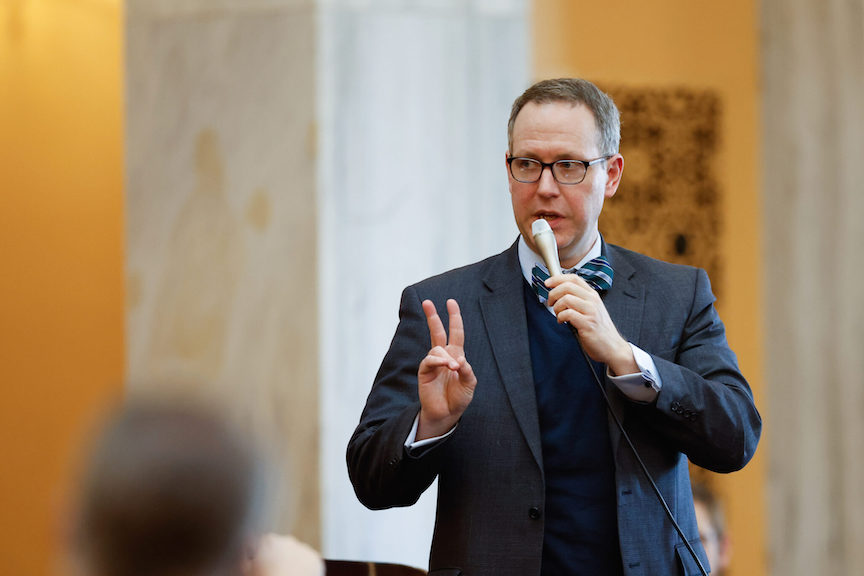
Ohio state Sen. Bill Blessing, R-Colerain Township, introduced Senate Joint Resolution 1, which would put a constitutional amendment on the November 2026 ballot to up the members of the House of Representative from 99 to 153 and increase members of the Senate from 33 to 51. The changes would be implemented starting Jan. 1, 2033.
“As of the last Census, the size of these districts in terms of population are roughly 358,000 and 119,000, respectively,” Blessing said Tuesday to the Senate General Government Committee during his sponsor testimony. “Smaller districts more firmly anchor legislators to their districts. They would represent fewer communities and constituents, and could devote more time to them.”
Legislative redistricting next occurs in 2031.
“Should SJR 1 be put on the ballot and passed, I strongly believe that the proportion of Republicans to Democrats would more closely approach proportional representation through no other means than mathematics,” Blessing said.
Seventeen senators’ four-year terms are set to begin in 2031 and 16 senators’ four-year terms are scheduled to begin in 2033. The proposal would keep the Senate’s term limit the same at four years in the long run. In order for that to happen, 34 senators would be up for election in 2032 with eight of them for a two-year term.
“However, this is only temporary and will not count against their term limits,” Blessing said.
State Sen. Willis E. Blackshear Jr., D-Dayton, asked about how much increasing lawmaker membership would cost the legislature.
“We have a $100 billion budget in this state,” Blessing said. “There is, in my opinion, no way that this would be more than low tens of millions of costs.”
Blackshear also asked if the legislature would be more or less efficient in passing legislation?
“I do think to some degree, it is going to be more difficult on leadership trying to herd the cats together,” Blessing said. “But in the end, hopefully you have more eyeballs on things. You have more subject matter experts.”
Ohio, the seventh most populous state, has the fourth largest population state senate seats and sixth largest population state representative seats, Blessing said.
“The average for all states is 161,000 and 61,000, respectively,” he said. “SJR 1, if it were law today, would mean Senate and House district sizes of roughly 232,000 and 77,000, respectively.”
* * *
••• Publisher's note: A free press is critical to having well-informed voters and citizens. While some news organizations opt for paid websites or costly paywalls, The Highland County Press has maintained a free newspaper and website for the last 25 years for our community. If you would like to contribute to this service, it would be greatly appreciated. Donations may be made to: The Highland County Press, P.O. Box 849, Hillsboro, Ohio 45133. Please include "for website" on the memo line.