


MARCS radio security update, Rocky Fork WWTP improvements, energy contracts on commissioners' agenda
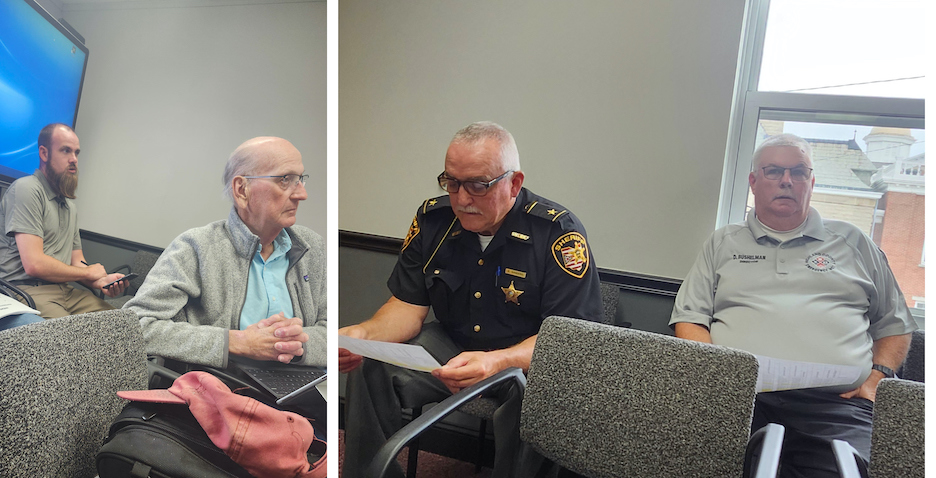
From left, pictured are Justin Mason and Steve Canter of Environmental Engineering Service, Highland County Sheriff Randy Sanders and Highland County EMA Director David Bushelman. (HCP Photos/Caitlin Forsha)
Major projects and their financial implications were common themes of a nearly two-hour commission meeting Wednesday, June 26, as Highland County commissioners David Daniels, Brad Roades and Terry Britton reviewed numbers involving MARCS radio and wastewater treatment plant upgrades and began energy contract discussions.
As discussed in October, EMA Director David Bushelman said that all Multi-Agency Radio Communications System (MARCS) radios will be required to have Link Layer Authentication (LLA) upgrades by July 1, 2025.
Bushelman and Sheriff Randy Sanders were present for the discussion Wednesday, with Bushelman providing a breakdown of cost estimates for the radio upgrades and/or replacements.
According to Bushelman’s handout, the county “is responsible for” the Highland County Sheriff’s Office, EMA, Dog Warden, Engineer, Common Pleas Court, Juvenile Court and Municipal Court radios, out of the 20 total agencies that are impacted across the county. The total cost on the county’s side is estimated to be approximately $282,950, while counting other municipalities, it will be around $637,600 altogether.
However, Bushelman said the EMA Board has already authorized him to spend the $40,550 needed to cover his agency’s radios (one upgrade and 10 replacements) out of their budget, so that can be taken from the county’s remaining total. (In March, commissioners had asked Bushelman for feedback on using a carryover in his department to put toward the MARCS expenses, and he said he would talk to his board.)
“I thought we were going to do all the upgrades,” Britton said.
“To my knowledge, nothing had ever been fully decided,” Bushelman said.
Britton pointed out that for the cost of replacing EMA’s 10 radios ($40,000), they could cover the cost of the Highland County Sheriff’s Office upgrades (44 radios, $24,200).
“I know that everything's got to be done, but you know, it looks like that that would be more beneficial to do that first,” Britton said.
“It's all got to be done, and we're on a timeline now,” Bushelman said.
As mentioned, the deadline for the upgrade is a year away, on July 1, 2025. According to the Ohio Department of Public Safety website, as of that date, “MARCS will be implementing new dual layered security as part of a statewide security effort. Radios without the security update will cease operating on this date.”
“I was at a meeting last week in Warren County,” Bushelman said. “MARCS was there. The July date is a hard date, and nobody sees any money coming from the state. The topic of grants came up, and nobody knows of any grants that this will fit and meet the timetable to get it done.”
Sanders said that he believed the HCSO may have “a substantial amount” they could contribute to the upgrade, using Targeted Community Alternatives to Prison (TCAP) funding. According to the county’s ARPA funding coordinator, Nicole Oberrecht, there is $145,000 available, with Sanders saying they needed approximately $12,000 of that for another project.
Daniels pointed out that combined with the EMA commitment, that would give the county roughly $180,000 to put toward the radio upgrades, while the Sheriff’s Office will receive additional TCAP funding in July 2025 that could potentially be used.
When Oberrecht and Bushelman objected that the next round of TCAP funding would be “too late,” Daniels said that “there’s no way” the state will stick to the “drop dead date” of July 1, 2025.
“They’re not going to be able to get radios,” Daniels said. “If they do, I mean, good, but we're going to have to buy them anyway. I'm looking for the long-term funding solution. We would be able to put money in the budget that could be reimbursed back into the general fund from that.”
Oberrecht agreed that they could, but said that’s assuming the sheriff is willing to dedicate another round of funding to the project.
“If he doesn't want to do that, my quick math here is we've got a $117,000 shortfall,” Oberrecht said.
Daniels asked Oberrecht, Bushelman and Sanders to work together to determine how much money the Sheriff’s Office could commit to the project as well as a plan for how to move forward. “Do we want to stage it? Do we want to make a one-time purchase? What do we want to with the funds that we've got?” Daniels asked.
Roades said that “we all need the EMA, the sheriff and everybody to get together, and whatever money you have to throw into this pot, put it into it,” but Daniels said, “We have to be strategic with how we do it.”
Some of the considerations mentioned were whether the radio companies can meet the demand statewide, whether the county needed to prioritize agencies (namely the HCSO) or types of radios (handheld vs. vehicle) over others first, whether they needed to focus on upgrades or replacements first and the timing of coordinating with the state. Another issue discussed by Bushelman is that upgrading the existing radios is “somewhat of a logistical nightmare” due to the coordination needed by multiple agencies.
“I see [the state] having trouble meeting that deadline,” Daniels said. “I mean, they can't simply shut off the system for people that haven't been able to get radios to upgrade.
“Maybe I'm looking at this wrong, but I continue to go back and look at changing from analog to digital TV. I mean, that deadline got extended 10 years because we just can't physically do it.”
“I don't necessarily disagree with you, but the information I am getting is what I'm bringing back to you guys,” Bushelman said.
Oberrecht said that she would try to have a recommendation for commissioners at their next meeting.
In unrelated discussion, commissioners met with Environmental Engineering representatives to revise bid specifications for the second phase of their Rocky Fork Lake Wastewater Treatment Plant upgrades.
As previously reported, the first phase of the project was awarded in April 2023 to Doll Layman in the amount of $2,597,700, and work has been ongoing since last year.
According to a handout from the project staff from Environmental Engineering, for the second phase, the total project cost is estimated at $2,210,000. That includes 22 different items totaling $1,980,000, plus $230,000 in contingencies.
However, Justin Mason of Environmental Engineering said that they believed they could reduce the cost by seeking proposals for some of the lower-priced items in the estimate.
“We are in the process of identifying certain components that we want to have as an add alternates,” Mason said. “We’ve also identified a few projects, a few components, that we would actually maybe just pull out completely and just get proposals on and self perform.
“One of those would be the sampling units. We got some pricing for those and I feel like the effort to install those, we could just handle that.”
Mason said that new filters (estimated at $905,000) are “what we still want to keep as the base bid component.” There will also be a cost involved with demolishing the existing filters, as pointed out by Steve Canter of Environmental Engineering, as well as mobilization/demobilization, bonds, insurance and general conditions.
Mason said that separating some of the other items from the new filters and putting them into alternate bids would ensure bidders “weren't including the add alternates for our general cost in the base bid.
“I think that's where if we pulled out some of these smaller items, it wouldn’t muddy the water so much, where they were tying bonds and [mobilization and demobilization] to a sampler unit, that we could just get proposals on,” Mason said. “Some of these items would be under, I think, the threshold of $75,000 as well, so I mean, it's a better way to handle that.”
The “new UV” listed in the bid packet was proposed to be the first alternate, with digester diffusers, blowers and pumps, as well as septage screen, also named as proposed alternates.
Daniels asked how quickly they would have the bid packages ready to go. Oberrecht said her suggestion was to begin advertising the project the second week of July, with a bid opening around Aug. 14.
For the first phase of the project, both the county and Environmental Engineering said they were pleased with the progress made so far, as they were scheduled to have a meeting with contractors after their regular meeting Wednesday.
Also on Wednesday, commissioners held two separate appointments to discuss potential energy cost savings in the future, as they are approximately one year into their current three-year contract.
The first conversation, via conference call, was with DJ Aultman of Integrity Energy, a commercial energy broker.
As discussed by Aultman, commissioners’ current contract with Muirfield Energy — which was approved in April 2023 — is “a 36-month contract at a rate of 6.44 cents per kilowatt hour.
“With regard to energy consumption, you guys are using roughly 5.6 million kilowatt hours a year,” Aultman said. “Your energy supply costs are about $363,000 a year, and over a three-year agreement, this purchase as you guys did was over a million dollars.”
Aultman said that Integrity could work with the county on “a more strategic approach” that could potentially save money in the long run, with Integrity “watching of the market and communicating with you guys” on recommendations.
Daniels asked how often, and from where, Integrity purchases energy.
“We wouldn't do anything different than what Muirfield, the current broker did, other than just doing it in portions versus doing three years’ worth of energy at once,” Aultman said. “ My recommendation would be to put an indexed contract in place to start when that contract expires.
“Your guys’ energy price is 6.44 cents per kilowatt hour. That doesn't just include energy. It includes other cost components like capacity, transmission, ancillary services, things like that. There's other fees besides the energy. Energy is just a large, large chunk of that price. The indexed contract that I'd recommend locking in now for when it expires just covers all those other cost components.”
According to Aultman, that would give Integrity “roughly two years” to “watch the market” and “capitalize on” any opportunities “to get lower pricing” for the county.
“It’s risk mitigation,” he said.
Daniels asked about average energy costs of existing Integrity customers. Aultman said that it various, with some similar customers to Highland County “paying lower than you” and others with higher costs.
“It all depends on when you're going to market to purchase your energy,” Aultman said. “I don't think you guys are necessarily in a bad spot.
“The rate you guys have isn’t a bad rate, but making a $1.1 million purchase when you guys signed this contract, the market definitely had ups and downs beyond the contract where that purchase could have maybe been $800,000 or $900,000 instead.”
Daniels pointed out, “And could have easily been $1.2 [million], $1.3 [million],” to which Aultman agreed.
After ending that conference call, commissioners held an in-person meeting with regional sales manager Graham Leu and intern Cameron McIntosh of IGS Energy, which is an energy supplier.
As explained by Leu, unlike a consultant or broker like Muirfield or Integrity, IGS would be the direct supplier of energy. According to Leu, a benefit of working directly with them is getting a “full picture” of the actual cost of energy.
“[Brokers or consultants] inherently will include an additional fee in all of the supplier rates that you're seeing,” Leu said.
Leu told commissioners he would expect the county could see “a 20- to 30-percent decrease on your supply rate for the next term.
“The good news is the supply portion of your invoice — which again, is the only piece that you have control over — that piece should be going down based on where the market is currently,” Leu said. “Now, the bad news is that the distribution costs with AEP, those obviously continue to increase, and being directly at the supplier level, we can help you guys budget for that. We've got a lot more insight into what's going on tariff-wise, what's going on at the account level, that we can actually provide you as far as like an all-inclusive budget.
“I think that would be a really good starting point, and something that I'd want to do for you guys is just get you what an indicative supply rate would look like June 2026 and beyond, as of today's market, and then from there, what we could really do is just start monitoring the market on your behalf, providing you updates much more regularly than what a broker can.”
One of Daniels’s questions was what “a normal broker fee” would be, based on Leu’s experience.
“Typically, I'll see anywhere from three to five mills as a typical broker fee, so that’s .003 to .005,” Leu said. “[For Highland County], that's roughly $6,000 to $10,000 annually, that you're paying a third party. Now, that's up for you guys to decide, hey, is the value that we're getting from the third party worth the additional fee? Sometimes it is, and if it is, then great.
“If not, then you guys are using enough power to where you should and deserve to be working directly with the supplier.”
Leu encouraged commissioners to be “proactive” over the next couple of years to try to get the best prices.
“Whether you guys do something now or not, having a proactive set of eyes on it and being able to start monitoring prices for the next term will definitely put you guys in a better spot,” Leu said.
Leu added that they were seeking an opportunity for “IGS to compete directly alongside those brokers and other consultants” looking for the county’s business in the next few years.
In discussing the difference between working with a broker/consultant versus a supplier, Leu explained that “the price that I'm going to give you guys would be the same price I would give the broker. The only difference is the broker is going to add something on top of it.
“If I were buying energy for a large company, I would include one broker, and I would include a direct supplier,” Leu told commissioners. “I would have them compete for my business. I would look at contracts, I would look at customer service and I would also look at price.
“There are things that we can do as a direct supplier that we cannot do when we're working through a broker.”
Commissioners encouraged representatives from both companies to continue communicating with commission clerk Mary Remsing for further discussions and potentially more specific estimates.
For more from Wednesday’s meeting, go to: https://highlandcountypress.com/news/highland-county-health-department-….
Publisher's note: A free press is critical to having well-informed voters and citizens. While some news organizations opt for paid websites or costly paywalls, The Highland County Press has maintained a free newspaper and website for the last 25 years for our community. If you would like to contribute to this service, it would be greatly appreciated. Donations may be made to: The Highland County Press, P.O. Box 849, Hillsboro, Ohio 45133. Please include "for website" on the memo line.