


NASA sends astronauts toward the moon for first time in 54 years
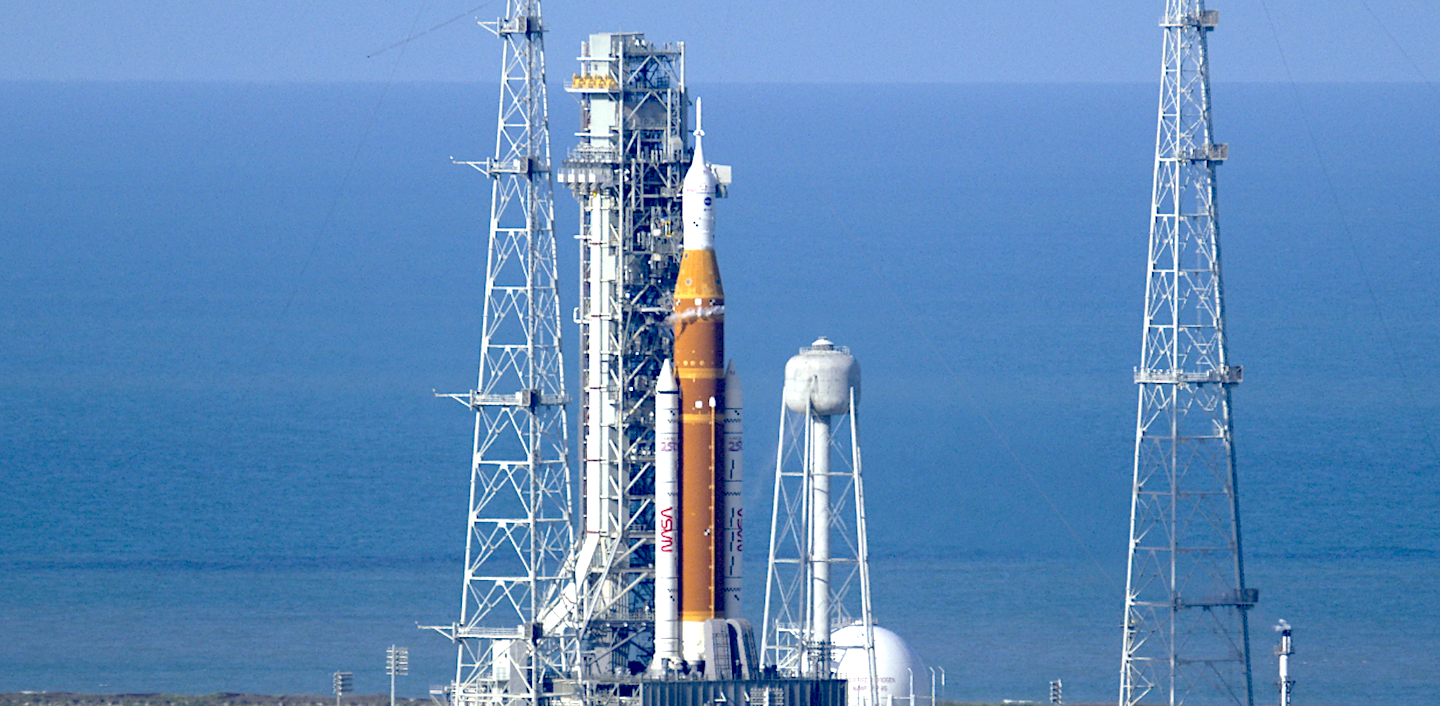
NASA’s Artemis II SLS (Space Launch System) rocket and Orion spacecraft are seen at Launch Complex 39B, at NASA’s Kennedy Space Center in Florida on Wednesday, April 1. The Artemis II test flight will take NASA astronauts Commander Reid Wiseman, Pilot Victor Glover, and Mission Specialist Christina Koch, and CSA (Canadian Space Agency) astronaut Mission Specialist Jeremy Hansen, on an approximately 10-day mission around the Moon and back to Earth. (https://www.nasa.gov/)
Live updates for launch of NASA’s Artemis II test flight will be published on this page: https://www.nasa.gov/. NASA’s launch broadcast coverage is airing on NASA+, Amazon Prime, and YouTube. All times are Eastern.
6:43 p.m.
Main engine cutoff of the SLS (Space Launch System) core stage is complete, and the core stage has successfully separated from the interim cryogenic propulsion stage and the Orion spacecraft. This marks the end of the first major propulsion phase of the Artemis II mission and the transition to upper‑stage operations.
The next major milestone is the deployment of the spacecraft’s SAWs (solar array wings) scheduled to begin approximately 18 minutes after launch. Once extended, the four SAWs will provide continuous electrical power to the spacecraft throughout its journey, supporting life‑support systems, avionics, communications, and onboard operations. Deployment is a critical step in configuring Orion for the remainder of its time in Earth orbit and for the outbound trip to the Moon.
6:38 p.m.
The spacecraft adapter jettison fairings that enclose the service module and the launch abort system have separated from the Orion spacecraft. With the rocket and spacecraft now flying above the densest layers of Earth’s atmosphere, Orion no longer requires the protective structures that shielded it during the early, high‑dynamic‑pressure portion of launch.
The next major milestone is core stage separation and Interim Cryogenic Propulsion Stage ignition.
6:37 p.m.
The SLS (Space Launch System) twin solid rocket boosters have separated. The boosters, each standing 177 feet tall and generating more than 3.6 million pounds of thrust at liftoff, provide most of the rocket’s power during the first two minutes of flight and separation reduces mass and allows the core stage to continue propelling the Orion spacecraft, named Integrity, toward orbit.
With the boosters now clear, the SLS core stage remains the primary source of thrust.
In about one minute, the spacecraft adapter jettison fairings that enclose Orion’s service module and the launch abort system will separate from the spacecraft.
6:35 p.m.
NASA’s Artemis II SLS (Space Launch System) rocket, with the Orion spacecraft atop carrying NASA astronauts Reid Wiseman, Victor Glover, and Christina Koch, along with CSA (Canadian Space Agency) astronaut Jeremy Hansen, lifted off from Kennedy Space Center’s Launch Complex 39B in Florida at 6:35 p.m. EDT to begin its journey to deep space.
The twin solid rocket boosters ignited first, delivering more than 75% of the thrust needed to lift the 5.75-million-pound rocket off the pad. Their combined power, along with the four RS-25 engines already at full thrust, generated an incredible 8.8 million pounds of force at liftoff. As the rocket rose, the umbilicals – which provided power, fuel, and data connections during prelaunch – disconnected and retracted into protective housings. This ensured the vehicle is free from ground systems and fully autonomous for flight.
The approximately 10-day Artemis II mission around the Moon is the first crewed flight under NASA’s Artemis campaign. It will help test the systems and hardware needed to continue sending astronauts on increasingly difficult missions to explore more of the Moon for scientific discovery, economic benefits, and to continue building toward the first crewed missions to Mars.
Below are the ascent milestones that will occur leading up to core stage separation. Times may vary by several seconds.
SLS clears launch tower; roll/pitch maneuver (Mission Elapsed Time [MET]) +00:00:07)
SLS reached supersonic speed (MET +00:00:56)
Maximum dynamic pressure (MET +00:01:12)
Solid Rocket Booster separation (MET +00:02:09)
Lauch abort system jettison (MET +00:03:13)
Core stage main engine cutoff (MET +00:08:02)
Core stage separates from interim cryogenic propulsion stage (MET +00:08:14)
TOWARD
"NASA sends astronauts toward the moon for first time in 54 years" Toward... I'll support that.