


Something like clockwork

Christine Tailer
By Christine Tailer
HCP columnist
Sometimes things don't work out quite the way we plan, but they often work out just the way they should.
I wrote a story back in the winter, about a special treasure that sat waiting for us in Cullman, Alabama, about 450 miles south of our creek valley home. We planned to drive down one day, spend the night, rent a box trailer the following morning, pack up the treasure, and drive back to the creek. This required finding a pet friendly hotel close to the treasure, as well as a trailer rental, also nearby. With a bit of internet research, I was able to secure both lodging and trailer, and on the appointed day, Greg and I and our dear dog set off on the seven-hour drive to Cullman.
After a fine hotel breakfast, we drove ten minutes down the road, picked up our one-way trailer rental, and headed ten more minutes down the road to greet our treasure.
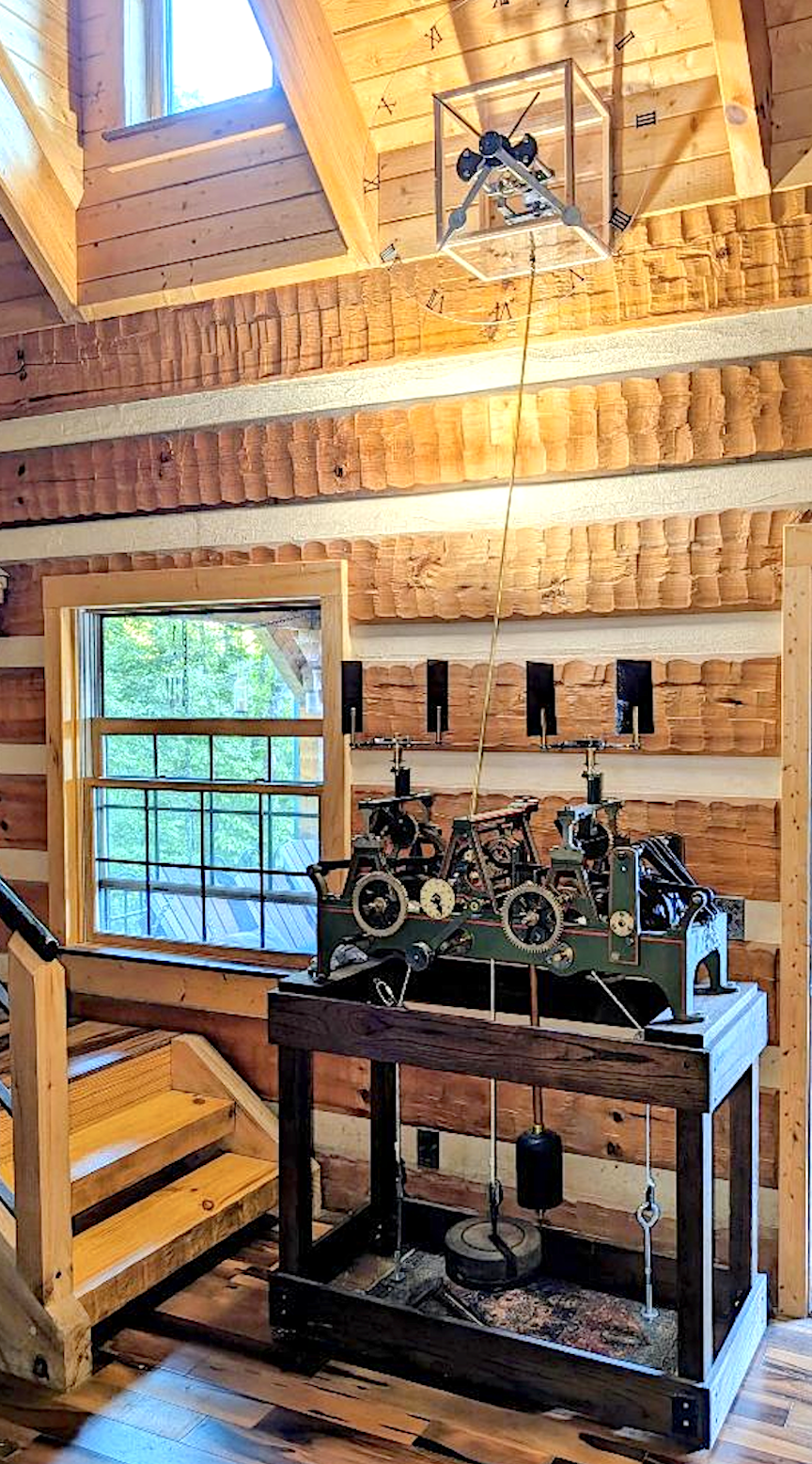
It was everything we had both imagined, a 100-year-old green turret clock that stood shoulder high, amid hundreds of other smaller clocks, inside Taylor's Fine Timepieces. As soon as I stepped through the door, I could hear the clock's strong beat. Its gears shone beautifully, all made of brass. The cast iron frame had been lovingly restored.
We learned that the clock had been built by J. Smith and Sons in 1929 in Clerkenwell, London, and was likely one of the last turret clocks the company had ever built. It was originally a four-face tower clock, each face measuring four feet across and proclaiming the time high over a now unknown town. Sadly, no one knows the clocks' original provenience, but with certainty it had been built by J. Smith and Sons of Clerkenwell.
We learned that the clock had been recently restored and set in a twelve-foot-tall wooden tower built by the Rocket City Regulators, a clock club in Huntsville, Alabama. Several of the restorers were there at the clock shop to meet us and help us load it into our trailer. I could see that they loved the clock and wished for it to travel with care.
I asked them if they had named it. They shook their heads no. Many of our clocks have names. Marcy is our 200-year-old French clock. She was built in Marcigny, France. We call the large cuckoo clock with dancing band, waltzing couples, bell ringer, water wheel, and river, The Village. Homer is our clock that once recorded the time of racing pigeons, and Roller is the clock whose pendulum is a tilting table with a track for a metal ball to roll along.
I learned that J. Smith, of J. Smith and Sons, was actually named John Smith. The clock works rest within a heavy cast iron frame that measures four feet long and is over a foot wide. The clock is clearly anything but little, but as soon as I laid eyes on it, I knew that it's creek valley name would be Little John, after its builder. It was, obviously, quite a bit smaller than London's Big Ben, and so I figured Little John would be appropriate
What had taken five men and one woman to load, one man, one woman, one dancing dog, and several pieces of farm machinery were able to unload. Little John soon stood solidly ticking away inside our log home. The 12-foot tower stood dismantled in our tractor show barn.
Over the course of the year, we had planned to build an enclosed clock gazebo with a tall tower allowing Little John to be properly housed under his own cover, but our lives have taken various zigs and zags, and our plans have been temporarily set aside.
Ever since the day we brought Little John home, he has happily kept beat, swinging his 40-pound pendulum in time to our lives. We were sad, though, because he was not keeping time. He had no clock face and no hands, so after a few months, we set out to remedy the situation. Greg searched, and recently found a set of vintage motion works that could be driven behind a clock face. These old works were so beautiful, we did not want to cover them up. Our solution was for Greg to design and build a clear faced, wood framed box, and a clear, three-foot clock dial that we could mount high on the wall. I am so thankful we have tall vaulted ceilings.
Greg then designed and fabricated a five-foot brass drive shaft that runs from the clock works up to the motion works behind the clear face. Little John now not only holds a steady beat, he also does what he was built to do. He keeps time, perfectly.
We still plan to build that enclosed clock gazebo, and let Little John preside over the entire creek valley. For now, however, I do believe that he is content. His strong beat is like a heartbeat, keeping time to our lives. I will miss him once he has his own home, so I suppose I'll need to let Greg know that he should make the clock house large enough so I can have a comfortable sitting spot, and be able to properly pass the time with Little John.
There is one more thing. I would be remiss if I didn't mention that Little John's move to the creek valley, even though it has not progressed quite as planned, has still worked out exactly as it should. I think this is considered something like clockwork.
Christine Tailer is an attorney and former city dweller who moved several years ago, with her husband, Greg, to an off-grid farm in south-central Ohio. Visit them on the web at straightcreekvalleyfarm.com.