


Health Department levy, all other issues unofficially pass; Highland County sees 8% voter turnout
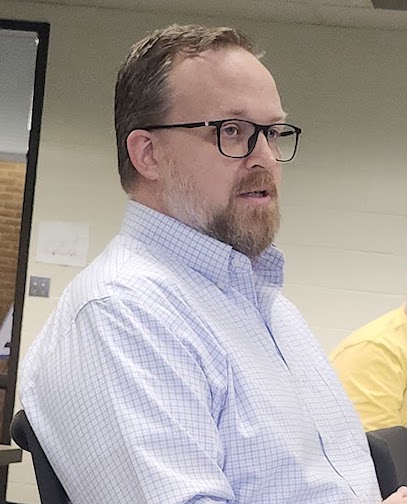
Highland County Health Commissioner Jared Warner. (HCP Photo/Caitlin Forsha)
With voter turnout of just over eight percent in Highland County, the May 6 primary election saw an unofficial sweep of all five proposed levies and issues, including the Highland County Health Department levy and State Issue 2.
The unofficial data Tuesday showed 2,260 ballots cast out of the 27,944 registered voters in Highland County, for turnout of 8.09 percent. Of those ballots, 1,723 were cast on Election Day at polling locations, with the remaining being cast in person at the Board of Elections during early voting hours or absentee.
According to Board of Elections Director Michelle Swallen, there are still 22 outstanding absentee ballots, and 10 provisional ballots were issued.
Unofficial results show the Highland County Health Department levy unofficially passing with 52.09 percent of the vote, with the issue receiving 1,171 votes in favor of the levy and 1,077 votes against it.
As proposed, this is a five-year replacement and decrease, by half a mill, of two existing levies, as the Health Department formerly received revenue through two half-mill levies. A different proposed replacement and decrease levy for the Health Department failed in the November 2024 general election. That was proposed as a 0.7-mill, five-year levy, replacing two existing levies and decreasing by 0.3 mill.
The levy considered by voters Tuesday is estimated to “collect $674,000 annually, at a rate not exceeding 0.5 mill for each $1 of taxable value, which amounts to $18 for each $100,000 of the county auditor's appraised value, for five years, commencing in 2025, first due in calendar year 2026.”
Highland County Health Department Jared Warner said in April that the half-mill levy “represents the smallest countywide tax that we have on the books” but would help fund their numerous programs, including public health, food inspections, nuisance investigations and more.
The only other issue on the ballot considered by all 2,260 Highland County voters this primary was Issue 2, proposed by Joint Resolution of the General Assembly, for a constitutional amendment regarding public infrastructure capital improvements by permitting the issuance of general obligation bonds.
Locally, the issue unofficially passed with 54.78 percent of the vote, with 1,227 “yes” votes and 1,013 “no” votes. As of this article’s posting, statewide results show the issue unofficially passing with 67.8 percent of the vote, with 96.89 percent of precincts reporting.
The amendment is a renewal of an existing provision “authorizing the State of Ohio to issue bonds to finance public infrastructure capital improvements for local governments through the State Capital Improvement Program.” It includes language to “limit the total principal amount of the state general obligations issued under the amendment to no more than $2.5 billion over a 10-year period.”
Several local public officials, including all three Highland County commissioners (Brad Roades, Terry Britton and David Daniels), Highland County auditor Chris Fauber and Hillsboro mayor Justin Harsha, have advocated for the issue in recent weeks.
Since fiscal year 2017, Fauber said the county has had 16 projects, including wastewater and street projects in Hillsboro, street projects in Greenfield, a sewer project in Leesburg and road projects in the county, funded through this program. In the current 10-year cycle, the county and its municipalities have received $37,780,863 in funding, Fauber said, and since the program began, it has funded a total of 111 projects in the county.
For more on Issue 2 statewide, see the Ohio Capital Journal story posted at https://highlandcountypress.com/news/ohio-voters-unofficially-approve-l….
There were three other items on the ballot in Highland County this May, with each involving one precinct. Those included:
• Voters in the Village of Lynchburg unofficially passed a proposed three-mill, five-year tax levy renewal “for the purpose of providing and maintaining motor vehicles, communications, other equipment, buildings, and sites for such buildings used directly in the operation of a police department, or the payment of salaries of permanent or part-time police, communications or administrative personnel.”
The unofficial results show Lynchburg voters approving the renewal with 63.86 percent of the vote (53 yes, 30 no). The village had 8.32-percent voters turnout.
• Voters in Marshall Township – who had 19.13-percent voter turnout – approved two separate local option issues regarding liquor sales, unofficially.
The first local option issue was to determine whether “the sale of wine and mixed beverages, under permits which authorize sale for on-premise consumption only, and under permits which authorize sale for both on-premise and off-premise consumption, [shall] be permitted in Marshall Township.” The matter unofficially passed with 75.4 percent of the vote (95-31 margin).
Also unofficially approved was an issue to determine whether “the sale of intoxicating liquor, of the same types as may be legally sold in this precinct on other days of the week, [shall] be permitted in this Marshall for consumption on the premises where sold, on Sunday.” This unofficially passed with 69.29 percent of the vote, or a margin of 88-39.
Publisher's note: A free press is critical to having well-informed voters and citizens. While some news organizations opt for paid websites or costly paywalls, The Highland County Press has maintained a free newspaper and website for the last 25 years for our community. If you would like to contribute to this service, it would be greatly appreciated. Donations may be made to: The Highland County Press, P.O. Box 849, Hillsboro, Ohio 45133. Please include "for website" on the memo line.