


Emotions should not trump science and math
Lead Summary
By
-
By Jim Thompson
HCP columnist
When I look back over my nearly 70 years on this earth, there seems to be a theme to the popular topics of the day. They all have an emotional component, then often a science and math component, too. Ironically, the emotional component is often the one that rules the day.
The first one I can think of is the surgeon general’s report on smoking and health. It was released on Jan. 11, 1964. Simply, it concluded that smoking, particularly cigarette smoking, was related to respiratory cancers. It was ranked among the top news stories of 1964. Yet, people did not believe it. Many still do not believe it.
We have had two very intelligent relatives die in this century (of old age) who went to their graves denying this link. Yet, smoking is still listed as the cause of nearly a half million deaths a year in the United States.
When the gas crisis hit in late 1973 (caused by a Mideastern war), there was talk we would run out of petroleum in eight years. Seems like that talk was not true. Whether this popular opinion was math, science or emotion, I will leave for you to decide.
The next incident I can think of is seat belt use in automobiles. The science (physics) says that wearing seat belts will prevent many deaths and serious injuries in automobile accidents.
Many people die in automobile accidents. Seat belts were required in new automobiles starting in the late 1960s. The government even mandated a linkage between seat belts and starting the car in 1974.
Despite the overwhelming math and science, there was such an outrage over this feature that it was pulled around halfway through that model year. What got us to wearing seat belts? Our kids came home from school trained to urge us to wear seat belts (there is another lesson here, but we will save it for another time). I still know people who refuse to wear seat belts.
We come to the famous global warming/climate change brouhaha. At the moment, emotions seem to be winning, but for a significant portion of the population, there is plenty of doubt about the math and science.
After years of discussion, the math and science still have not been explained in simplistic and significant enough terms to sway a large swath of the population. For others, they are so emotionally wrapped up in it, they could care less what the math and science might tell us. The reaction is split and both sides continue to be very passionate.
Finally, there is the year 2020, part 1 and part 2. As in many other experiences like I have outlined above, there are emotional and scientific/math perspectives for each part.
You would think for the coronavirus portion, we could rely on science and math (statistics) and reach a general consensus on what is going on, what should be done. Obviously not.
Emotions run high, the medical profession responds with data and information that some believe, others do not. The path forward here is as confusing as any of the subjects previously mentioned.
And then the last one, the passionate racial debate. You would think economic, historical and medical data could, here if nowhere else, give us clear answers as to what has happened and the reasonable path forward. This has not been the case.
The emotions run high on all sides and no one will be silent long enough to examine the data and collaboratively choose a right path forward (a path of equality, fairness, and justice).
Everyone has his or her own thoughts; everyone has his or her own answers.
Professionally, for many decades, I have trained people how to read data, presented in tabular or graphical form. I have consistently told such readers to beware of all of it. For no matter how scientific and mathematically pure it may look, the assembler and presenter of the data had a preconceived message they wanted the reader to believe.
Nearly all of the time, that data is not as pure as it looks.
If you have not spent a lot of time digging into data or if you know math and science are not strengths for you, I have a recommendation, should you want to discern the truth for yourself. Gather as much information as you can. Then, seek out people you trust on both sides of whatever issue you are examining. Listen to them, roll it over in your mind, then decide for yourself, having gathered as much information as you can, what way to go.
I also have a recommendation as to where not to gather information for your opinions. Television or social media. Both spew the emotional side only.
Lord, how I miss Walter Cronkite.
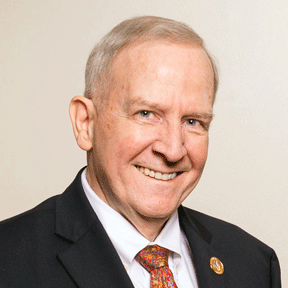
Jim Thompson, formerly of Marshall, is a graduate of Hillsboro High School and the University of Cincinnati. He resides in Duluth, Ga. and is a columnist for The Highland County Press. He may be reached at jthompson@taii.com.
HCP columnist
When I look back over my nearly 70 years on this earth, there seems to be a theme to the popular topics of the day. They all have an emotional component, then often a science and math component, too. Ironically, the emotional component is often the one that rules the day.
The first one I can think of is the surgeon general’s report on smoking and health. It was released on Jan. 11, 1964. Simply, it concluded that smoking, particularly cigarette smoking, was related to respiratory cancers. It was ranked among the top news stories of 1964. Yet, people did not believe it. Many still do not believe it.
We have had two very intelligent relatives die in this century (of old age) who went to their graves denying this link. Yet, smoking is still listed as the cause of nearly a half million deaths a year in the United States.
When the gas crisis hit in late 1973 (caused by a Mideastern war), there was talk we would run out of petroleum in eight years. Seems like that talk was not true. Whether this popular opinion was math, science or emotion, I will leave for you to decide.
The next incident I can think of is seat belt use in automobiles. The science (physics) says that wearing seat belts will prevent many deaths and serious injuries in automobile accidents.
Many people die in automobile accidents. Seat belts were required in new automobiles starting in the late 1960s. The government even mandated a linkage between seat belts and starting the car in 1974.
Despite the overwhelming math and science, there was such an outrage over this feature that it was pulled around halfway through that model year. What got us to wearing seat belts? Our kids came home from school trained to urge us to wear seat belts (there is another lesson here, but we will save it for another time). I still know people who refuse to wear seat belts.
We come to the famous global warming/climate change brouhaha. At the moment, emotions seem to be winning, but for a significant portion of the population, there is plenty of doubt about the math and science.
After years of discussion, the math and science still have not been explained in simplistic and significant enough terms to sway a large swath of the population. For others, they are so emotionally wrapped up in it, they could care less what the math and science might tell us. The reaction is split and both sides continue to be very passionate.
Finally, there is the year 2020, part 1 and part 2. As in many other experiences like I have outlined above, there are emotional and scientific/math perspectives for each part.
You would think for the coronavirus portion, we could rely on science and math (statistics) and reach a general consensus on what is going on, what should be done. Obviously not.
Emotions run high, the medical profession responds with data and information that some believe, others do not. The path forward here is as confusing as any of the subjects previously mentioned.
And then the last one, the passionate racial debate. You would think economic, historical and medical data could, here if nowhere else, give us clear answers as to what has happened and the reasonable path forward. This has not been the case.
The emotions run high on all sides and no one will be silent long enough to examine the data and collaboratively choose a right path forward (a path of equality, fairness, and justice).
Everyone has his or her own thoughts; everyone has his or her own answers.
Professionally, for many decades, I have trained people how to read data, presented in tabular or graphical form. I have consistently told such readers to beware of all of it. For no matter how scientific and mathematically pure it may look, the assembler and presenter of the data had a preconceived message they wanted the reader to believe.
Nearly all of the time, that data is not as pure as it looks.
If you have not spent a lot of time digging into data or if you know math and science are not strengths for you, I have a recommendation, should you want to discern the truth for yourself. Gather as much information as you can. Then, seek out people you trust on both sides of whatever issue you are examining. Listen to them, roll it over in your mind, then decide for yourself, having gathered as much information as you can, what way to go.
I also have a recommendation as to where not to gather information for your opinions. Television or social media. Both spew the emotional side only.
Lord, how I miss Walter Cronkite.
Jim Thompson, formerly of Marshall, is a graduate of Hillsboro High School and the University of Cincinnati. He resides in Duluth, Ga. and is a columnist for The Highland County Press. He may be reached at jthompson@taii.com.