


Tickets still available for Kentucky Headhunters' May 12 concert at Fling Barn
Lead Summary
By
-
The Highland County Press
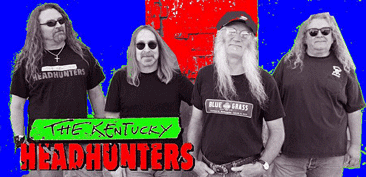
The Fling Barn welcomes the Kentucky HeadHunters this week for a May 12 performance at the Folsom events center.
Tickets are still available at the door.
The Kentucky HeadHunters – Doug Phelps, Greg Martin, Fred Young and Richard Young – have been called a "heavy metal bluegrass band" and may be best known for their hit 1990 single, "Dumas Walker."
According to the band's website, www.kentuckyheadhunters.com, the group traces its beginnings to Metcalfe County, Ky., and the Youngs family farm where they rehearsed.
"The year was 1968, and the band was called Itchy Brother. The shack was really a farmhouse now known as the infamous Practice House. And the deep and dark forest was a place on Richard and Fred Young's family farm. Together, with cousins Anthony Kenney and Greg Martin, armed with a pickup-truck load of amps, drums, and guitars, and a stack of American and English rock records, they set out to conquer the world by creating their own brand of rock and roll," their website says.
"As the years went by, they made good on their promise to each other, and the record companies came. First, from Cincinnati, then Atlanta and Macon, Ga., California, New York, and England, but something always stopped them from leaving the rock club circuit and becoming a national recording act. Presidential elections, plane crashes, the death of a record executive and disco, but most of all, their ages. The train hauling the heyday of Southern rock had come and gone. Itchy Brother got caught in the changing of the guard. They never got to ride the train, but they never gave up."
In the early 80s, we started to hang out in Nashville. Because it wasn't known as one of the rock and roll cities, we had always avoided it like the plague. Our only bout with Nashville was a TV show called Young Country, said Richard Young. Itchy Brother played Robert Johnson's Crossroads on the show in 1970 and though it was fun. "It opened our eyes and pointed our hearts in a different direction," he recalls.
"In 1986, Greg Martin introduced Richard and Fred Young to Doug Phelps. Prior to this, the plan had been to record an Itchy Brother album and go for it again, but Anthony declined. Doug Phelps was asked to join in Anthony's place. The HeadHunters started rehearsing in March 1986 in Greg's basement, then moved to the Practice House when the weather warmed up."
"We were determined to create a whole new sound just like Itchy Brother had in the 1970s. I knew there was a true passion from the first rehearsal and the fact that the other three were relatives, and had spent their whole lives playing together, made it like a fast-drying glue. For me, it was magic from day one," said Doug Phelps.
"The mid-to-late 1980s were very special. If you go back and look at the musical diversity going on, especially the roots and college music scene, even country music was allowing things to happen. Their guards were down. This spilled over into the local scene around here. Bowling Green, Ky., Louisville, and Nashville were all hopping, as well as the rest of the country. This had a huge impact on us and helped fuel the formation of the HeadHunters, said Greg.
"We are who we are and that's what makes us what we have become," adds Fred. "From our life experiences and how we approach and interpret music is how we became a band that tells real life stories. We are a band of many styles: rock, blues, country, jazz, bluegrass, rockabilly, and other roots music. That is the foundation of our sound. Johnnie Johnson once told me "Music has no color. If I had to color the HeadHunters, I'd color us music with a feeling."
In the earlier part of 1988, the HeadHunters met Jonathan D. W. Lyle. He was a huge blues music fan and fell in love with the HeadHunters music. He had a history of helping struggling bands, and ended up giving us $4,500 to go into the studio and record our music. In late 1988, after much coaxing from Tom Long at ASCAP and song publisher Larry Shell, the HeadHunters agreed to do a record company showcase at Douglas Corner, a local Nashville hangout.
The HeadHunters signed with Mercury Records in July 1989 and added Kentucky to the band's name. Albums such as "Pickin' On Nashville" and "Electric Barnyard" followed and the rest is history.
After some changes among band members, in 2000 and 2003, the HeadHunters came back with "Grass String Ranch" and "Soul." In 2006, "Flying Under the Radar" was released. "
The band's mix of country, blues and rock continues to entertain its loyal fans, especially those in the Midwest.
The HeadHunters will be at The Fling Barn on Thursday, May 12, with Slow & Low Barbecue serving food at 7 p.m.[[In-content Ad]]
The Fling Barn welcomes the Kentucky HeadHunters this week for a May 12 performance at the Folsom events center.
Tickets are still available at the door.
The Kentucky HeadHunters – Doug Phelps, Greg Martin, Fred Young and Richard Young – have been called a "heavy metal bluegrass band" and may be best known for their hit 1990 single, "Dumas Walker."
According to the band's website, www.kentuckyheadhunters.com, the group traces its beginnings to Metcalfe County, Ky., and the Youngs family farm where they rehearsed.
"The year was 1968, and the band was called Itchy Brother. The shack was really a farmhouse now known as the infamous Practice House. And the deep and dark forest was a place on Richard and Fred Young's family farm. Together, with cousins Anthony Kenney and Greg Martin, armed with a pickup-truck load of amps, drums, and guitars, and a stack of American and English rock records, they set out to conquer the world by creating their own brand of rock and roll," their website says.
"As the years went by, they made good on their promise to each other, and the record companies came. First, from Cincinnati, then Atlanta and Macon, Ga., California, New York, and England, but something always stopped them from leaving the rock club circuit and becoming a national recording act. Presidential elections, plane crashes, the death of a record executive and disco, but most of all, their ages. The train hauling the heyday of Southern rock had come and gone. Itchy Brother got caught in the changing of the guard. They never got to ride the train, but they never gave up."
In the early 80s, we started to hang out in Nashville. Because it wasn't known as one of the rock and roll cities, we had always avoided it like the plague. Our only bout with Nashville was a TV show called Young Country, said Richard Young. Itchy Brother played Robert Johnson's Crossroads on the show in 1970 and though it was fun. "It opened our eyes and pointed our hearts in a different direction," he recalls.
"In 1986, Greg Martin introduced Richard and Fred Young to Doug Phelps. Prior to this, the plan had been to record an Itchy Brother album and go for it again, but Anthony declined. Doug Phelps was asked to join in Anthony's place. The HeadHunters started rehearsing in March 1986 in Greg's basement, then moved to the Practice House when the weather warmed up."
"We were determined to create a whole new sound just like Itchy Brother had in the 1970s. I knew there was a true passion from the first rehearsal and the fact that the other three were relatives, and had spent their whole lives playing together, made it like a fast-drying glue. For me, it was magic from day one," said Doug Phelps.
"The mid-to-late 1980s were very special. If you go back and look at the musical diversity going on, especially the roots and college music scene, even country music was allowing things to happen. Their guards were down. This spilled over into the local scene around here. Bowling Green, Ky., Louisville, and Nashville were all hopping, as well as the rest of the country. This had a huge impact on us and helped fuel the formation of the HeadHunters, said Greg.
"We are who we are and that's what makes us what we have become," adds Fred. "From our life experiences and how we approach and interpret music is how we became a band that tells real life stories. We are a band of many styles: rock, blues, country, jazz, bluegrass, rockabilly, and other roots music. That is the foundation of our sound. Johnnie Johnson once told me "Music has no color. If I had to color the HeadHunters, I'd color us music with a feeling."
In the earlier part of 1988, the HeadHunters met Jonathan D. W. Lyle. He was a huge blues music fan and fell in love with the HeadHunters music. He had a history of helping struggling bands, and ended up giving us $4,500 to go into the studio and record our music. In late 1988, after much coaxing from Tom Long at ASCAP and song publisher Larry Shell, the HeadHunters agreed to do a record company showcase at Douglas Corner, a local Nashville hangout.
The HeadHunters signed with Mercury Records in July 1989 and added Kentucky to the band's name. Albums such as "Pickin' On Nashville" and "Electric Barnyard" followed and the rest is history.
After some changes among band members, in 2000 and 2003, the HeadHunters came back with "Grass String Ranch" and "Soul." In 2006, "Flying Under the Radar" was released. "
The band's mix of country, blues and rock continues to entertain its loyal fans, especially those in the Midwest.
The HeadHunters will be at The Fling Barn on Thursday, May 12, with Slow & Low Barbecue serving food at 7 p.m.[[In-content Ad]]